



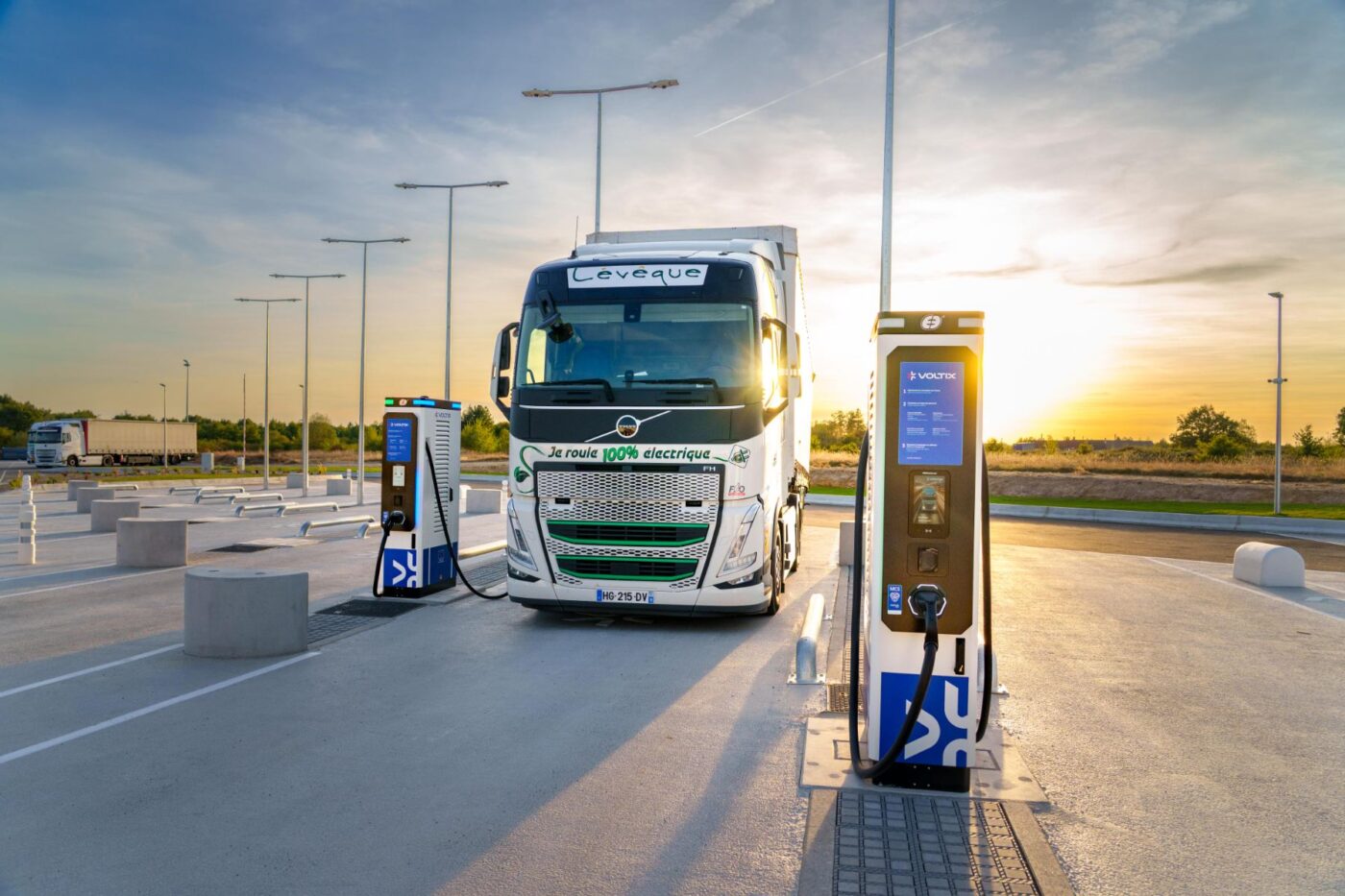
Voltix has opened its first public fast-charging station for electric heavy-duty trucks in Vierzon, central France, with four charging points capable of delivering up to 1.5 MW each. The facility supports both Combined Charging System (CCS) and Megawatt Charging System (MCS) connectors, with plans to expand the site to eight charging points as the company develops its European network.
The station is operated by Voltix, a subsidiary of Vinci Concessions, and is located in the Cher department at the intersection of major transport routes linking Paris, Toulouse and Clermont-Ferrand. The nearby A85 motorway also provides connections towards Tours and France’s Atlantic coast.
According to Voltix, the site is currently France’s highest-power charging station for electric trucks. The company said heavy-duty electric vehicles can recharge enough energy to continue their journeys in approximately 30 to 45 minutes, aligning with the mandatory driving breaks required after 4.5 hours behind the wheel.
Voltix Plans 50 Charging Sites by 2028
The Vierzon station is the first operational site in Voltix’s planned network of public charging infrastructure for electric heavy-duty vehicles.
In September, Vinci Concessions, Épopée Gestion and ADEME Investissement announced plans to invest nearly €90 million in the network. The initial development phase is expected to include around 20 sites, primarily in France, before expansion into Germany and Spain.
Voltix aims to establish 50 sites by 2028, supporting the deployment of electric trucks on longer-distance freight routes. The network is intended to provide high-power charging infrastructure at locations suited to commercial transport operations.
At the Vierzon opening, Renault Trucks, Volvo Trucks, Daimler Truck, Scania and MAN displayed electric heavy-duty truck models equipped with MCS charging capability. Voltix also reported that registrations of heavy-duty electric trucks in France have multiplied since 2021.
CCS and MCS Support High-Power Truck Charging
Each of the four initial charging points at Vierzon is equipped with CCS and MCS connectors, allowing the site to accommodate different charging configurations for electric heavy-duty vehicles.
The planned expansion to eight charging points would increase the facility’s capacity to serve electric freight vehicles using the strategic motorway junction.
The station is also part of the DRIVE-FR project and receives co-financing through the European Connecting Europe Facility Alternative Fuels Infrastructure Facility (CEF-AFIF). The programme supports the development of charging infrastructure for heavy-duty commercial vehicles along the Trans-European Transport Network (TEN-T).
Voltix is also involved in Germany’s public charging infrastructure development for heavy-duty commercial vehicles. Working with Eliso as a bidding consortium, the company was awarded a contract covering 25 sites in a government-backed network planned for motorway rest areas without existing service facilities.
Charging Infrastructure Targets Road Freight Emissions
Voltix positions its network as part of efforts to reduce emissions from French road freight transport. The company states that road transport accounts for 89% of domestic land freight transport in France and 7.4% of the country’s greenhouse gas emissions.
Nicolas Notebaert, Director General of Concessions at Vinci, highlighted the role of charging infrastructure in enabling electric trucks to operate over longer distances.
“An electric truck without charging infrastructure is just a promise,” said Nicolas Notebaert, Director General of Concessions at Vinci. “With Vierzon, the company wants to demonstrate that the necessary infrastructure for long-distance electric transport is already being built.”
The opening of the Vierzon station marks the start of Voltix’s planned rollout of high-power charging sites for electric trucks. The company’s next challenge will be to expand the network across major freight corridors and provide sufficient charging capacity to support the wider adoption of battery-electric heavy-duty vehicles.