



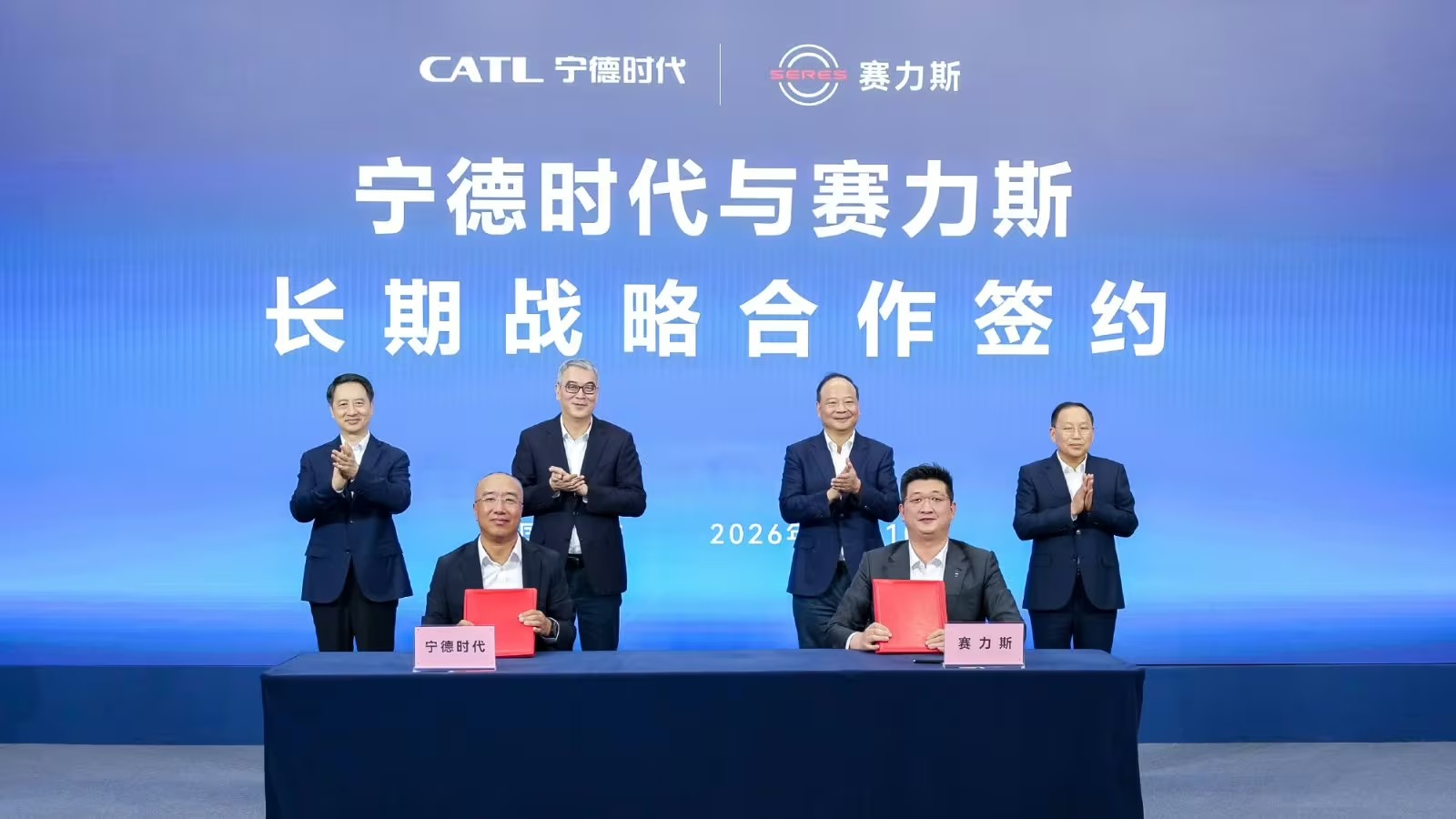
CATL and Seres have signed a long-term strategic cooperation agreement to expand battery manufacturing capacity for Seres’ Aito vehicle brand, with combined annual production capacity at their joint facility planned to exceed 20 GWh once the expansion is complete. The agreement also covers supercharging infrastructure, battery lifecycle services and cooperation in overseas markets.
The companies signed the agreement on Saturday in Chongqing, Seres’ headquarters city. Under the arrangement, Aito will continue using CATL batteries across its model lineup over the long term, extending an existing supply relationship between the automaker and the battery manufacturer.
CATL said all Aito models have used its batteries since the brand was established, with cumulative vehicle deliveries surpassing 1.2 million units.
CATL and Seres Expand Battery Manufacturing
A central part of the agreement is the acceleration of the second phase of the companies’ plant-in-plant project at the Seres manufacturing facility in Chongqing. The new phase is designed to provide annual production capacity of 10 to 12 GWh.
Once both phases are completed, the facility’s combined annual capacity is expected to exceed 20 GWh. The companies aim to strengthen supply chain resilience and improve manufacturing competitiveness by integrating battery production more closely with vehicle assembly.
The plant-in-plant model places battery system manufacturing within an existing vehicle production site, allowing the two companies to coordinate battery supply and vehicle manufacturing at the same location.
CATL began operating two CTP 2.0 battery pack production lines at the Seres plant on June 30, 2025. The lines provide a local source of battery systems for Aito vehicles and marked CATL’s first production base in Chongqing, as well as its first deployment of the plant-in-plant model.
The latest agreement will expand that manufacturing presence. However, the companies did not disclose when construction of the second phase would begin or when the additional capacity would enter operation.
Cooperation Extends to Charging and Battery Services
Beyond manufacturing, CATL and Seres plan to cooperate on supercharging networks and battery services, with the aim of establishing a service system covering the battery lifecycle.
The announcement did not provide technical specifications for the planned charging infrastructure, including charging power, network size or deployment schedules. It also did not detail the battery services that will be introduced.
The broader cooperation indicates that the companies intend to extend their relationship beyond battery supply and production into charging infrastructure and related services supporting Aito vehicles.
CATL and Seres Target Overseas Markets
The agreement also identifies Europe, the Middle East and Central Asia as target regions for joint overseas development.
The companies did not specify which Aito models would be involved, the countries they intend to enter first or how the overseas cooperation would be implemented.
The plans come as Seres advances Aito’s international expansion. The brand has reportedly been preparing for a potential European market entry in 2027, including work related to European Union Whole Vehicle Type Approval.
Seres is also strengthening its cooperation with Huawei, which jointly developed the Aito brand with the automaker. The companies signed a new five-year cooperation agreement in Shenzhen on September 30 to support the brand’s further development.
Under arrangements announced on October 1, Huawei and Seres will establish a dedicated Aito team and continue developing brand-specific operations, with the stated objective of strengthening the brand and improving customer service.
CATL Strengthens Its Aito Battery Supply Relationship
The latest agreement reinforces CATL’s position as a key battery supplier to Seres’ Aito vehicle lineup. The planned capacity expansion is intended to support the brand’s manufacturing requirements while bringing battery production closer to vehicle assembly.
For Seres, the arrangement combines long-term battery supply with expanded production capacity and potential cooperation in charging services and overseas markets.
The companies have not disclosed the agreement’s duration, the investment required for the second production phase or a timetable for its completion. The scale and timing of their international cooperation also remain unspecified.


