
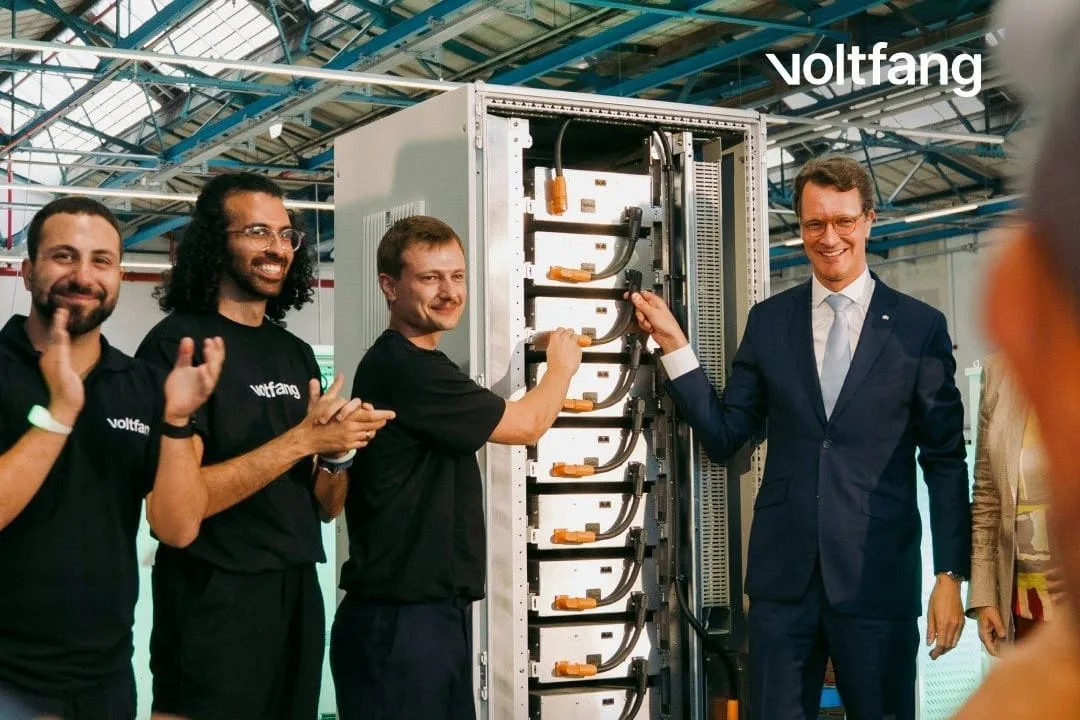
Startup Voltfang has officially inaugurated its new factory in Aachen, Germany, which repurposes used electric vehicle (EV) batteries and surplus production cells into stationary battery storage systems. Production at the facility has been running since April.
The plant, named “Voltfang Future Fab,” occupies the former halls of insolvent EV manufacturer Next.e.GO. The company aims to reach an annual production of 250 MWh by the end of 2026 and 1 GWh by the end of 2030. The announcement follows a recent €15 million funding round to support production expansion.
North Rhine-Westphalia Prime Minister Hendrik Wüst (CDU), who attended the opening ceremony, said, “Voltfang demonstrates how sustainable innovations can create real impact and contribute to the competitiveness of our industry. With the opening of Europe’s largest second-life battery factory, Voltfang sets a milestone for a future-ready energy system.”
The “Second Life” concept involves reusing retired EV batteries in stationary storage systems. These systems can store electricity from solar installations or stabilize power at EV charging stations, releasing energy when vehicles arrive and storing it when charging demand is low.
Voltfang also incorporates “New Life” batteries—unused cells from EV production overcapacity or insufficient demand—into projects such as a storage system at Stuttgart Airport. The company said these approaches expand the availability of reliable, sustainable energy storage while supporting the transition to renewable power and electrified transport.