
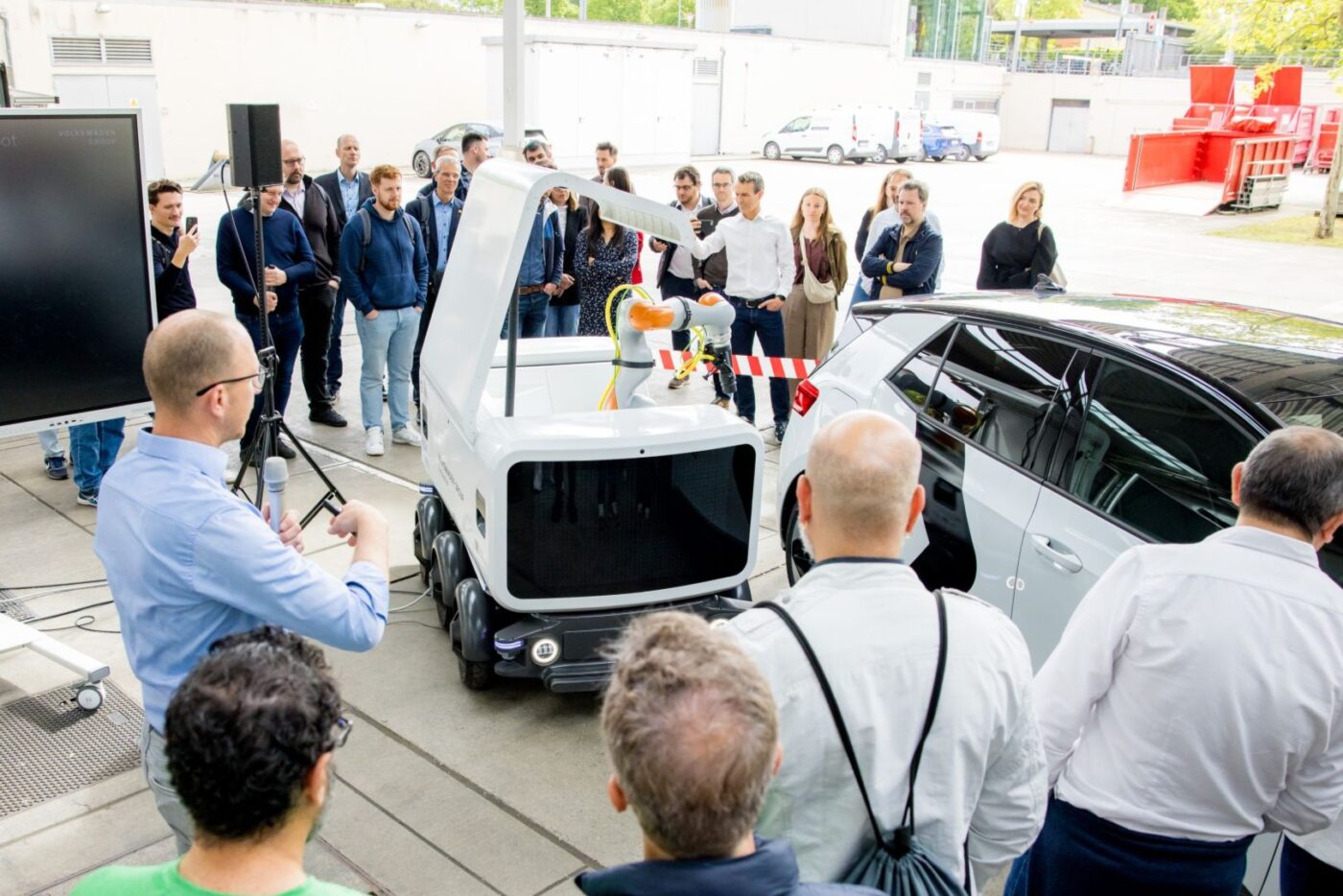
Volkswagen has unveiled a prototype autonomous charging robot designed to support electric vehicle charging in urban environments, as part of the European Union-backed “MOBILITIES for EU” Smart Cities initiative launched in 2024.
Mobile Charging Concept Expands on Existing Technologies
The concept builds on earlier developments in robotic charging technology, a field already being explored by Dutch startup Rocsys. Existing systems typically use stationary robotic arms equipped with computer vision technology to identify a vehicle’s charging port, connect the charging plug automatically, and begin charging without human intervention. Such solutions have been targeted primarily at applications including autonomous logistics vehicles and robotaxi fleets.
Volkswagen’s approach introduces a more mobile solution. The prototype consists of a compact six-wheeled vehicle carrying an integrated robotic arm, charging cable, and charging plug concealed beneath a protective flap while the robot is in motion.
Part of Dresden Smart Mobility Ecosystem
According to project information released by the City of Dresden, the autonomous charging robot will be integrated with the Mobility Data Space developed by Dresden-based Fraunhofer IVI, forming part of a broader ecosystem intended to support user-friendly charging infrastructure and electric mobility services at the Ostra Sports Park.
The City of Dresden said the project is expected to complement the area’s existing charging network, where the number of charging points remains limited. Project documentation indicates that Volkswagen Group Innovation plans to develop, build, and test two autonomous charging robots as part of the initiative.
Designed for Areas Where Fixed Chargers Are Not Feasible
Technical information released so far remains limited. However, the project description states that the robots will be equipped with a 55-kWh battery and are designed to support both manual and autonomous connection of charging plugs.
The city noted that the units can be deployed “anywhere structural or economic constraints make it impossible to install a fixed charging station,” potentially offering a flexible alternative for locations where conventional charging infrastructure is difficult or costly to build.
If successfully tested, the technology could provide municipalities and site operators with an additional option for expanding charging access without the need for permanent infrastructure installations.