
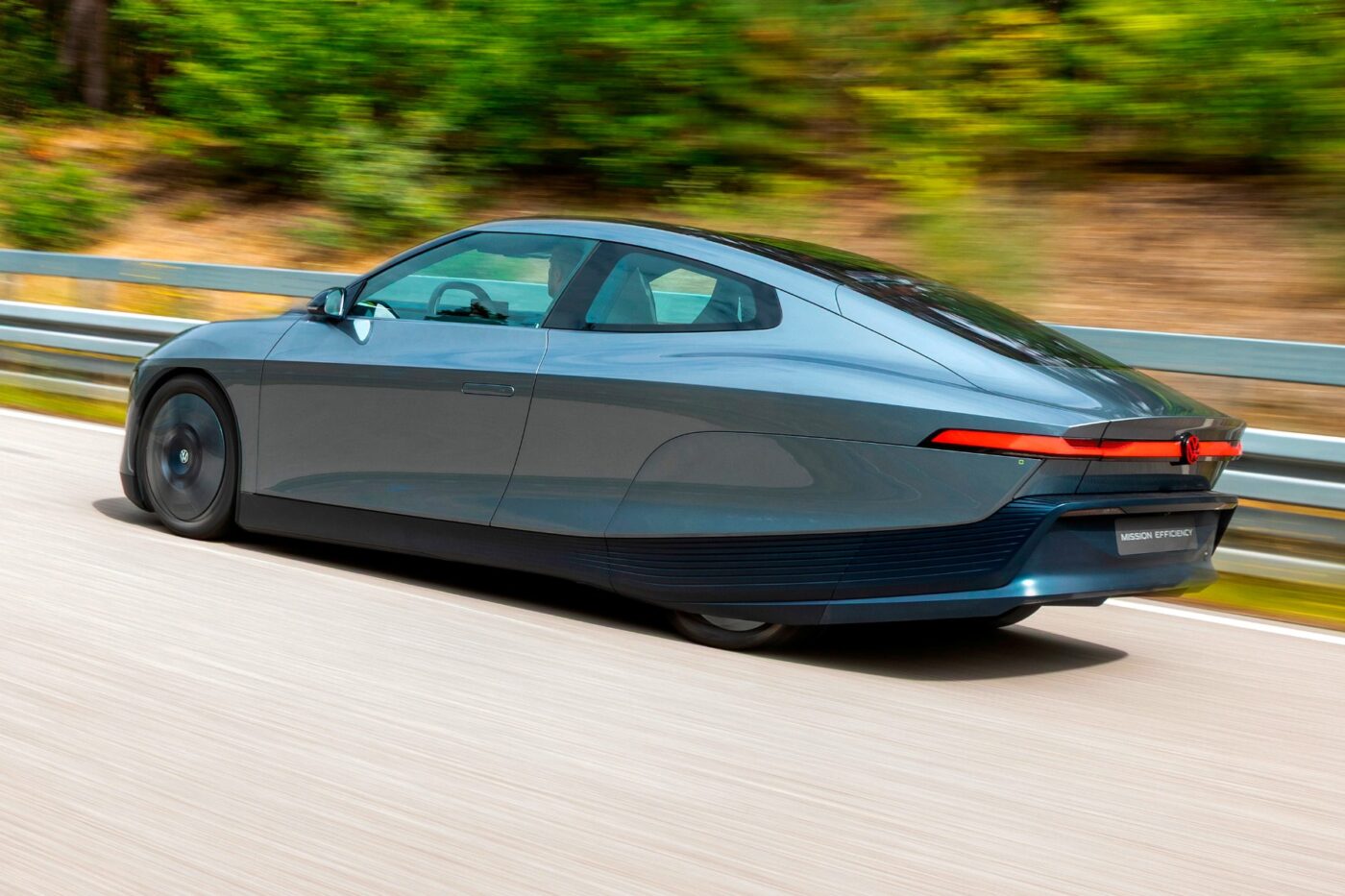
Volkswagen has unveiled its Mission Efficiency concept, a near-production electric vehicle designed to demonstrate how mass-production technology, lightweight construction and advanced aerodynamics can significantly reduce energy consumption.
The concept uses components from Volkswagen’s MEB+ platform rather than specialised technologies developed exclusively for a limited-run vehicle. Its development focuses heavily on reducing aerodynamic drag and energy demand, positioning the vehicle as a modern successor in concept to the limited-production Volkswagen XL1.
Aerodynamics Drive Efficiency Gains
The Mission Efficiency features a streamlined, teardrop-inspired body designed to minimise aerodynamic resistance. The exterior incorporates a flat front, enclosed rear wheel covers and a fully covered underbody.
Volkswagen says the aerodynamic benefits become particularly significant above 80 km/h, with energy consumption falling by more than 30% compared with conventional electric vehicles.
The concept measures nearly 4.80 metres in length and has a minimalist four-seat interior. Despite its streamlined design, the vehicle provides 481 litres of boot space.
MEB+ Technology Underpins The Concept
Rather than relying on expensive bespoke technology, the Mission Efficiency uses production components from Volkswagen’s MEB+ platform, including technology also found in the new ID. Polo and ID. Cross.
The vehicle is equipped with Volkswagen’s APP290 front-wheel-drive system, producing 99 kW. It uses a 54.9-kWh net high-voltage battery.
Specially developed low-rolling-resistance tyres supplied by Continental further contribute to efficiency. Solar cells integrated into the glass roof and tailgate provide additional electricity for the vehicle’s onboard electrical systems during everyday operation.
Volkswagen said the approach demonstrates how improvements in vehicle efficiency can be achieved using technology suitable for broader production rather than relying solely on high-cost specialist components.
1,278-Kilometre Drive Demonstrates Efficiency
The Mission Efficiency completed a documented 1,278-kilometre journey from Wolfsburg to Vienna, requiring only one battery recharge during the route.
Volkswagen reports real-world energy consumption of 6.89 kWh per 100 kilometres over the journey. The vehicle also achieved a drag coefficient of 0.158, which the company describes as a new benchmark for road-legal vehicles.
The results highlight the potential impact of combining a relatively modest battery with a highly aerodynamic vehicle design. With a usable battery capacity of 54.9 kWh, the concept is designed around reducing energy consumption rather than relying on a larger battery to extend driving range.
Successor To The XL1 Philosophy
The Mission Efficiency follows the philosophy of the Volkswagen XL1, a limited-production vehicle built in Osnabrück between 2014 and 2016.
Only 200 XL1 vehicles were produced. The model became known as the “one-litre car” and used a plug-in hybrid powertrain rather than being fully electric.
Unlike the XL1, which used an expensive carbon-fibre body and served primarily as a technology demonstrator, the Mission Efficiency is intended to show how similar efficiency principles can be applied using components designed for mass production.
Volkswagen Highlights Mass-Market Technology
Volkswagen brand board member Thomas Schäfer said the concept illustrates the company’s approach to electric vehicle development.
“Mission Efficiency is the ideal way to demonstrate what distinguishes Volkswagen in the electric age: technology for the masses – not just for the few,” said Thomas Schäfer, Volkswagen brand board member.
Kai Grünitz, board member for Technical Development, highlighted the potential of the production-oriented powertrain used in the concept.
“The new Mission Efficiency impressively demonstrates the incredible potential of the drive system in our new ID. Polo. Developed for all models based on MEB+ with front-wheel drive, the system is extremely light, very efficient and thus the ideal drive system for our record-breaking vehicle,” said Kai Grünitz, Volkswagen board member for Technical Development.
The Mission Efficiency therefore serves as a demonstration of Volkswagen’s effort to improve electric vehicle efficiency through aerodynamics, weight reduction and optimisation of existing production technology, rather than relying exclusively on larger batteries or more specialised components.