

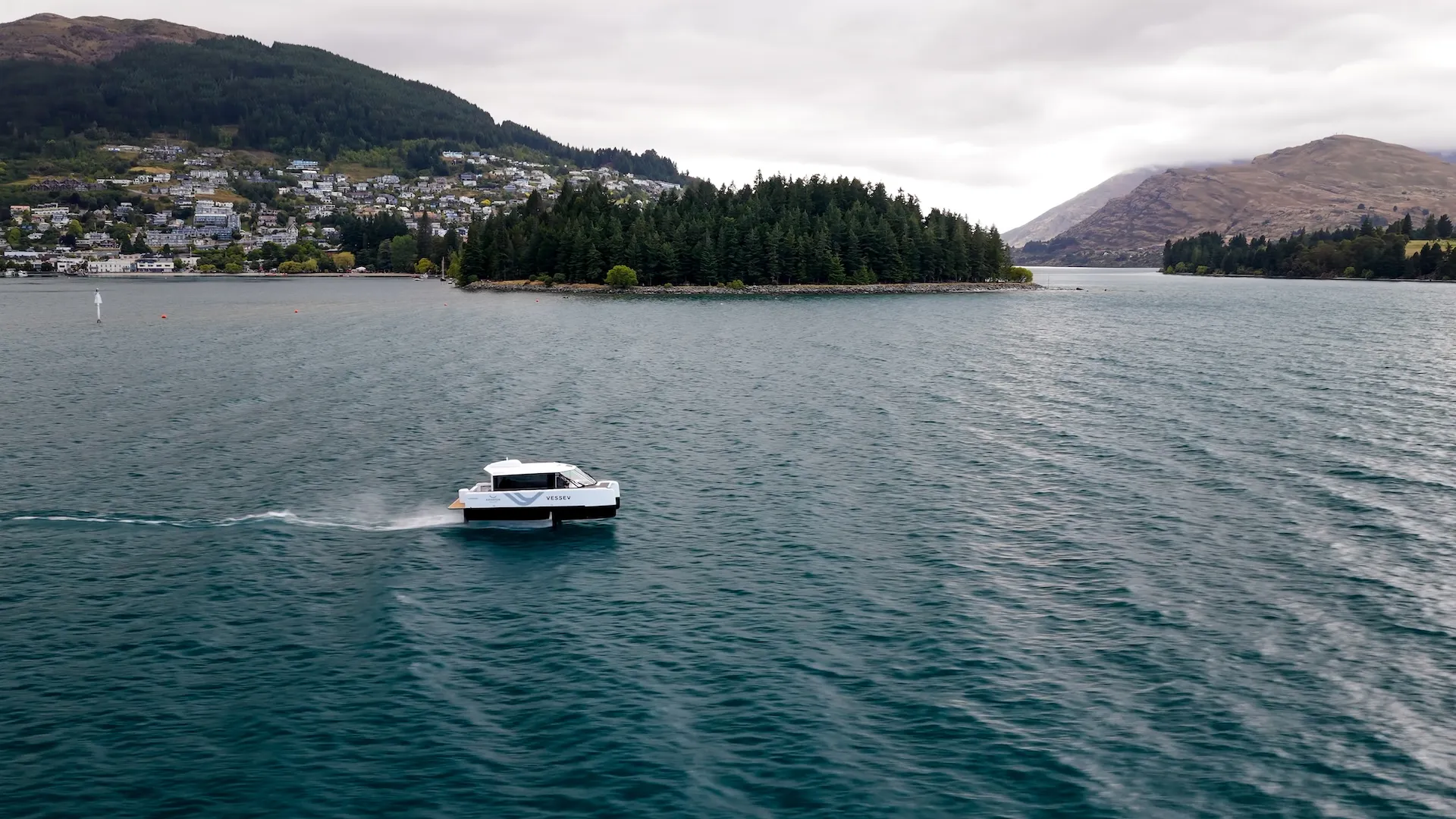
Vessev will trial its VS–9 electric hydrofoiling passenger vessel on Lake Wakatipu this month, as part of a study examining whether battery-electric water transport could help ease congestion in one of New Zealand’s fastest-growing cities.
The demonstration, scheduled for Feb. 10, will evaluate the performance of the VS–9 on the lake between Queenstown and Kingston, including travel times, passenger experience and operational requirements. The trial is being conducted in partnership with residential developer Kingston Village and regional stakeholders, with findings expected to inform a broader feasibility study later this year.
See also: New Zealand’s Vessev Secures First European Customer for VS-9 Electric Hydrofoil
Queenstown’s road network is constrained by the surrounding lake and mountainous terrain, while tourism and population growth continue to place pressure on existing transport infrastructure. Local authorities have set an ambition for the city to become the world’s first fully electrified urban area, prompting interest in alternative, low-emission mobility solutions.
“Queenstown is growing, and with that comes congestion and longer commute times,” said Eric Laakmann, chief executive and co-founder of Vessev. “The lake itself presents an opportunity. Electric hydrofoiling gives us a practical way to change that.”
See also: New Zealand’s Vessev Opens First US Office, Eyes Local Production of Electric Hydrofoil Vessels
Laakmann said the VS–9’s hydrofoiling design, which lifts the hull above the water, allows for faster and more comfortable travel across a wider range of conditions, while consuming significantly less energy than conventional vessels.
Kingston Village general manager Nicola Tristram said the trial aligns with long-term planning aimed at improving livability as the area develops. “This trial will provide valuable insight into how lake transport could complement existing road and bus networks as well as the proposed cable car network,” she said.
See also: Vessev’s VS-9 Electric Hydrofoil Receives Commercial Approval for Auckland Service
The VS–9 is a 29-foot electric hydrofoiling catamaran built from carbon-fibre composites and powered entirely by batteries through Vessev’s proprietary VS–Drive electric motor. The vessel can cruise at around 25 knots, reach a top speed of 30 knots and travel up to 40 nautical miles at full load, or 50 nautical miles with a lighter payload. Vessev says the craft uses up to 90% less energy than a conventional vessel of comparable size.
The VS–9 has been operating commercially for more than a year and is one of only two electric hydrofoiling vessels globally to hold full commercial certification. Vessev said the Queenstown trial will also serve as a reference case for other cities exploring electric passenger transport on busy waterways.