
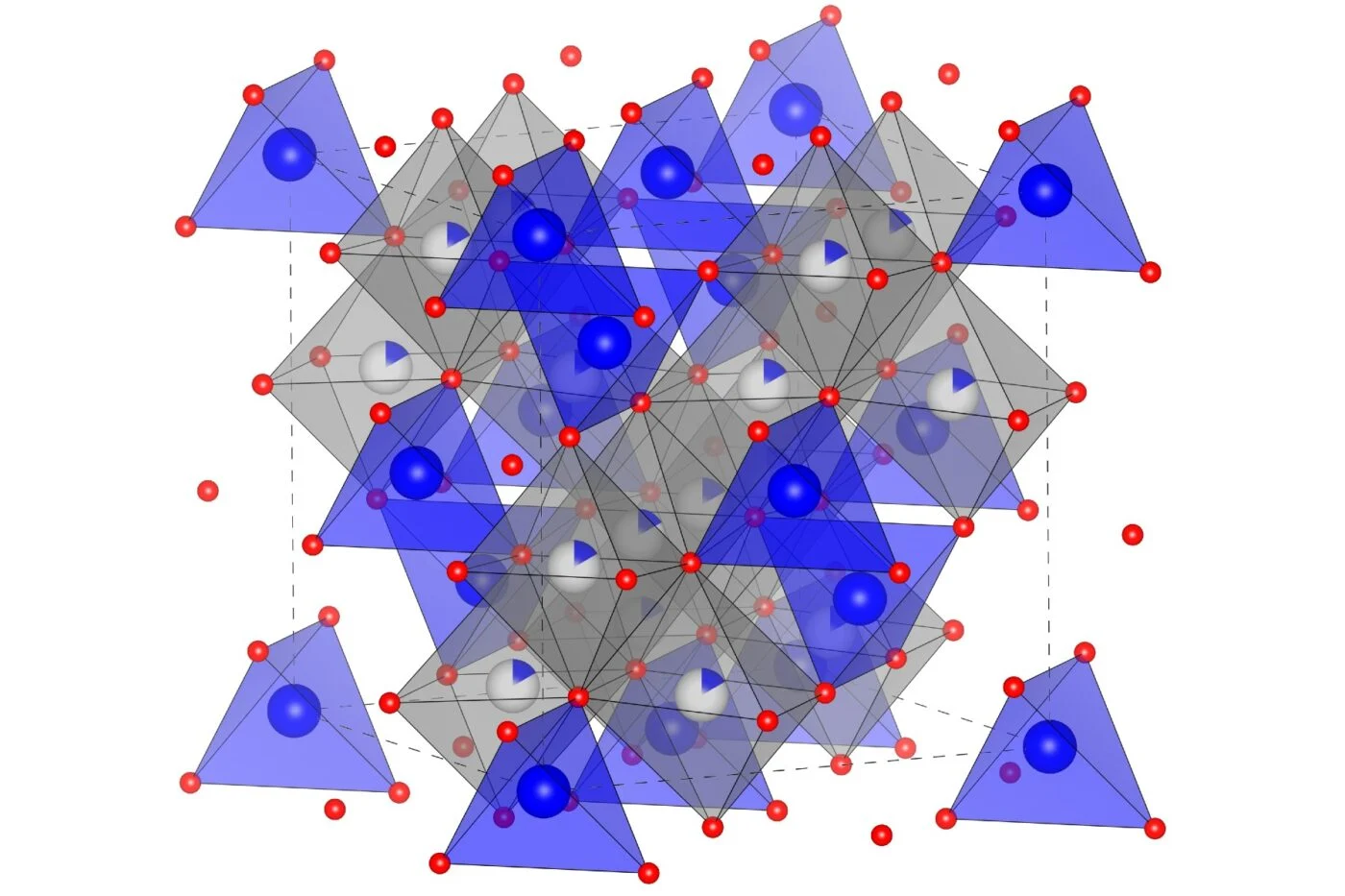
Researchers at TU Graz have developed a method to significantly improve the ionic conductivity of lithium titanate, a battery anode material used alongside graphite in lithium-ion batteries. By deliberately creating oxygen vacancies in the material’s crystal lattice, the researchers activated a lithium-ion migration pathway that is normally blocked in untreated lithium titanate.
The study focuses on lithium titanate with the composition Li4Ti5O12, which has relatively poor lithium-ion conductivity in its original, non-lithiated state. The researchers found that modifying its atomic structure can substantially improve ion mobility without changing its basic chemical composition.
TU Graz Researchers Develop Wood-Based EV Battery Housing That Outperforms Tesla Standard
Oxygen Vacancies Activate Lithium-Ion Pathway
Researchers Bernhard Gadermaier and Martin Wilkening from the Institute of Chemical Technology of Materials at TU Graz created defects in the lithium titanate crystal lattice by removing individual oxygen atoms.
These defects, known as oxygen vacancies, create an alternative pathway through which lithium ions can move within the material.
“When individual oxygen atoms are removed from the crystal lattice, these vacancies unlock a migration pathway for ions that was previously blocked. This diffusion path is already predefined by the LTO structure but is only activated by the defect structure,” said Martin Wilkening.
The researchers created the vacancies by heating lithium titanate to 300 degrees Celsius in an atmosphere with low oxygen content. The relatively mild heat treatment removes individual oxygen atoms from the crystal lattice and produces the required vacancies.
Graz University Develops AI System to Expedite Electric Vehicle Powertrain Design
Experiments Confirm Faster Ion Transport
TU Graz researchers used conductivity spectroscopy and nuclear magnetic resonance (NMR) spectroscopy to verify the change in lithium-ion transport.
The NMR measurements provided direct experimental evidence of the newly activated atomic diffusion pathway, while conductivity measurements demonstrated the resulting improvement in ion conduction.
The findings indicate that the performance of lithium titanate depends not only on its chemical composition but also on the arrangement of defects within its crystal structure and its thermal history.
“Our experimental study impressively shows that the properties of a solid are not solely determined by its chemical composition but are also significantly influenced by its local defect structure and thermal history,” said Martin Wilkening.
The research demonstrates that anionic defect chemistry can be used to influence the mobility of lithium ions within a solid material.
Potential Applications Beyond Batteries
Lithium titanate is already used as an anode material in some battery applications, but its relatively low ionic conductivity in its untreated state can limit its functionality.
The TU Graz findings could provide a new approach for modifying the material by controlling its crystal defects rather than changing its fundamental chemical composition.
TU Graz Receives Major Funding for ‘Battery4Life’ Research Center
The researchers also identified potential longer-term applications beyond battery electrodes. They said controlled ionic conductivity through defect chemistry could have implications for ionotronic, memristive and neuromorphic components used in microelectronics and nanoelectronics.
The experimental findings were published in Science Advances, providing a basis for further research into how atomic-scale defect structures can influence the macroscopic performance of battery and electronic materials.