
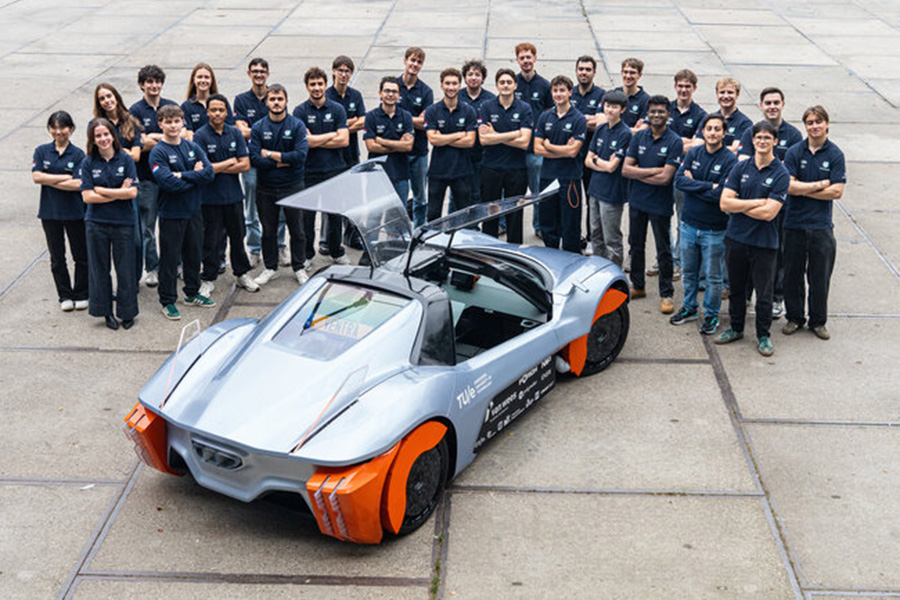
Students at TU Eindhoven have developed VENTRA, an electric vehicle concept designed to address fine particles generated by tire, brake and road wear. The research vehicle combines a particle collection system with lightweight construction and driving guidance intended to reduce the generation of wear particles.
Unlike conventional exhaust emissions, non-exhaust particles remain an issue for electric vehicles because tires, brakes and road surfaces continue to generate particulate matter during driving. VENTRA focuses on capturing some of these particles directly around the wheels while also reducing the vehicle factors that contribute to wear.
VENTRA Uses Electrically Charged Particle Collection
The VENTRA concept is designed to collect particles in the wheel area rather than relying on a conventional filter.
The system electrically charges particles generated by tire and brake wear and then attracts them toward a grounded collection surface. The particles are intended to adhere to the surface, which the development team says can subsequently be cleaned with a vacuum cleaner or water.
The technology remains at the research and demonstration stage. So far, the team has disclosed simulation results rather than real-world testing data.
According to the simulations, around 24% of generated particles could be directed into the collection system at speeds between 50 and 80 km/h. At lower speeds, the calculated capture proportion increases to as much as 42%.
Lightweight Construction Targets Lower Wear
VENTRA is also designed to reduce the amount of wear generated in the first place.
The vehicle uses lightweight carbon-fibre-reinforced thermoplastic panels for much of its chassis. According to the student team, the approach reduces the vehicle’s weight by nearly 100 kg.
Reducing mass can lower the loads placed on tires and brakes, potentially reducing the amount of material released during operation.
The concept therefore combines particle capture with measures intended to address one of the factors contributing to non-exhaust emissions.
Clean-Drive System Provides Driving Guidance
VENTRA also incorporates a system called Clean-Drive, which analyses driving behaviour and provides suggestions through the vehicle’s display.
The system can recommend smoother acceleration, less abrupt braking and fewer unnecessary steering movements. The objective is to reduce tire and brake wear by encouraging a driving style that places less stress on these components.
The collected particles could also have a potential second use. TU/ecomotive envisions collecting and recycling the material, and the concept vehicle already incorporates some of the captured material into interior components.
EVs Still Produce Non-Exhaust Particles
VENTRA addresses a source of vehicle emissions that remains present regardless of whether a vehicle has an internal combustion engine or an electric powertrain.
Electric vehicles eliminate local tailpipe emissions, but tire, brake and road wear continue to generate particles. The student team also notes that the higher weight of many electric vehicles and their high levels of driving torque can influence tire wear.
These non-exhaust emissions are becoming increasingly relevant to vehicle regulation.
Euro 7 Adds Tire and Brake Emissions Requirements
The issue is also reflected in the European Union’s Euro 7 emissions framework, which introduces requirements covering particle emissions from brakes and tire wear.
TU/ecomotive points to November 2026 as the start of the new regulatory requirements referenced in connection with the project.
The VENTRA project is intended to demonstrate potential technical approaches to addressing these emissions rather than serve as a production vehicle. The team has not announced plans for series production or specific cooperation with an automotive manufacturer.
TU/ecomotive Continues Sustainability-Focused Concepts
VENTRA is the latest research vehicle from TU/ecomotive, the student team at TU Eindhoven that develops concept vehicles around specific sustainability challenges in mobility.
At the end of 2025, the team presented the modular Aria urban electric vehicle, which focused on repairability and extending vehicle service life.
With VENTRA, the focus has shifted toward tire and brake wear, combining particle collection, lightweight construction, material reuse and driver guidance in a single electric vehicle research concept.