


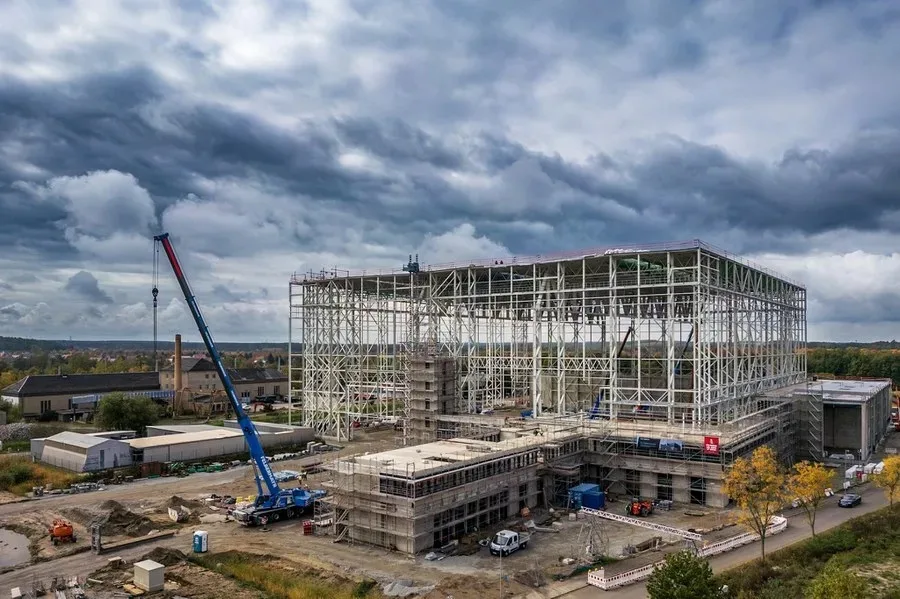
TU Dresden has marked a key milestone in its mobility research ambitions with the topping-out ceremony for its new Smart Mobility Lab (SML) at the Lausitz Research Campus.
The €86 million facility, located in the Hoyerswerda district of Schwarzkollm, is set to become one of Europe’s most advanced testing and innovation centres for automated, connected, and zero-emission mobility.
See also: Infineon to Build €5 Billion Chip Manufacturing Plant in Dresden, Germany
The SML will focus on developing and testing solutions for future mobility across multiple sectors, including automated road transport, autonomous aviation, and robotic agricultural systems. Research initiatives at the facility will include projects such as SivaS (safety of connected and automated road traffic), TAFAS (test centre for automated flight and autonomous systems), FarmingSwarm-Cobots (automated agriculture with mixed field swarms), and TERECULT (recultivation robotics for productive landscapes).
Construction began in early 2024, with completion scheduled for late 2026 and operations expected to commence in January 2027. The 42-metre-high testing hall will feature a 100 x 100 metre indoor area and a 75 x 75 metre outdoor driving and landing zone, alongside laboratories, workshops, and flexible office spaces.
See also: Germany Approves €920 Million Subsidy for Infineon’s Dresden Chip Plant Expansion
It will house specialised facilities such as a climate chamber, electromagnetic testing hall, and energy-autonomous infrastructure designed to power over 75% of the lab’s needs through solar, geothermal, hydrogen, and battery systems.
TU Dresden Rector Professor Ursula Staudinger said the SML represents a “major milestone” in the university’s mission to drive structural change in Lusatia through research and innovation. Hoyerswerda Mayor Torsten Ruban-Zeh added that the Smart Mobility Lab and the upcoming SCART Institute will create over 300 new jobs and enhance the city’s role as a regional hub for advanced technology and international collaboration.