
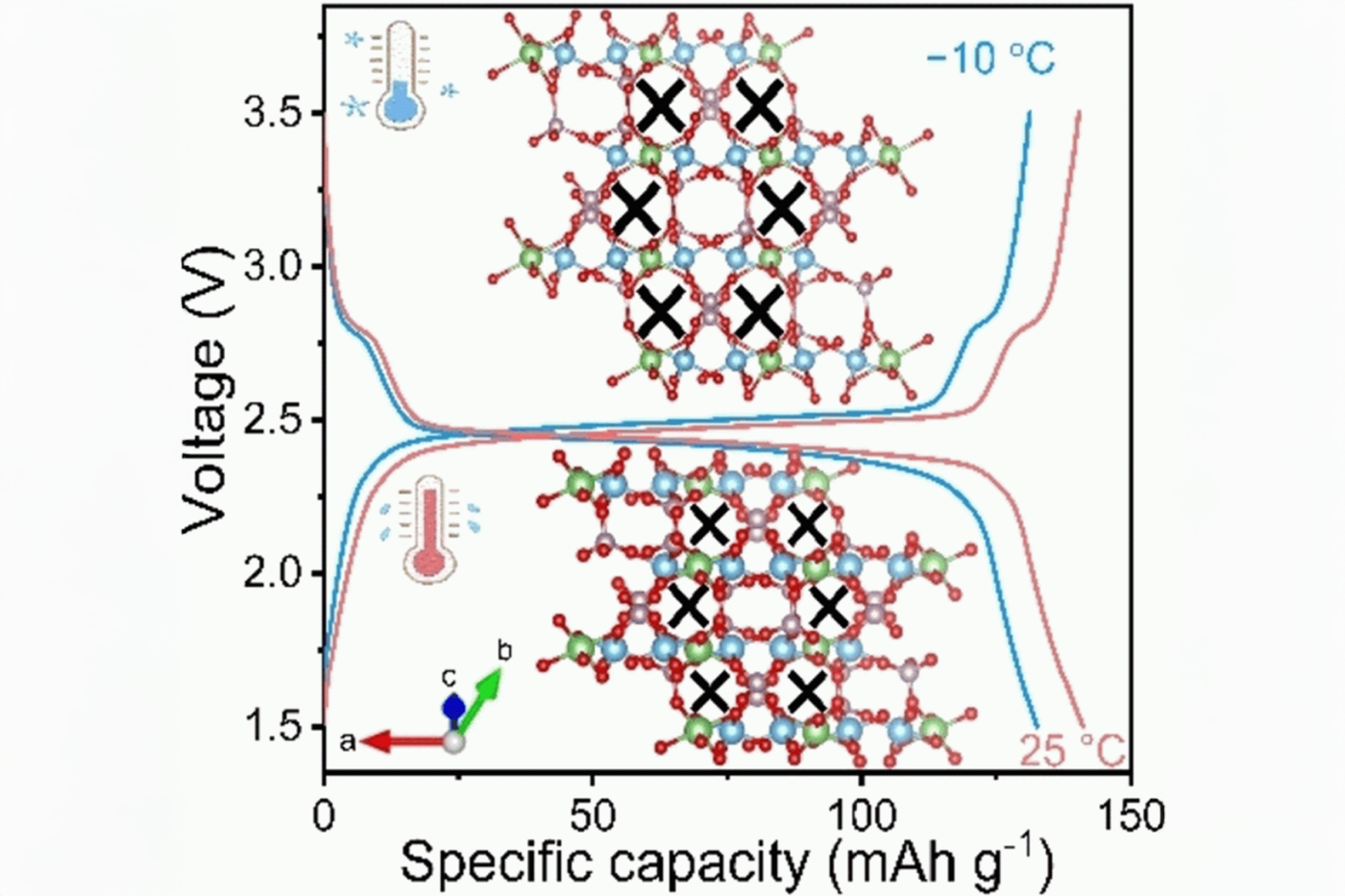
Lithium-ion batteries often experience a significant decline in performance in cold environments, a limitation that has spurred research into alternative materials.
A team of Chinese researchers has demonstrated the potential of lithium titanium phosphate (LTP) as a promising electrode material capable of addressing this issue by tackling the root cause of performance loss at low temperatures.
See also: China Proposes Export Restrictions on Battery and Metal Processing Technologies
Current strategies to mitigate the “cold problem,” such as incorporating battery heaters or modifying electrolytes and electrode coatings, come with added complexity and costs, often at the expense of performance.
Researchers from Donghua University, Fudan University, and Inner Mongolia University opted for a different approach, focusing on materials with negative thermal expansion (NTE). Unlike most materials, which contract in the cold, NTE materials like LTP expand during cooling, enabling improved lithium-ion storage and transport.
Detailed in Angewandte Chemie, the study highlights how LTP’s unique crystal structure facilitates ion diffusion at low temperatures. When coated with carbon, creating C-LTP, the material demonstrated impressive performance metrics. At -10 degrees Celsius, it retained 84% of its diffusion rate compared to 25 degrees Celsius. Additionally, it exhibited superior cycle stability, maintaining 96.8% capacity over 1,000 cycles at a 2C charge rate.
See also: China’s Sunwoda and XTC Join Forces to Advance Solid-State Battery Development
While LTP and similar materials show promise in overcoming cold-weather battery challenges, researchers emphasize that these developments remain experimental.
More work is needed before these materials can replace conventional methods like battery heating in electric vehicles or other lithium-ion battery applications.