




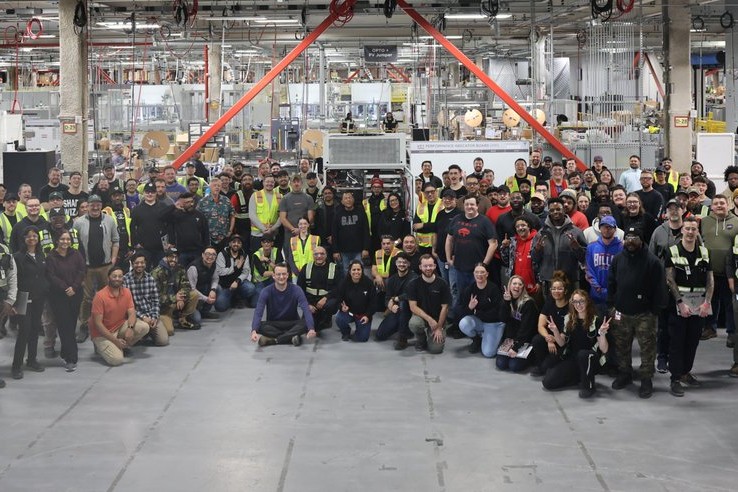
Tesla has ended production of its V3 Supercharger power cabinets at its New York factory, transitioning fully to manufacturing V4 cabinets as part of efforts to increase charging capacity and modernise its global charging network.
The company said it produced more than 15,000 V3 units over a period of more than seven years. The shift reflects Tesla’s push to support higher charging speeds and accommodate newer electric vehicle architectures, including 800-volt systems.
See also: Tesla Opens Four Supercharger Sites in Malaysia to Non-Tesla EVs
Tesla introduced its V4 Supercharger concept in 2023, though initial deployments combined new V4 charging stalls with older V3 power cabinets, limiting maximum charging speeds to 250 kW for most vehicles. Only certain models, such as the Cybertruck, were able to achieve higher charging rates of up to 325 kW under that configuration.
With the rollout of V4 cabinets, Tesla said charging performance can reach up to 500 kW for compatible vehicles, while its Semi electric truck is expected to support charging at up to 1.2 MW. The new cabinets were first deployed at a public charging site in Redwood City, California, in September 2025.
See also: LG Energy Solution Said to Shift Tesla Cathode Supply From LG Chem to L&F
Tesla said the V4 cabinets are designed to improve efficiency and reduce costs while accelerating the expansion of charging infrastructure. The company described the system as offering “the world’s most reliable power electronics.”
The New York facility—known as Gigafactory 2—has been producing Supercharger components, including charging stalls and power cabinets, as well as other energy-related products through Tesla subsidiary SolarCity. It remains unclear whether Tesla’s charging equipment production in China has also fully transitioned to V4 technology.
See also: Tesla Opens First Public Megacharger for Semi Trucks in California
The transition to V4 cabinets is expected to enhance compatibility with a broader range of electric vehicles. While earlier V4 deployments initially prioritised Tesla vehicles, the company indicated it planned to open access to third-party EVs, including 800-volt models, as testing and validation progressed.
The move underscores Tesla’s broader strategy to scale high-power charging infrastructure as electric vehicle adoption grows and vehicle architectures evolve.


