


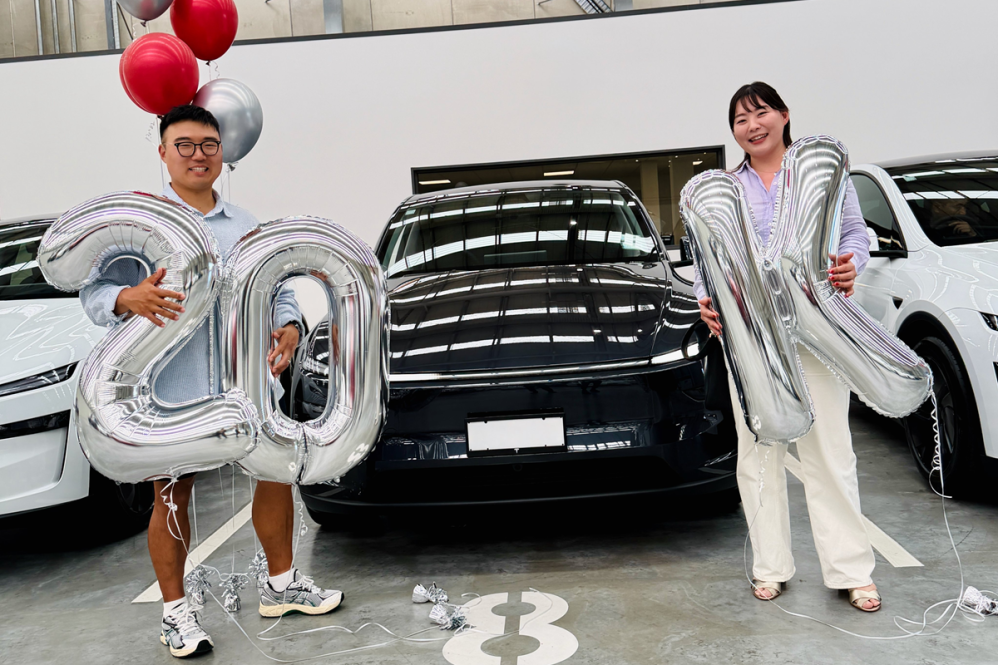
Tesla said 20,000 of its vehicles are now on the road in New Zealand, marking a new milestone for the U.S. electric car maker in one of its smaller Asia-Pacific markets.
The update was shared by Tesla Australia & New Zealand on social media in a post thanking local owners, accompanied by the message “Ngā mihi Aotearoa,” a Māori expression of appreciation.
See also: Tesla Offers Nearly $5,000 Discount on Full Self-Driving Software in Australia and New Zealand
While modest compared with Tesla’s presence in larger markets such as the United States, Europe and Australia, the figure represents a significant share of New Zealand’s growing electric vehicle fleet. Tesla first entered the market with the higher-priced Model S and Model X, but adoption accelerated after the launch of the more affordable Model 3, which quickly became one of the country’s best-selling EVs.
More recently, the Model Y has emerged as Tesla’s top-selling vehicle in New Zealand, driven by strong demand for electric sport utility vehicles offering longer range, greater storage space and competitive pricing.
See also: Tesla Expands Model Y Lineup with Performance Edition for Australia and New Zealand Markets
Government policy has also supported adoption. The Clean Car Discount, which reduced upfront purchase costs for eligible low-emission vehicles, helped accelerate early EV take-up, though the scheme has since been revised. New Zealand’s electricity mix, which relies heavily on hydro, wind and geothermal power, has further strengthened the environmental case for electric vehicles.
Tesla’s expansion of its Supercharger network across both the North and South Islands has supported growth by improving access to fast charging along major travel routes and in urban centres including Auckland, Wellington and Christchurch.
See also: IM Motors Launches IM6 Electric SUV in New Zealand as LS6 Expansion Continues
The New Zealand milestone follows a larger regional benchmark in Australia earlier this month, where Tesla confirmed its fleet had reached 150,000 vehicles. Full Self-Driving software has also recently been introduced in both Australia and New Zealand, though it remains limited to vehicles equipped with the company’s latest hardware.