
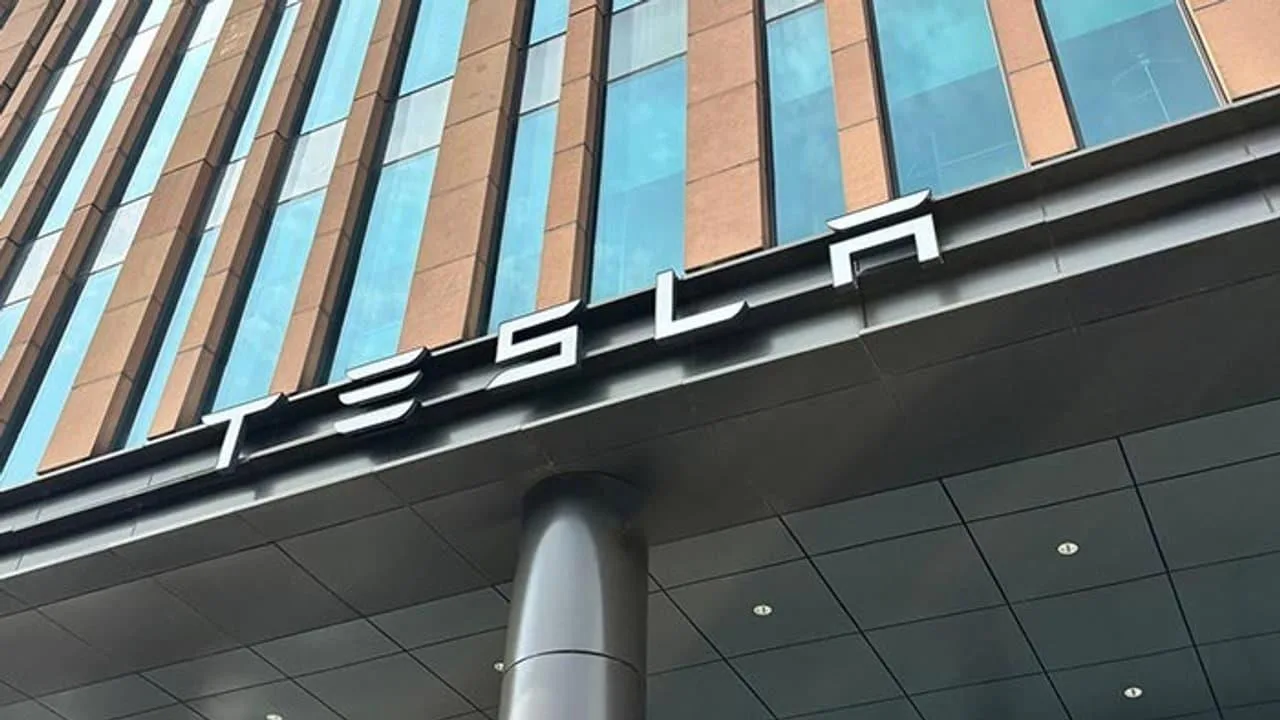
Tesla has opened its second showroom in India, located in Delhi’s Aerocity district, alongside its first Supercharger facility in the city, as the electric vehicle maker prepares to begin Model Y deliveries from September.
The American EV manufacturer leased an 8,200 square foot space in the Worldmark 3 building to establish the new retail outlet, called the “Tesla Experience Center Aerocity.” The showroom sits near Indira Gandhi International Airport in an upscale commercial zone. Tesla has also secured a 33,000 square foot property in Gurugram, part of the National Capital Region (NCR), for delivery and service operations under a nine-year lease agreement.
Beneath the Delhi showroom, Tesla installed its first Supercharger site in the city, featuring four chargers with a maximum output of 250 kW and three Destination Chargers rated at 11 kW. The company is actively expanding its charging infrastructure in and around Delhi, with additional Supercharger locations planned in Saket, Gurugram, and Noida.
Tesla is focusing its retail operations on India’s two major metropolitan areas, Delhi and Mumbai, aiming to serve affluent and progressive customers in the northern and western regions. The automaker has also confirmed plans to add a Supercharger location in Bengaluru, a leading city for electric vehicle adoption. Isabel Fan, Tesla’s Senior Director for Southeast Asia, Hong Kong, and Macau, said at the showroom opening: “We cannot miss Bangalore (Bengaluru), so we have to do that.”
Tesla launched the Model Y in India last month, offering standard-range rear-wheel drive and long-range all-wheel drive variants. Prices start at approximately 5.989 million rupees (about 58,700 euros) for the standard model and 6.789 million rupees (around 66,600 euros) for the long-range version, both excluding on-road costs. The vehicles are imported as completely built-up units from China.
The new showroom and charging infrastructure underline Tesla’s strategy to build a foothold in India’s emerging EV market by targeting key urban centers while steadily expanding support facilities ahead of broader adoption.