

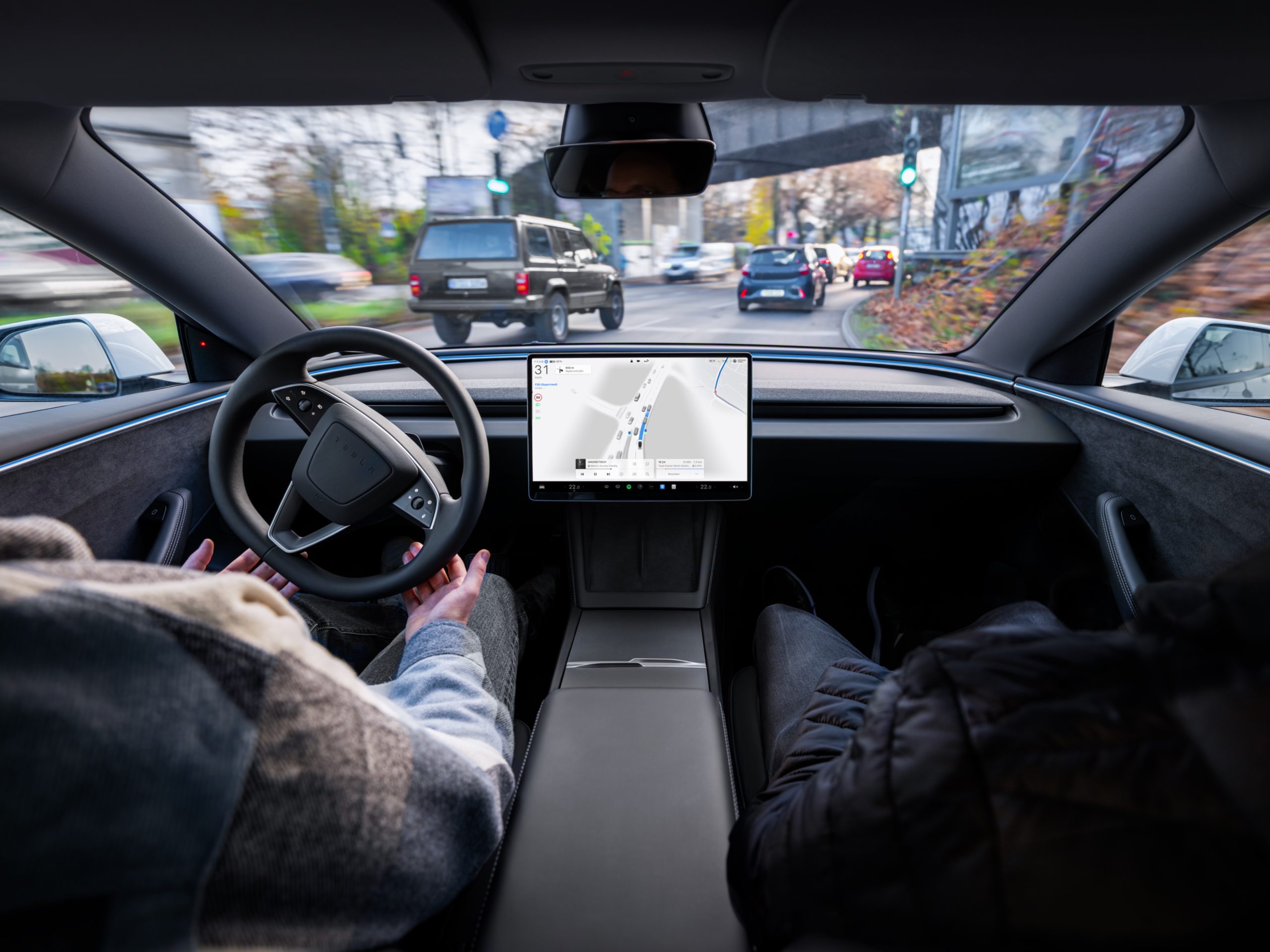
Tesla has started rolling out its latest Full Self-Driving (Supervised) update, version 14.3, to vehicles equipped with HW4/AI4 hardware, with early access users—including some in Canada—already receiving the software.
The update, delivered under software version 2026.2.9.6, introduces a broad set of improvements aimed at enhancing real-world driving behavior, perception and system responsiveness. Tesla said the update reflects a continued shift toward more advanced, human-like reasoning rather than reliance on pre-mapped data.
One of the most significant changes is a complete overhaul of Tesla’s AI compiler and runtime using MLIR (Multi-Level Intermediate Representation), which the company says improves reaction time by around 20% while accelerating development cycles for future updates. The upgrade also strengthens the system’s reinforcement learning (RL) training, allowing the neural network to better handle a wider range of driving scenarios.
Tesla has also enhanced its vision system, upgrading the neural network encoder to improve performance in low-visibility conditions and complex environments. The update expands traffic sign recognition and improves 3D spatial understanding.
On-road behavior has been refined, with improvements in how the system responds to emergency vehicles, school buses and right-of-way violations. Tesla said it has also reduced issues such as unnecessary lane positioning and minor tailgating—two areas frequently highlighted in user feedback.
The update places additional emphasis on handling rare and unpredictable situations. According to Tesla, the system is now better equipped to detect unusual objects entering the driving path and to respond to small animals, supported by training on more challenging real-world data from its fleet.
Complex intersections are another focus, with enhanced handling of multi-light configurations, curved roads and yellow-light decisions. Tesla also said the system is more resilient, maintaining control during temporary system degradations and recovering automatically to reduce disengagements.
Parking functionality has been improved as well, with more decisive spot selection and maneuvering, along with a new map-based “P” icon to indicate predicted parking locations.
Tesla said additional features are in development but not yet included in this release, such as expanded reasoning beyond navigation tasks, pothole avoidance and enhanced driver monitoring through improved eye-tracking and performance in varying lighting conditions.
As with previous releases, the rollout of FSD v14.3 is expected to proceed gradually, beginning with early testers before expanding to a wider user base in the coming weeks.