




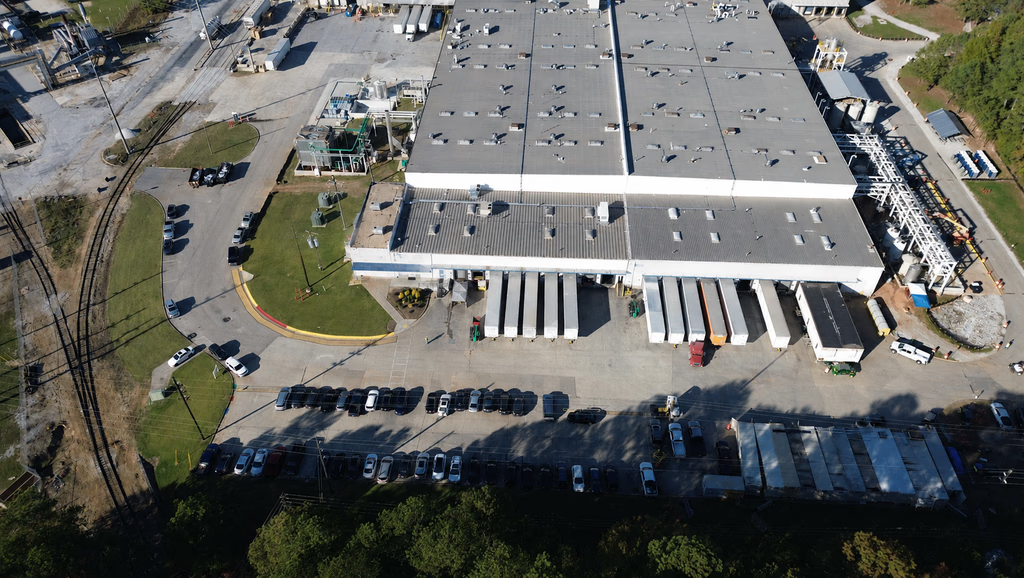
R3 Lithium has begun producing lithium carbonate from recycled battery materials at its facility in Covington, Georgia, marking the start of a transition toward continuous commercial operations at the site.
The existing facility is designed to produce up to 2,500 tonnes of lithium carbonate annually. R3 Lithium acquired the approximately 14,300-square-metre site in July 2026 and plans to invest $15 million from its Series A financing round to upgrade the facility for continuous production.
Georgia Facility Uses Recycled Battery Feedstock
The Covington facility was previously owned by Ascend Elements, which invested around $150 million in the site before becoming insolvent, according to R3 Lithium.
Lithium carbonate with 99% purity was produced at the facility in 2025 using entirely recycled feedstock. R3 Lithium describes the site as the first commercially proven facility of its type in North America.
The facility combines several stages of battery recycling. Its shredding plants have an annual processing capacity of 30,000 tonnes and convert production scrap and end-of-life batteries into black mass.
R3 Lithium then processes the black mass at the same site to recover lithium. The company uses a calcination-based crystallisation process followed by water-based precipitation to produce lithium carbonate.
The remaining concentrate contains nickel, cobalt, manganese and graphite, which R3 plans to market separately.
R3 Plans To Expand Lithium Carbonate Capacity
The existing production line has an annual capacity of 2,500 tonnes of lithium carbonate. Space has already been allocated for a second line of similar size, potentially allowing the facility’s capacity to double.
R3 Lithium has not provided a timeline for installing the second line. Its immediate priority is to upgrade the existing facility and establish continuous commercial production.
The company has also secured offtake agreements valued at approximately $1 billion with customers including commodity trader Trafigura. However, R3 has not disclosed the volumes, contract durations or pricing terms, making the stated contract value difficult to evaluate.
R3 expects to account for more than half of U.S. lithium carbonate production by 2027. Its forecast also illustrates the limited scale of current domestic production, given the existing 2,500-tonne annual capacity at Covington.
Recycled Materials Provide Alternative To New Lithium Extraction
R3 Lithium’s approach differs from projects that extract lithium from newly mined or naturally occurring resources.
For example, Smackover Lithium is developing a project in southwest Arkansas based on lithium extraction from brine. LG Energy Solution has secured 8,000 tonnes per year of lithium carbonate from the planned project beginning in 2029, while Trafigura has also agreed to take the same annual volume on a long-term basis.
The Smackover project is initially expected to reach annual production of 22,500 tonnes.
R3, by contrast, is focused on recovering lithium already present in the battery supply chain. Its Covington facility is therefore designed to process production scrap and end-of-life batteries rather than extract new lithium resources.
Consistent Feedstock Remains A Key Challenge
The transition to continuous production will test whether R3 can process different types of battery feedstock consistently at commercial scale.
Black mass can vary depending on factors including battery chemistry, age and the origin of the batteries. The company therefore needs to demonstrate that varying input materials can reliably produce lithium carbonate at the required purity.
While lithium carbonate production from recycled materials has already been demonstrated at Covington, R3 has not disclosed detailed figures for recovery yields or production costs.
The economic performance of the process during continuous operation will therefore be an important measure of the facility’s commercial viability.
“The U.S. has spent years discussing critical mineral independence while the vast majority of lithium processing has remained overseas,” said Linh Austin, President and CEO of R3 Lithium. “R3 Lithium is here today, with a proven facility that has already produced the product, the team that made it happen, and the capital needed to upgrade the line and keep it running, at commercial scale. R3 Lithium is setting a new pace for domestic lithium production, starting now.”
Battery And Energy Storage Demand Supports Lithium Market
Demand for lithium carbonate extends across electric vehicles, consumer electronics, defense applications, data centers and energy storage.
Global battery storage demand increased 51% in 2025 to more than 300 gigawatt-hours of installations, while global battery energy storage capacity is projected to increase sixfold between 2025 and 2030 at a compound annual growth rate of 42%.
Grid-scale battery storage also requires significant quantities of lithium carbonate, with approximately 880 tonnes of lithium carbonate consumed for every gigawatt-hour of storage capacity.
The growth of energy storage, alongside expanding EV and battery manufacturing, is increasing demand for domestic sources of battery materials.
Trafigura Highlights Domestic Supply Gap
R3 Lithium has secured approximately $1 billion in offtake agreements, including with Trafigura, as the company seeks to establish a domestic source of recycled lithium carbonate.
“Battery manufacturers, the Department of Energy, and OEMs are increasingly seeking reliable sources of domestic lithium to support the growing U.S. battery supply chain and improve security of supply. To date, however, domestic supply has remained relatively limited,” said Tim Wood-Dow, Battery Metals Trader at Trafigura.
“R3 Lithium’s Covington facility helps address that gap in the physical supply chain by producing lithium carbonate from recycled feedstock on U.S. soil.”
R3 Lithium plans to develop additional facilities in North America and Europe over the longer term. For now, the company is concentrating on ramping up the Covington operation and demonstrating that its recycled-feedstock process can operate continuously and economically at commercial scale.


