


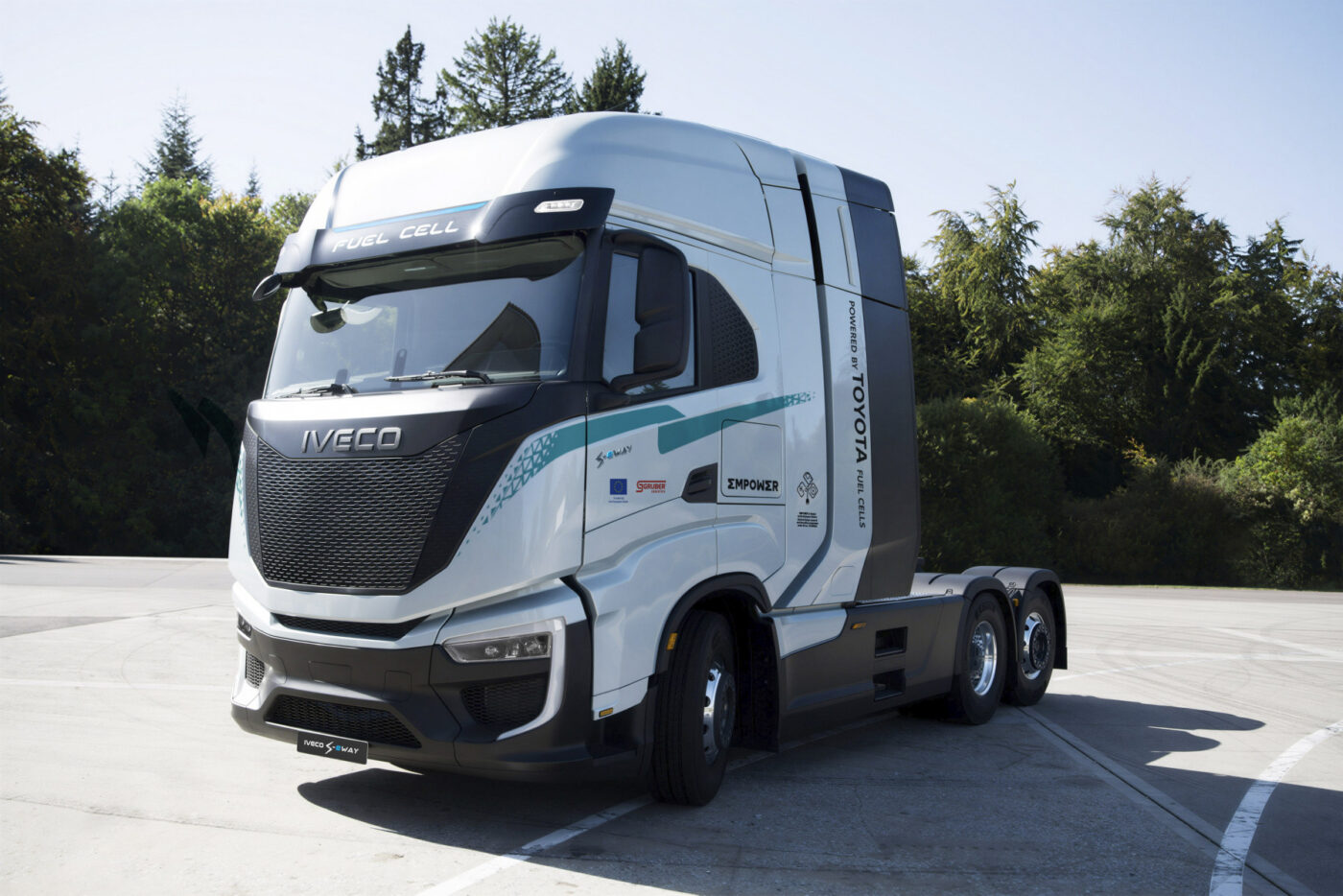
Iveco and Toyota are developing the next generation of heavy-duty hydrogen fuel cell trucks under the EU-funded EMPOWER research project, with the new Iveco S-eWay Fuel Cell expected to deliver more than 900 kilometres of range.
Under the partnership, Toyota will supply its third-generation fuel cell technology, while Iveco will develop, integrate and validate the complete vehicle. The S-eWay Fuel Cell will use Toyota fuel cell systems with a combined output of 300 kW.
The partners are targeting a fuel cell system lifespan of more than 25,000 operating hours, while development will focus on improving efficiency, vehicle weight and overall system architecture.
New S-eWay Uses Toyota Third-Generation Fuel Cell
The new S-eWay Fuel Cell builds on Iveco’s experience from the European H2Haul project, where the company deployed an earlier generation of fuel cell trucks using a Bosch fuel cell system.
Compared with that first-generation vehicle, the new truck is designed with a simplified architecture and reduced weight. Iveco and Toyota have also optimised the energy management system to reduce the battery requirement.
According to the companies, the new S-eWay Fuel Cell will require only half the battery capacity of its predecessor while maintaining a targeted range of more than 900 kilometres.
The approach is intended to improve energy efficiency while supporting the requirements of long-distance heavy-duty transport.
Toyota Expands European Truck Partnerships
The Iveco agreement represents Toyota’s latest collaboration with a European truck manufacturer focused on deploying its fuel cell technology.
Earlier in September, Toyota announced a partnership with Scania involving 40 trucks equipped with its current 300-kW fuel cell system. Real-world logistics testing of those vehicles is scheduled to begin in early 2027.
Toyota is also working with Sinotruk and VDL Group on hydrogen fuel cell trucks. The Japanese company has additionally joined Cellcentric, the fuel cell joint venture established by Daimler Truck and Volvo Group, as an equal partner.
The series of partnerships reflects Toyota’s increasing focus on applying its fuel cell technology to commercial vehicles and heavy-duty transport.
EMPOWER Builds On H2Haul Experience
Iveco will incorporate experience from the H2Haul project into development of the new S-eWay Fuel Cell.
Through EMPOWER, the partners will focus on improving the truck’s performance, energy efficiency and fuel cell lifespan while evaluating the technology under real-world operating conditions.
Validation and testing of the new vehicle are scheduled to begin in the fourth quarter of 2026. Initial public road testing is planned for the first half of 2027.
The data collected during the road tests will be used to support the next stages of development and future industrialisation.
Iveco Positions Hydrogen For Heavy-Duty Transport
Iveco said hydrogen could play an important role in long-distance heavy-duty transport, where range, operating time and energy resilience are important considerations.
“Hydrogen is a key enabler of the future energy and mobility ecosystem. By joining forces with Toyota through EMPOWER, we are investing in a long-term vision for heavy-duty transport, one that combines sustainability, energy resilience and operational performance,” said Marco Liccardo, Chief Technology & Digital Officer at Iveco Group.
“Through EMPOWER, we are bringing together leading fuel cell expertise and advanced vehicle engineering to help unlock the full potential of hydrogen and drive the evolution of zero-emission heavy-duty transport. Together, we aim to accelerate the adoption of zero-emission solutions and contribute to redefining how goods move in the decades ahead,” Liccardo added.
Toyota said fuel cell technology could offer advantages for high-mileage commercial operations by combining range, operating uptime and efficiency without producing tailpipe emissions.
“The transition to zero-emission freight requires technologies that can meet the realities of commercial transport. For high-mileage, heavy-duty operations, hydrogen fuel cell technology offers strong potential by combining range, uptime and efficiency,” said Shinichi Yasui, Executive Vice President, R&D, Toyota Motor Europe.
“By working together with IVECO, we aim to demonstrate how Toyota’s third-generation fuel cell system can help customers move towards zero-tailpipe emission logistics without compromising operational needs,” Yasui added.
Road Testing Set To Begin In 2027
The development programme will move from validation work into public road testing next year. Iveco and Toyota expect the first public tests of the S-eWay Fuel Cell during the first half of 2027.
The combination of Toyota’s 300-kW fuel cell technology and Iveco’s vehicle engineering is intended to deliver a hydrogen truck capable of more than 900 kilometres of range while reducing battery requirements compared with the previous generation.
The results of the EMPOWER programme will help determine the technology’s readiness for future industrialisation and broader deployment in zero-emission heavy-duty transport.