





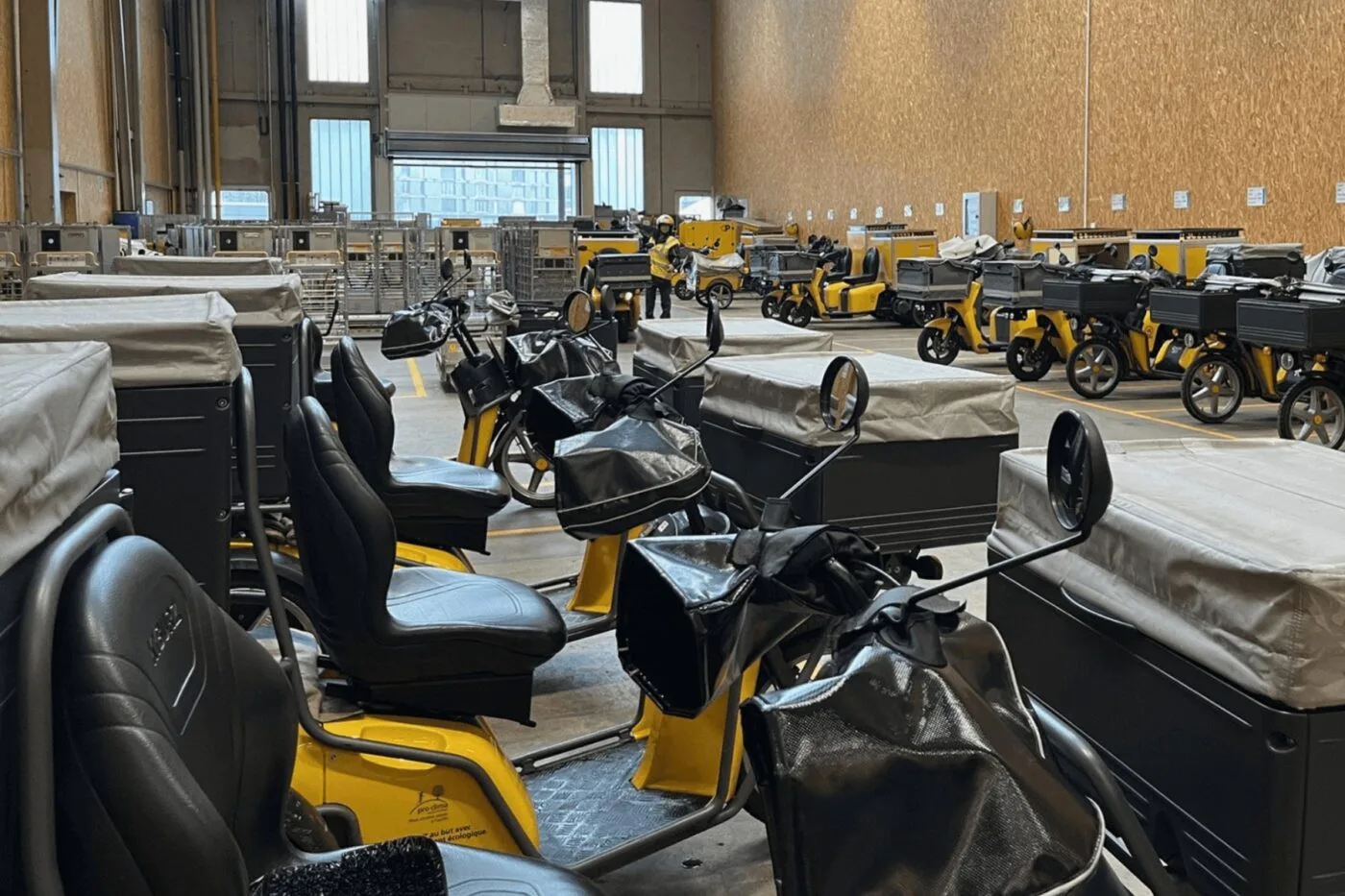
Swiss Post has launched a four-month pilot project to evaluate whether its fleet of light electric delivery vehicles can contribute to local grid stability and serve as an additional income source, the company said on Monday.
The project, located in the canton of Fribourg, aims to test bidirectional charging—also known as vehicle-to-grid (V2G)—using postal ebikes and electric scooters. The initiative involves Swiss Post, vehicle manufacturer Kyburz Switzerland AG, and the Lucerne University of Applied Sciences and Arts (HSLU), with financial backing from Switzerland’s Federal Office of Energy.
“As soon as the scooters arrive at the depot in the early afternoon, we calculate the charging and discharging profiles in accordance with the Groupe-e variable tariff in order to get the most out of the vehicles in supporting the electricity grid,” said Severin Nowak, a project lead at HSLU.
Unlike many V2G systems that use direct current (DC), this trial employs an alternating current (AC) charging process converted onboard into DC, simplifying integration with existing grid infrastructure. The fleet, managed via Kyburz’s backend system, follows regular delivery routes to identify windows for grid interaction.
Michael Graf, a representative from Swiss Post, highlighted the economic ambition behind the trial: “With the project in Fribourg, the participants want to find out whether the economies of scale from the large number of scooters would be large enough for Swiss Post to earn money with the help of arbitrage.”
Though variable tariffs are not yet widespread in Switzerland, the Groupe-e network area offers a suitable environment for testing. The findings may inform both regulatory evolution and broader adoption of V2G technology among fleet operators. Swiss Post already operates fully electric fleets in Zurich and Bern and sees the project as part of its wider sustainability agenda.


