




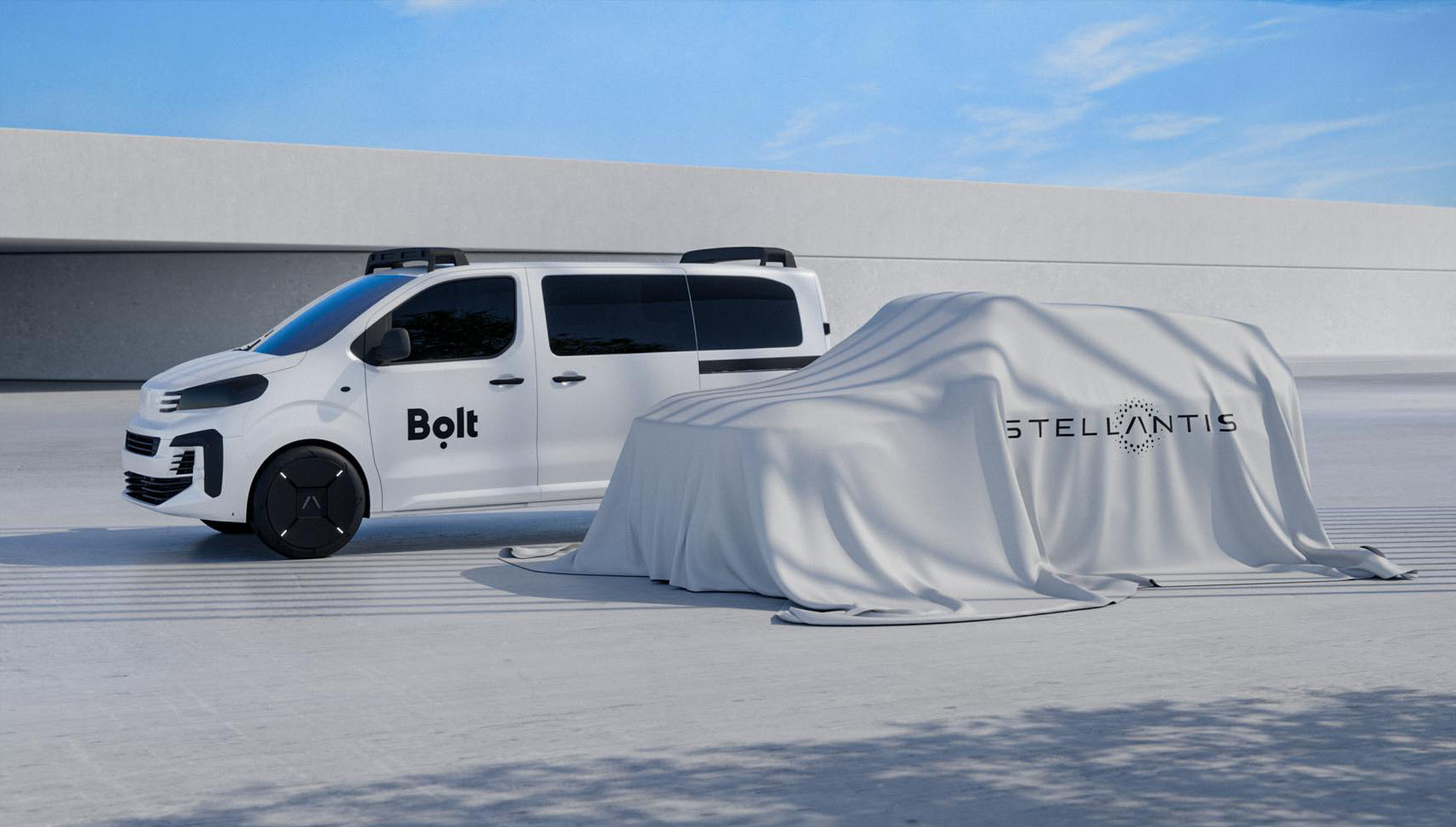
Stellantis and Bolt, Europe’s ride-hailing and mobility platform, announced a strategic partnership to jointly explore the development and deployment of Level 4 (driverless) autonomous vehicles (AVs) for commercial operations across the continent.
The collaboration will combine Stellantis’ purpose-built AV-Ready Platforms™—specifically the eK0 medium size van and the STLA Small architectures—with Bolt’s extensive mobility network, which spans more than 50 countries. Bolt aims to integrate these autonomous vehicles into its shared mobility platform to offer fully autonomous, driverless ride-hailing services.
The phased deployment plan anticipates the start of test vehicle trials in European countries beginning in 2026, with an initial production target for the scaled-up AV fleet set for 2029. Both companies committed to working closely with European regulators to ensure the service meets the highest safety, data protection, and cybersecurity standards.
Antonio Filosa, CEO of Stellantis, highlighted the strategic intent: “Autonomous fleets can also contribute to a lower carbon footprint by enabling a shared and optimized mobility, reducing congestion and emissions. Partnering with Bolt is intended to bring this vision closer to reality, combining our engineering expertise with their operational reach in the hopes of making driverless mobility a trusted part of everyday life in Europe.”
The partnership expands Stellantis’ driverless mobility strategy in Europe, following a non-binding Memorandum of Understanding (MoU) signed in October with autonomous driving company Pony.ai to jointly advance robotaxi solutions.
Markus Villig, Founder and CEO of Bolt, underscored the importance of the European focus for the development and deployment of autonomous mobility. “This partnership brings together two companies who understand the specific dynamics of operating in Europe. By combining Stellantis’ AV-Ready Platforms™ and our operational expertise, we plan to create the best autonomous vehicle offering that is tailored for European needs, in line with European standards, that millions of people will be able to use,” Villig said.
Villig previously criticized Europe’s focus on the electrification transition at the expense of developing self-driving technology. “There’s so much on EVs but we’ve lost the plot on autonomous driving,” Villig said in October, arguing that autonomous technology “will be the core technology” for the next decade of mobility.


