


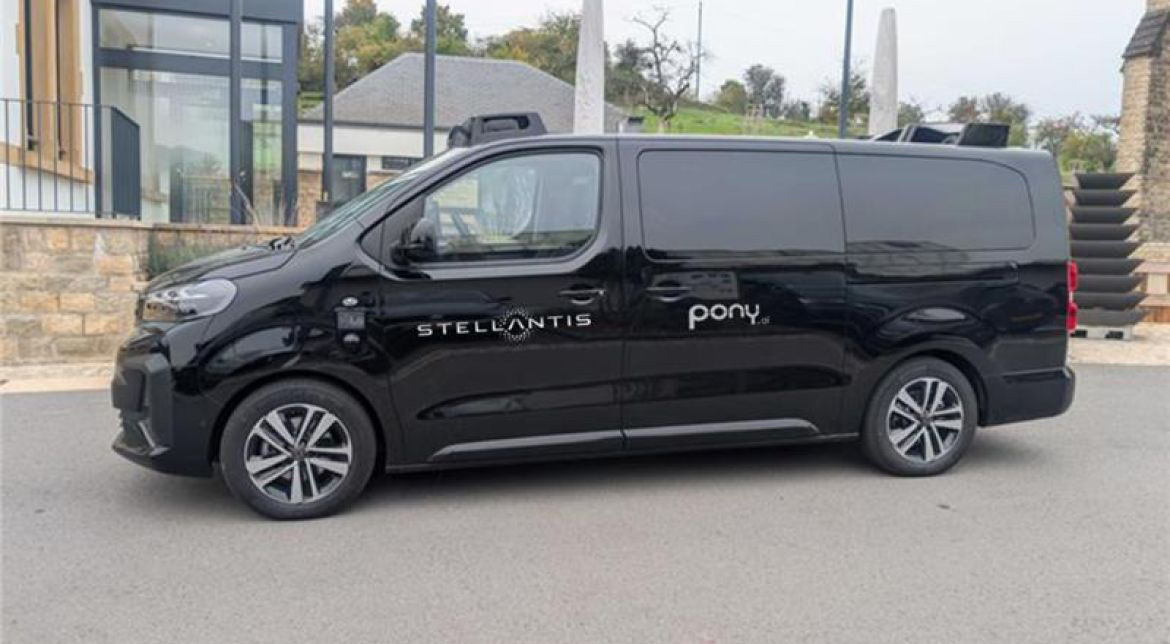
Stellantis and autonomous driving company Pony.ai announced on Friday that they have signed a non-binding Memorandum of Understanding (MoU) to jointly advance the development and deployment of robotaxi solutions across Europe.
The collaboration will combine Pony.ai’s autonomous driving software with Stellantis’ AV-Ready Platform – BEV version, starting with medium-sized vans. Pony.ai’s European division, headquartered in Luxembourg, will lead the project, with the first Peugeot e-Traveller–based test vehicles expected to hit the road in the coming months. Broader deployment across European cities is targeted for 2026, as both companies work to validate safety, performance, and regulatory readiness.
See also: Pony.ai and WeRide Receive Regulatory Approval for Hong Kong Listings
The partnership initially focuses on light commercial vehicles (LCVs), where Stellantis holds a strong market position through its Pro One division. The automaker’s diverse LCV lineup offers flexibility for applications ranging from compact robotaxis to eight-passenger autonomous vans, optimized for urban mobility.
“Driverless vehicles have the potential to transform the way people move in our cities, offering safer and more affordable options for communities,” said Ned Curic, Stellantis Chief Engineering & Technology Officer. “To bring this vision to life, we’ve built Stellantis’ AV-Ready Platforms and are partnering with the best players in the industry. Pony.ai stands out for their technical expertise and collaborative approach.”
See also: Pony.ai Gains Dubai Permit to Test Robotaxis, Eyes Commercial Launch by 2026
“We are delighted to partner with Stellantis to bring our autonomous mobility technology to Europe,” said Dr. James Peng, Pony.ai Founder and CEO. “Their strong European presence and portfolio of iconic brands make them the ideal partner to help accelerate our growth in this key market.”
Stellantis’ AV-Ready Platform is engineered to support SAE Level 4 autonomous driving, featuring system redundancies, compatibility with advanced sensor suites, and the integration of a comprehensive autonomous software stack. The companies said the platform will enable “hands-off, eyes-off” operation while maintaining the highest safety and reliability standards.
See also: Pony.ai Begins 24/7 Robotaxi Testing in Major Chinese Cities
While the initial focus remains on light commercial vehicles, Stellantis and Pony.ai said the collaboration could pave the way for broader applications, including autonomous mobility services for both passengers and goods across European cities.
Pony.ai Ramps Up Gen-7 Robotaxi Production, Targets 1,000 Vehicles by Year-End


