
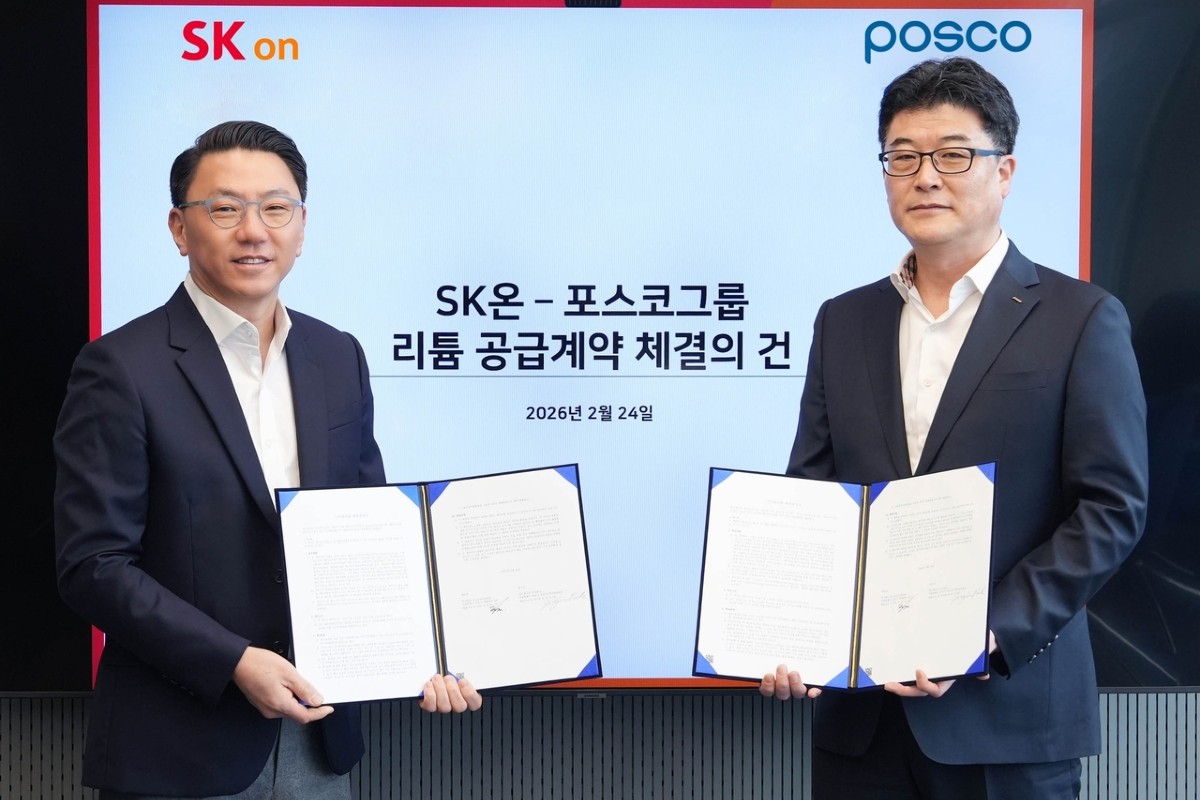
SK On and POSCO have signed a lithium supply agreement running through 2028, covering up to 25,000 tonnes of lithium concentrate sourced from Argentina.
The volume is expected to support the annual production of approximately 400,000 electric vehicle batteries, according to SK On. The lithium concentrate will be used in battery-electric vehicle projects in Europe and North America, as well as in stationary energy storage systems.
See also: SK On, Seoul National University Report Breakthrough in Single-Crystal Cathode Research
SK On said the agreement forms part of its broader effort to diversify its raw material supply chain. South Korean media reported that the company is seeking to reduce dependence on China for critical battery inputs, in line with policy initiatives in the European Union and North America aimed at strengthening supply chain resilience. Automotive manufacturers have also called for reduced reliance on Chinese-sourced materials in battery production.
The lithium will be sourced from salt lake operations in the Hombre Muerto region of Argentina, operated by Posco Argentina. The companies described the contract as the largest concluded since the Argentine lithium production facility began operations in 2024.
“This agreement is part of our supply chain diversification strategy to strengthen mid- to long-term raw material stability and sourcing competitiveness,” said Park Jong-jin, Head of Strategic Procurement at SK On. “We will also continue to expand SK On’s raw material sourcing capabilities beyond EVs and into the energy storage system (ESS) sector,” he added.
See also: SK On Ends U.S. Battery Joint Venture With Ford as It Refocuses on Energy Storage Systems
In 2024, SK On signed a separate three-year contract with Posco Pilbara Lithium Solution for the supply of up to 15,000 tonnes of lithium hydroxide used in nickel-cobalt-manganese (NCM) cathodes. The joint venture, established in 2021 between POSCO and Australia’s Pilbara Minerals, processes lithium hydroxide in South Korea using raw material mined in Australia.
Source: Korea Herald