
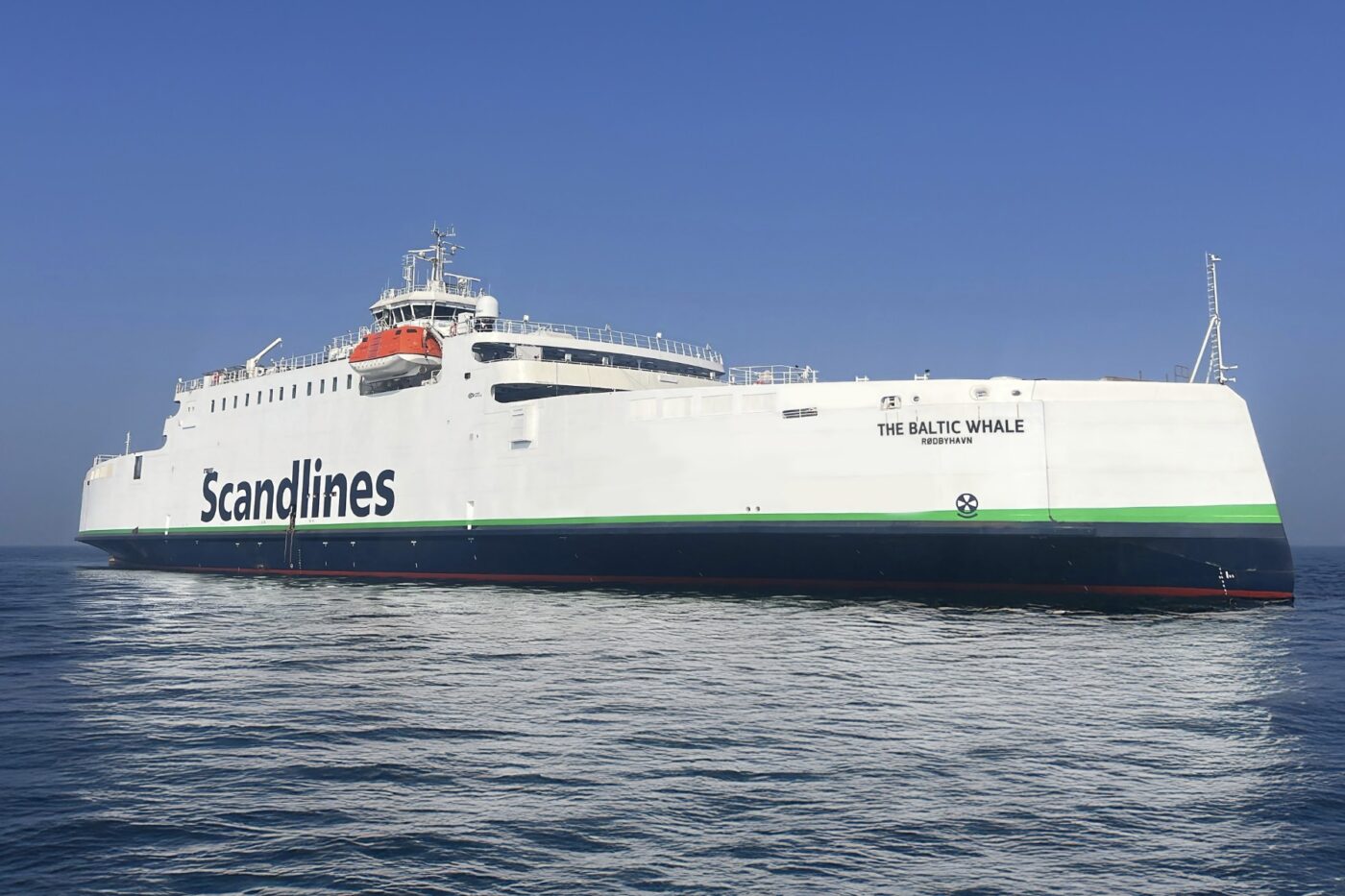
Ferry operator Scandlines has put what it describes as the world’s largest electric freight ferry into service, deploying the vessel Baltic Whale on the Fehmarn Belt route between Rødby and Puttgarden.
The ferry, measuring 147.4 meters in length, is equipped with a 10 megawatt-hour (MWh) battery system, allowing it to operate fully electrically or in hybrid mode using diesel generators. The vessel completed its maiden voyage on March 10, 2026, marking the culmination of a project first announced in 2022 when the ship was known as PR24.
According to Scandlines, the ferry can complete the 18.5-kilometre crossing between Rødby and Puttgarden entirely on battery power in about one hour. When operating in hybrid mode with supplementary diesel generators, the journey time is reduced to approximately 45 minutes.
The ferry has been under construction since 2022 at the Cemre Shipyard in Turkey, while the vessel’s battery system was supplied by Swiss manufacturer Leclanché. The battery pack has a total capacity comparable to the combined battery systems of around 100 luxury electric cars.
To support rapid charging, Scandlines installed new high-capacity electrical infrastructure at both ports. At Puttgarden, the company built a 30 kV / 15 MW power cable connection along with medium-voltage switchgear and charging facilities. At Rødbyhavn, a 50 kV / 25 MW power cable system was deployed, including a charging tower, transformer, and control systems positioned directly at the berth.
The automated charging tower can connect to the ferry within about 15 seconds, allowing the vessel’s batteries to be recharged in approximately 12 minutes between sailings.
Designed primarily for freight transport, the Baltic Whale provides capacity for 66 freight units across two decks. The ferry is equipped to handle various types of cargo, including hazardous goods such as industrial materials, batteries, cosmetics, and automotive components.
By dedicating the vessel to freight transport, Scandlines said it expects to free additional capacity for passenger vehicles and travelers on other ferries operating on the route, particularly during peak travel periods.
“The deployment of the Baltic Whale on the Fehmarn Belt is a milestone for Scandlines—a day we have been waiting for over many years,” said Michael Guldmann Petersen, the company’s chief operating officer. “The idea for a battery-powered ferry was first conceived in 2018, and now it has become a reality. It is a great success and something we have been eagerly anticipating.”
Scandlines said the vessel forms part of its broader strategy to reduce emissions and eventually operate a fully emission-free ferry fleet by 2040.
Since 2013, the company has invested more than €430 million in technologies aimed at reducing environmental impact. These investments include hybrid ferries, onboard battery systems, rotor sails, energy-efficient propellers, and the electrification of port infrastructure.