




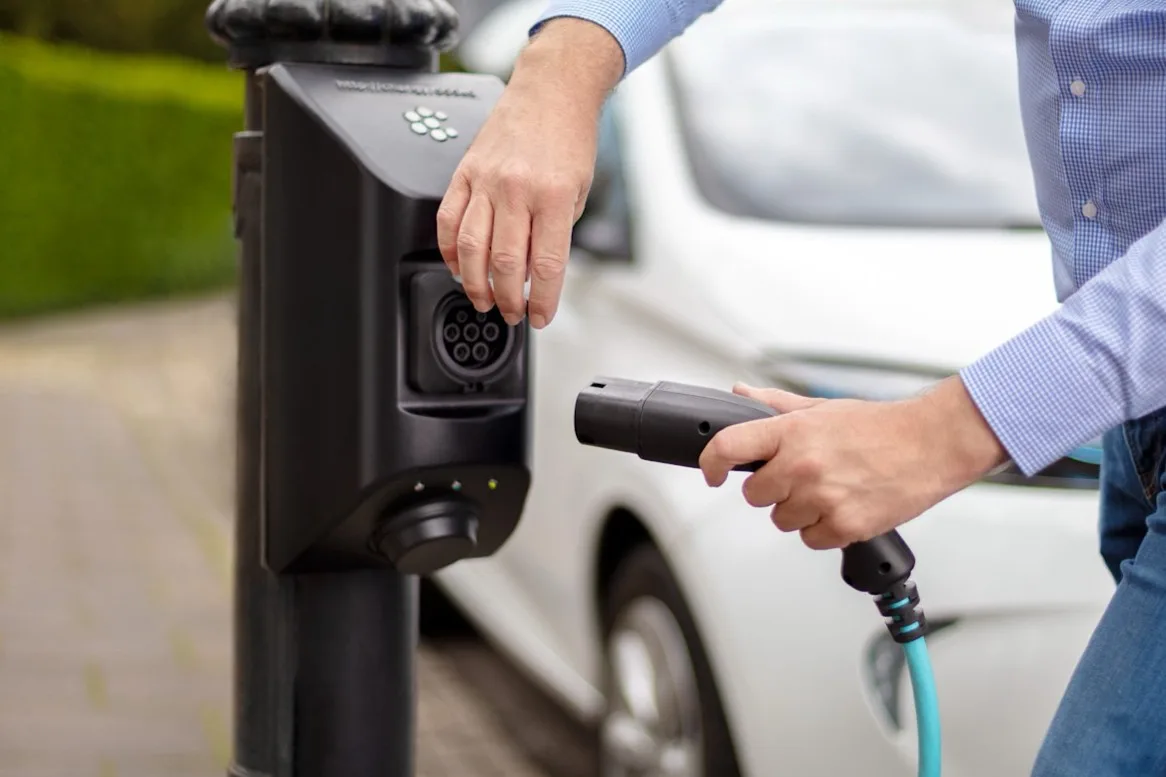
Reading Borough Council has partnered with EV charging company char.gy to install around 2,600 public electric vehicle charge points across residential streets in Reading, England.
The 15-year programme aims to ensure that at least 90% of households without access to private driveways are located within 100 metres of a public charger.
Initial installations are expected to begin in the coming months, with approximately 1,500 charging points planned to be operational within the first two years.
Most of the chargers will be integrated into existing street lamp columns, while standalone charging units will also be deployed where suitable space is available.
The project is supported by 866,000 pounds ($1.1 million) in funding from the UK government’s Local Electric Vehicle Infrastructure (LEVI) programme.
According to Reading Borough Council, nearly half of local households lack access to private driveways or off-street parking, creating barriers for residents considering electric vehicle ownership.
The council said the charging rollout forms part of its wider decarbonisation and air quality strategy.
Transport currently accounts for around 26% of local carbon emissions, according to council figures.
Alongside EV charging expansion, Reading Borough Council is also investing in additional low-emission transportation projects, including a 9 million-pound programme supporting deployment of 49 electric buses and measures aimed at encouraging walking and cycling.
John Ennis, lead councillor for climate strategy and transport, said the initiative was intended to accelerate EV adoption among residents without home charging access.
“This scheme aims to speed up the transition to electric vehicles by giving households across Reading access to around 2,600 public charging points,” Ennis said.
“Almost half of households in the borough do not have driveways or off-street parking which is a significant barrier to people choosing EVs,” he added.
Ennis said installation efforts would prioritise densely populated residential areas lacking off-street parking facilities.
char.gy Chief Executive John Lewis said the partnership would focus on building a charging network suited to local travel and parking patterns.
“Together, we’ll deliver thousands of public charge points designed around the way people in Reading actually live, park and travel,” Lewis said.
“Our goal is to create a network that’s reliable, accessible and fair, giving more people the confidence to make the switch to electric vehicles,” he added.
Separately, the council has also secured an additional 202,000 pounds in government funding for a pavement charging initiative.
The programme will support around 400 households with the installation of pavement cable channels, allowing residents to safely connect home chargers to vehicles parked on public streets.
The latest initiative reflects broader efforts across the United Kingdom to expand public charging infrastructure and support wider electric vehicle adoption among urban residents without private parking access.