
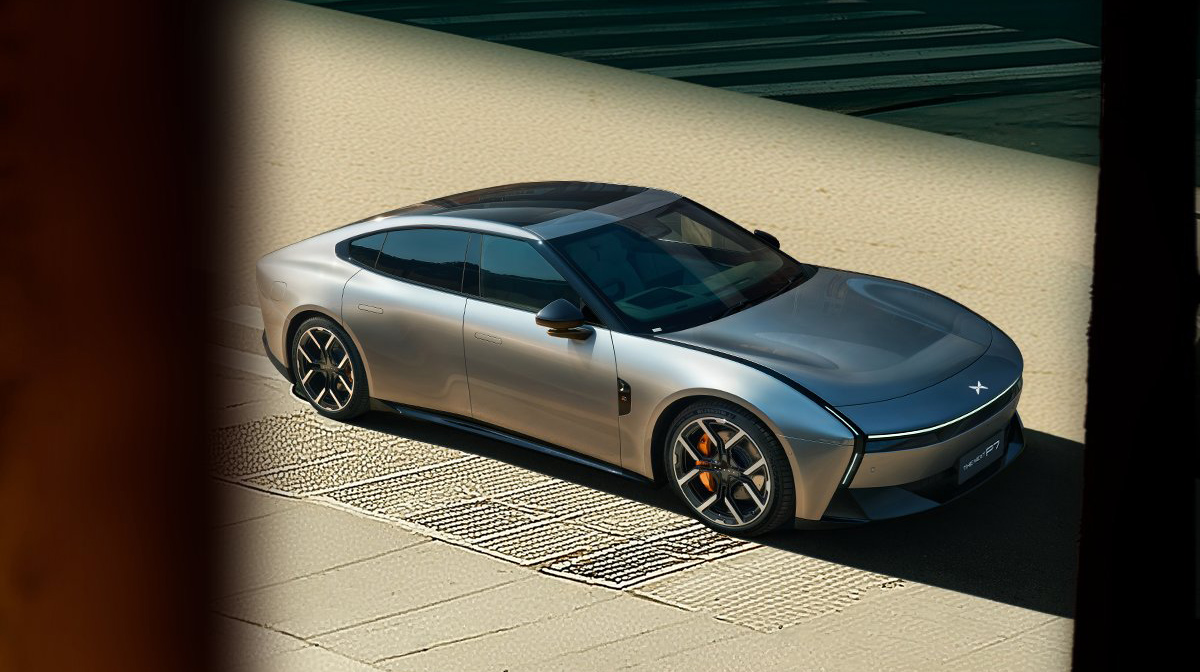
China’s Xpeng has introduced a new version of its P7 electric liftback capable of autonomously driving from the production line to the shipping area at its Guangzhou factory, marking a step toward wider deployment of driverless operations.
The latest P7 integrates three in-house developed Turing AI chips, each with a computing capacity of 750 trillion operations per second (TOPS), delivering a combined peak performance of 2,250 TOPS. This level of computing power is around three times higher than Tesla’s Model Y powered by the AI 4 system-on-chip and exceeds Nvidia’s Orin Thor. The system supports large-scale Vision-Language-Action and Vision-Language Models, allowing the vehicle to process visual data and language instructions for advanced driver assistance capabilities.
The P7 relies primarily on camera-based sensing, with its computing architecture designed to enable functions such as Navigation Guided Pilot (NGP) on both highways and city roads. Xpeng has positioned the model as ready for Level 3 automation, which would allow drivers to disengage from active control under certain conditions, though regulatory approval for such systems is not yet in place in China.
Beyond its autonomous driving hardware, the P7 features aerodynamic styling with a drag coefficient of 0.201 Cd, achieved through a low beltline and concealed door handles. The car measures 5,017 mm in length with a wheelbase of 3,008 mm, providing a spacious interior equipped with a 15.6-inch floating display, slim digital instrument cluster, and an 87-inch augmented-reality head-up display.
The model comes with an 800-volt high-voltage platform and offers two battery options: a 74.9 kWh LFP pack and a 92.2 kWh NMC pack. Performance variants include a single-motor rear-wheel-drive version rated at 270 kW (362 hp) and an all-wheel-drive configuration with dual motors producing up to 437 kW (586 hp), accelerating from 0 to 100 km/h in 3.7 seconds.
Source: Weibo