

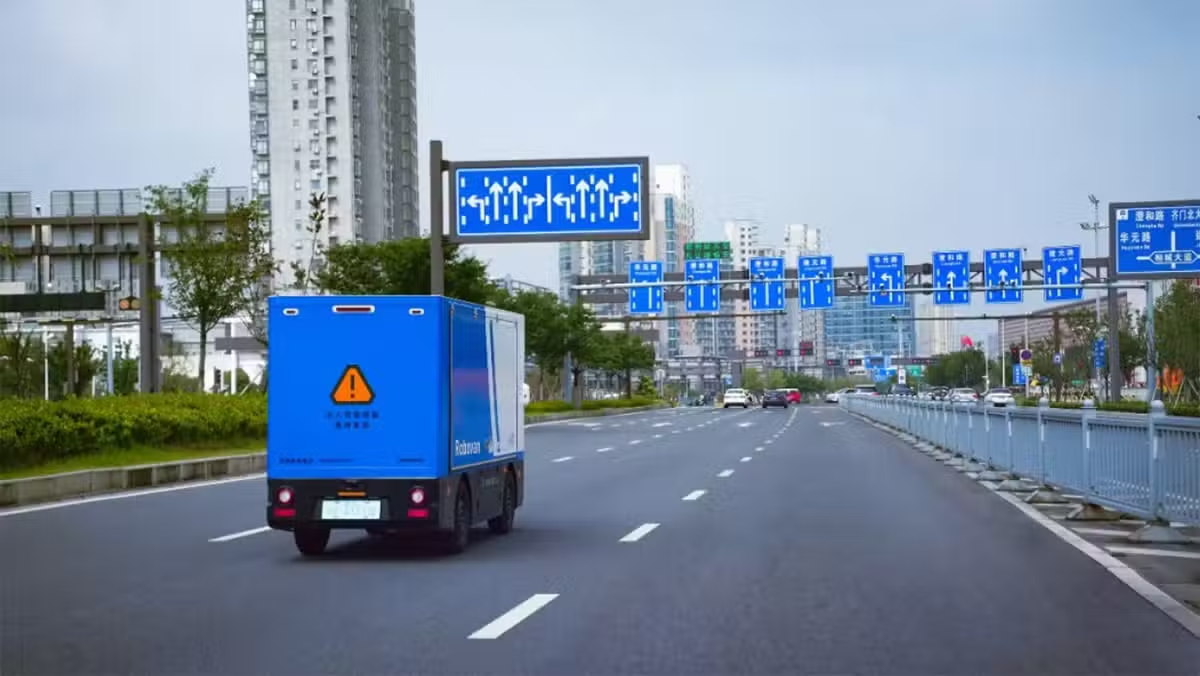
Chinese autonomous driving technology company Momenta has officially entered the autonomous delivery vehicle market, launching its robovan business in Suzhou as it seeks to expand the commercial use of its self-driving technology beyond passenger vehicles.
The company said its driverless delivery vans have begun operating in Xiangcheng District, Suzhou, where Momenta is headquartered, supporting express and overnight delivery services designed to improve last-mile logistics. The announcement follows earlier reports by local media outlet 21jingji that the vehicles had been operating in the city for several months.
Driverless Delivery Targets Commercial Growth
Momenta said its robovans are powered by the company’s proprietary R7 world model and are built to automotive-grade standards.
The company added that the vehicles use its high-definition map-free autonomous driving technology, which has already been validated through large-scale deployment in passenger vehicles. According to Momenta, removing dependence on HD maps can improve operational efficiency while reducing delivery costs.
“Removing the reliance on high-definition maps improves delivery efficiency and lowers delivery costs.”
Momenta said its autonomous driving platform has accumulated more than 12 billion kilometers of real-world driving data, from which it has generated over 100 million segments of what it describes as “golden data” to improve system performance.
The expansion into autonomous logistics comes as the company seeks to leverage its research and development investments across multiple business segments. Momenta spent 1.87 billion yuan ($275 million) on research and development in 2025, representing 77.5% of its annual revenue.
Following its Hong Kong listing on July 8, which raised approximately HK$6.8 billion, the company said around 60% of the proceeds would be allocated to research and development, while another 20% would support the commercialization of its robotaxi business.
Growing Competition in Driverless Logistics
The R7 world model entered mass production in April and forms the foundation of Momenta’s strategy to deploy a single artificial intelligence model across passenger vehicles, robovans, robotrucks and robotaxis, with future expansion into embodied AI applications.
Driverless delivery is increasingly viewed as one of the earliest commercially viable applications for Level 4 autonomous driving. According to the China Federation of Logistics & Purchasing, more than 33,000 autonomous delivery vehicles had been deployed across China by the end of 2025.
Industry forecasts indicate annual production and sales of autonomous delivery vehicles in China could reach 860,000 units by 2030, with the total operating fleet exceeding 2 million vehicles.
Despite the market’s growth potential, Momenta enters a sector dominated by a small number of companies. Data for the first quarter of 2026 showed Cainiao-backed Zelos accounted for more than half of the market with over 25,000 vehicles, while Neolix operated approximately 17,000 vehicles. Together with Rino, the three companies controlled more than 95% of the market.
Falling hardware costs have helped improve the commercial outlook for autonomous delivery vehicles. LiDAR sensor prices have declined significantly in recent years, while the overall manufacturing cost of a driverless delivery vehicle has fallen below 100,000 yuan.
However, regulatory approval remains a challenge. China has yet to introduce nationwide certification standards for autonomous delivery vehicles, requiring companies to obtain operating permits from local governments on a city-by-city basis.
Momenta joins a growing list of companies expanding into the sector, including WeRide, which introduced its mass-produced W5 robovan in 2025.