



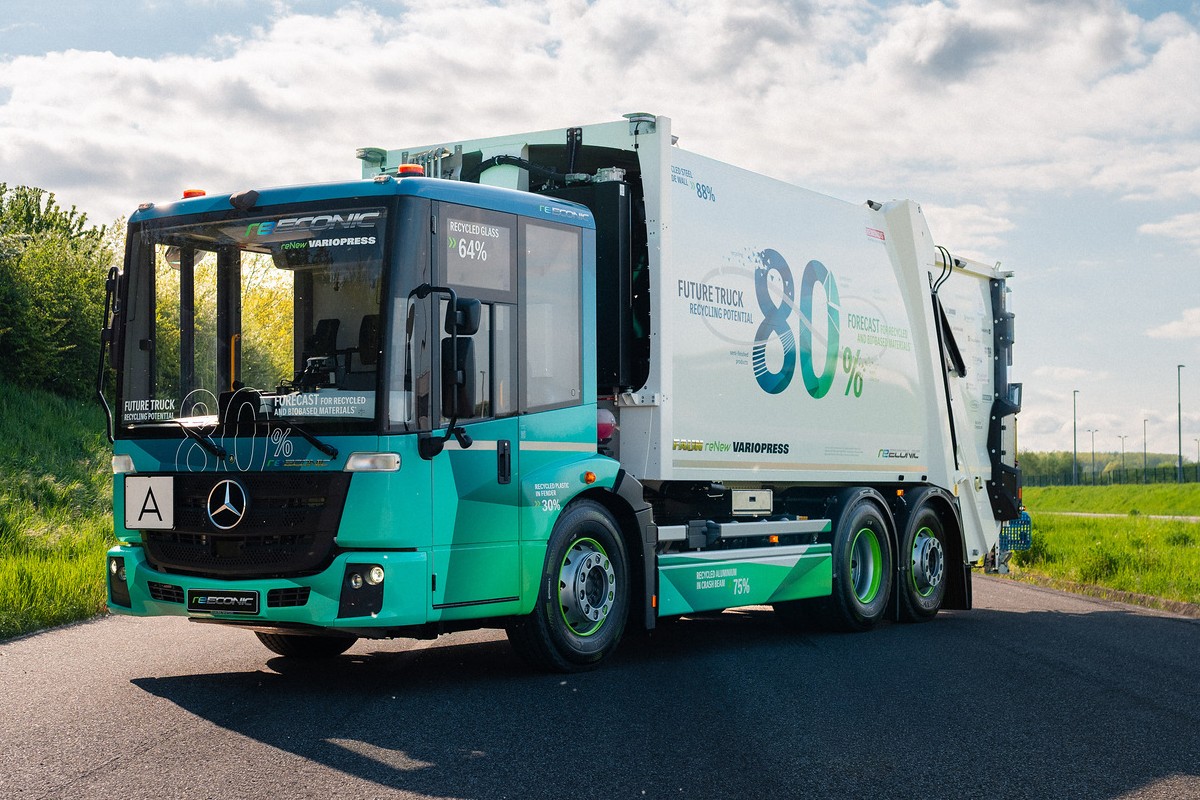
Mercedes-Benz Trucks has unveiled a battery-electric refuse truck concept designed to test how recycled and bio-based materials could be integrated into future commercial vehicle production across its lineup.
The concept vehicle, named ReEconic and based on the Mercedes-Benz eEconic, was presented at the IFAT Munich environmental technology exhibition in Munich.
The project brings together 33 industry partners and focuses on evaluating the practical use of recycled materials in areas such as the truck’s interior, body panels and glazing systems.
Mercedes-Benz Trucks said the ReEconic will enter operational testing in the second half of 2026 at waste management company Remondis in Frankfurt am Main, where the vehicle will be used in refuse collection operations.
Christian Wilz, chief executive of Mercedes-Benz Trucks & Fuso Germany, described the vehicle as “a vehicle that has, in a sense, collected itself.”
The project is led by Mercedes-Benz Trucks together with refuse vehicle specialist Faun Umwelttechnik and recycling company TSR Group, which originally initiated the programme.
According to the companies, the concept aims to support circular economy principles by integrating recycled, natural and bio-based materials into vehicle manufacturing.
The ReEconic incorporates recycled steel, aluminium, plastics, glass and wood in various structural and interior components.
The front axle and longitudinal frame beams use CO₂-reduced recycled steel produced through electric arc furnace technology. Mercedes-Benz Trucks said the flat steel used in the beams contains an average recycled content of 88%, while forged steel components in the axle body reach a recycling rate of 97%.
The truck’s cab frame and battery impact protection structures are largely manufactured from recycled aluminium with at least 75% post-consumer recycled content.
Developers also replaced several conventional petroleum-based plastics with recycled polymers and bio-based alternatives.
For example, the seat upholstery uses recycled polyamide sourced from discarded carpets and fishing nets, while the dashboard incorporates lignin-based plastics.
Other materials include natural fibre-reinforced polylactide composites, recycled thermoset plastics from wind turbine rotor blades and sunflower-oil-based fillers.
According to the project partners, 64% of the vehicle’s glass surfaces are manufactured using recycled glass.
The ReEconic also marks the first use of wood in a modern Mercedes-Benz commercial vehicle. Beechwood sourced from certified forestry operations is used in parts of the floor, wheel arches, cab roof and seat shell.
The vehicle is additionally equipped with a reNew VARIOPRESS refuse collection body supplied by Faun Umwelttechnik that also incorporates recycled materials.
Project partners estimate that up to 80% of the steel, aluminium, plastic and glass used in a standard production eEconic could theoretically be replaced with recycled or bio-based alternatives in future production vehicles.
The companies said these material groups account for around 6.5 tonnes of the vehicle’s gross weight, meaning approximately 5.2 tonnes could potentially be substituted using existing manufacturing technologies and materials.
TÜV Süd certified the methodology and calculations used in the study.
Roland Dold, project manager for ReEconic at Mercedes-Benz Trucks, said the estimated 80% replacement figure was “extremely realistic.”
However, Dold noted that the vehicle’s three 100-kWh battery packs were excluded from the calculations because battery recycling infrastructure remains underdeveloped in Europe.
“Together with our European partners, we have done pioneering work in the field of material recycling and the use of natural materials and bio-based alternative products in commercial vehicle manufacturing,” Dold said.
“It consists, among other things, of materials with a history—from fishing nets to automotive parts,” he added.
“Even after the end of their useful life, many of these components can be converted back into their raw materials and reused—that is the circular economy in its purest form.”
Mercedes-Benz Trucks said findings from the project could eventually support industrial-scale use of recycled materials across future truck series.
Bernd Fleschenberg, chief operating officer of TSR Group, said the initiative demonstrates the importance of collaboration across the supply chain.
“We initiated this project because closed-loop systems can only be created if they are conceived and implemented collaboratively across the entire value chain,” Fleschenberg said.
“This conserves resources, significantly reduces energy consumption, and lowers CO₂ emissions,” he added. “At the same time, it strengthens the resilience of industrial supply chains and reduces dependence on global raw material markets.”


