
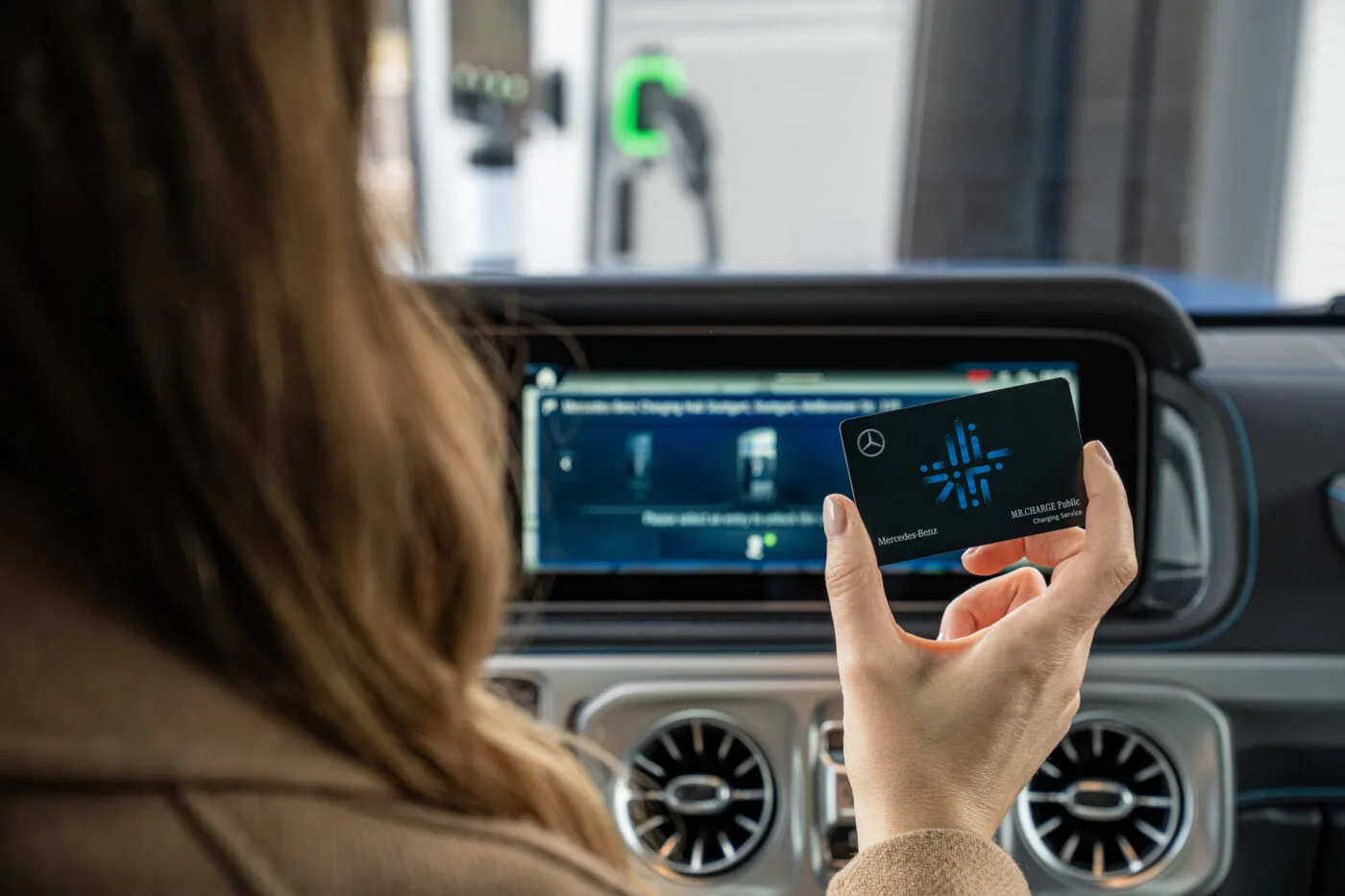
Mercedes-Benz has rolled out MB.Charge in India, introducing a unified public charging service that allows its electric vehicle customers to access more than 9,000 DC fast chargers nationwide, according to a report by Autocar Professional.
The system integrates charger discovery, authentication and payment into a single interface, enabling drivers to locate chargers, start sessions and complete payments either through the vehicle’s head unit or the Mercedes-Benz smartphone app. Payments are processed automatically after charging, removing the need for multiple third-party apps and advance payments that have long characterised India’s fragmented public charging network.
See also: India Issues Tender for 6,230 Electric Buses Under National Urban Transport Drive
“Discoverability, connectivity, multiple apps, and fragmented payments were the four biggest pain points for EV customers in India, and we have solved all four with MB.Charge,” said Santosh Iyer, managing director and chief executive officer of Mercedes-Benz India, as quoted by Autocar Professional. “You discover the charger, you charge, and you pay – everything is seamless, very similar to the Tesla Supercharger experience.”
Mercedes-Benz said MB.Charge has been under development for about 18 months and will be offered free of cost to all existing Mercedes-Benz EV customers in India. The company sees the service as a key part of building a supportive ecosystem for electric mobility, particularly in dense urban areas where public charging availability is critical.
See also: India Electric Car Sales Rise 77% in 2025 as Public Charging Network Expands Beyond 27,000 Stations
Electric vehicles currently account for about 20% of Mercedes-Benz’s top-end sales in India, a figure the company attributes partly to favourable tax policies for premium EVs. While overall EV penetration in India’s passenger car market remains relatively low, adoption is accelerating, with battery-electric vehicle sales rising 77% year-on-year, according to industry data cited by the company.
Iyer said luxury EV buyers in India are increasingly evaluating vehicles based on total cost of ownership rather than driving range alone. “Luxury EV customers are buying the car as a complete TCO proposition, and that is where the equation works today,” he said.
See also: BMW India Plans Three New EV Launches as It Scales Line-Up and Retail Network
Mercedes-Benz began local manufacturing of the EQS SUV in India in 2024 and plans to introduce 12 new vehicles in the country in 2026, spanning both electric and internal combustion models. The company said it is prioritising long-term ecosystem development over rapid volume growth as it expands its presence in the Indian market.