


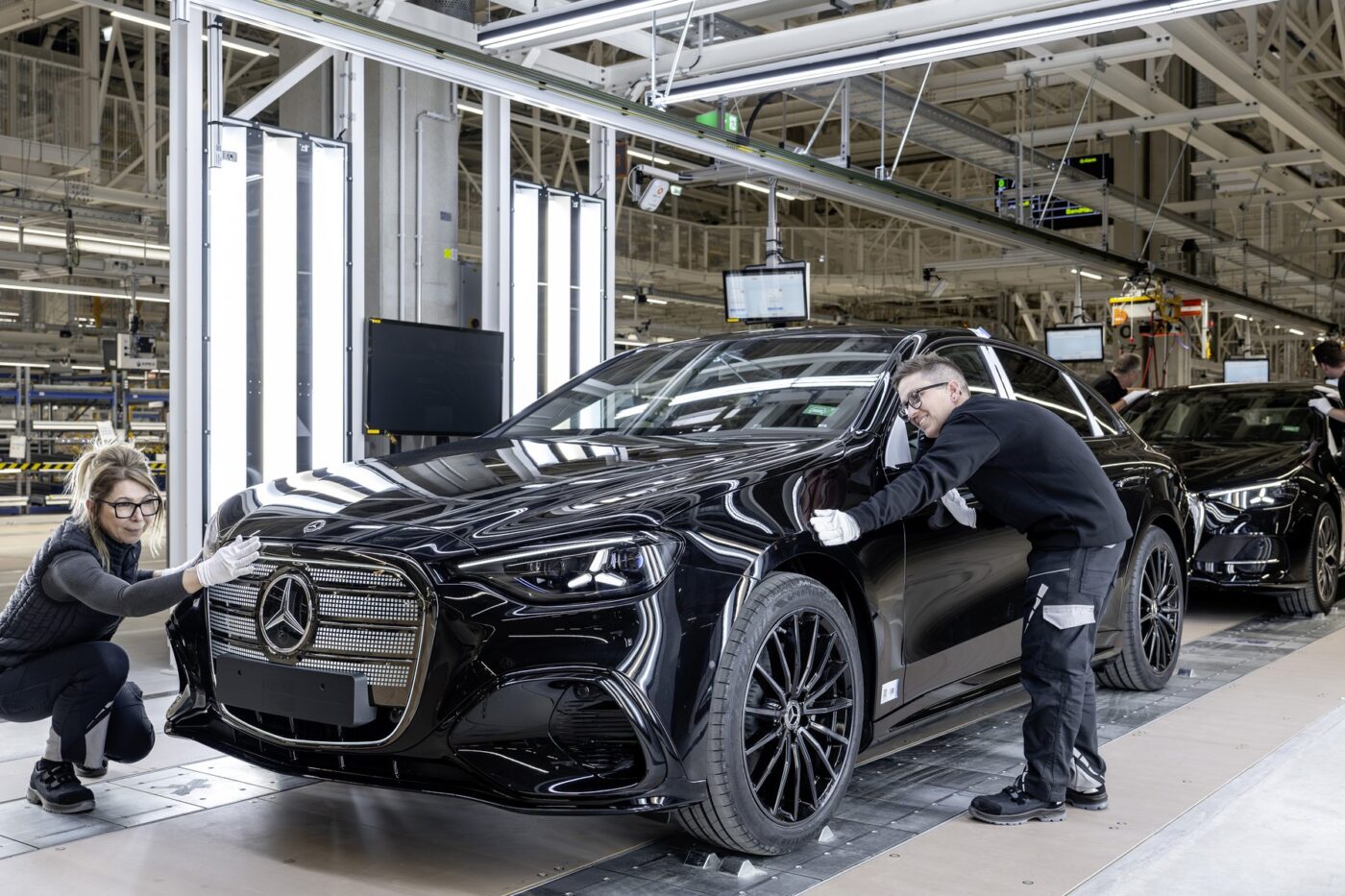
Mercedes-Benz has completed the expansion of its manufacturing plant in Kecskemét, Hungary, and has begun production of the new all-electric C-Class at the site. The automaker also confirmed that the upcoming compact G-Class will be produced exclusively at the Hungarian facility.
Following the expansion, the Kecskemét plant has become Mercedes-Benz’s largest manufacturing site in Europe within its global production network. The facility’s footprint has increased from 200 hectares to 440 hectares through an investment of approximately €1 billion.
The expansion includes new body and assembly halls, a second press shop, a paint facility and a battery assembly plant designed to increase production capacity and support the company’s transition to electric vehicles. Hungarian Prime Minister Péter Magyar attended the inauguration ceremony.
Electric C-Class Joins Production Line
The Kecskemét plant currently manufactures the A-Class and the battery-electric GLB. With the latest expansion, it has also become the first site outside Germany to produce the new all-electric C-Class, marking the first “Core” segment model to be built at the Hungarian facility.
Mercedes-Benz held a symbolic start of production for the model, which was unveiled globally in April. The electric C-Class is based on the company’s MB.EA-M platform and features an 800-volt electrical architecture.
The C400 4MATIC version is equipped with a 94-kilowatt-hour battery, supports charging at up to 330 kilowatts and delivers 360 kilowatts of power. The vehicle offers a driving range of up to 762 kilometres under the WLTP testing cycle.
Mercedes-Benz said key components, including body structures and traction batteries, are manufactured at the Kecskemét site, helping shorten supply chains and improve production efficiency.
Plant Dedicated to Electric Vehicle Manufacturing
The expanded facility adopts a dual-production strategy. Existing production lines can assemble both internal combustion engine and battery-electric vehicles, while the newly constructed production hall is dedicated exclusively to electric vehicle manufacturing.
Mercedes-Benz said the plant will operate as part of a flexible European production network alongside its facilities in Germany, allowing selected electric vehicle models to be manufactured at multiple locations depending on market demand.
Michael Schiebe, Member of the Board of Management of Mercedes-Benz Group AG responsible for Production, Quality and Supply Chain Management, said the investment strengthens the company’s manufacturing network.
“With the plant extension in Kecskemét, we are increasing the resilience and flexibility of our global production network.”
He added that the facility reflects the future of vehicle manufacturing through greater digitalisation, efficiency, quality and sustainability while supporting production of models including the electric C-Class and GLB.
Compact G-Class Confirmed for Hungary
Mercedes-Benz also confirmed that the forthcoming compact G-Class will be manufactured exclusively at the Kecskemét plant.
The new model is expected to be built on the company’s MMA platform for compact vehicles and will expand the G-Class lineup, which currently includes both conventional and battery-electric variants.
Although Mercedes-Benz has not disclosed the plant’s new annual production capacity, German media have reported that the expansion could increase output to between 300,000 and 400,000 vehicles per year, significantly strengthening the company’s manufacturing presence in Europe.