





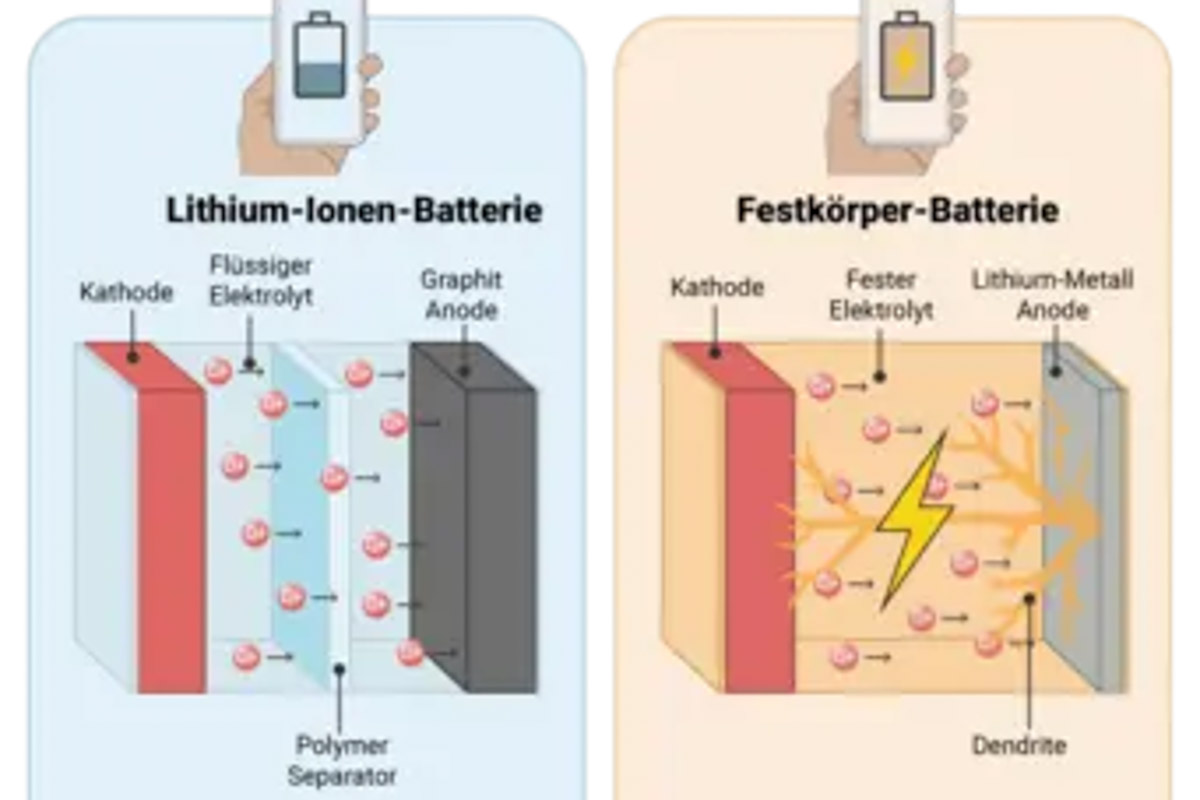
An interdisciplinary team at the Max Planck Institute for Sustainable Materials has identified the mechanism behind short circuits in solid-state batteries, offering new insights that could help improve the safety and durability of next-generation energy storage systems.
The findings, published in the journal Nature, focus on the role of dendrites—microscopic, tree-like lithium structures that can grow inside batteries and create internal short circuits. While dendrites are a known issue in conventional lithium-ion batteries using liquid electrolytes, they also pose a major challenge for solid-state designs.
The researchers examined how lithium metal, a relatively soft material, is able to penetrate the much harder ceramic electrolyte used in solid-state cells. “Although the electrodes and the forming dendrites consist of lithium metal, which is soft like a gummy bear, the dendrites are able to penetrate the ceramic electrolyte and lead to a short circuit,” said Yuwei Zhang, lead author of the study and research group leader at the institute.
To investigate the phenomenon, the team conducted experiments under controlled conditions, including vacuum environments and cryogenic temperatures, to eliminate external influences such as oxygen, moisture and measurement interference. Their results showed that lithium does not accumulate at the dendrite tip, contradicting one of the previously proposed explanations.
“The soft lithium metal is able to penetrate the stiff ceramic electrolyte, like a continuous water jet that penetrates a rock,” Zhang said. “We calculated that hydrostatic stress in the dendrite leads to brittle fracture of the solid electrolyte in the end.”
The study concludes that internal stress generated within the growing dendrites causes cracks in the ceramic electrolyte, allowing the structures to propagate and eventually connect the anode and cathode, triggering a short circuit.
The findings provide a basis for developing countermeasures to improve battery performance and safety. The institute outlined several potential strategies, including strengthening the electrolyte material to resist cracking, introducing microscopic cavities to redirect dendrite growth, and applying protective coatings to lithium electrodes to suppress dendrite formation.
The research highlights a key obstacle facing solid-state battery technology, which is widely viewed as a promising alternative to conventional lithium-ion systems due to its potential for higher energy density and improved safety.


