
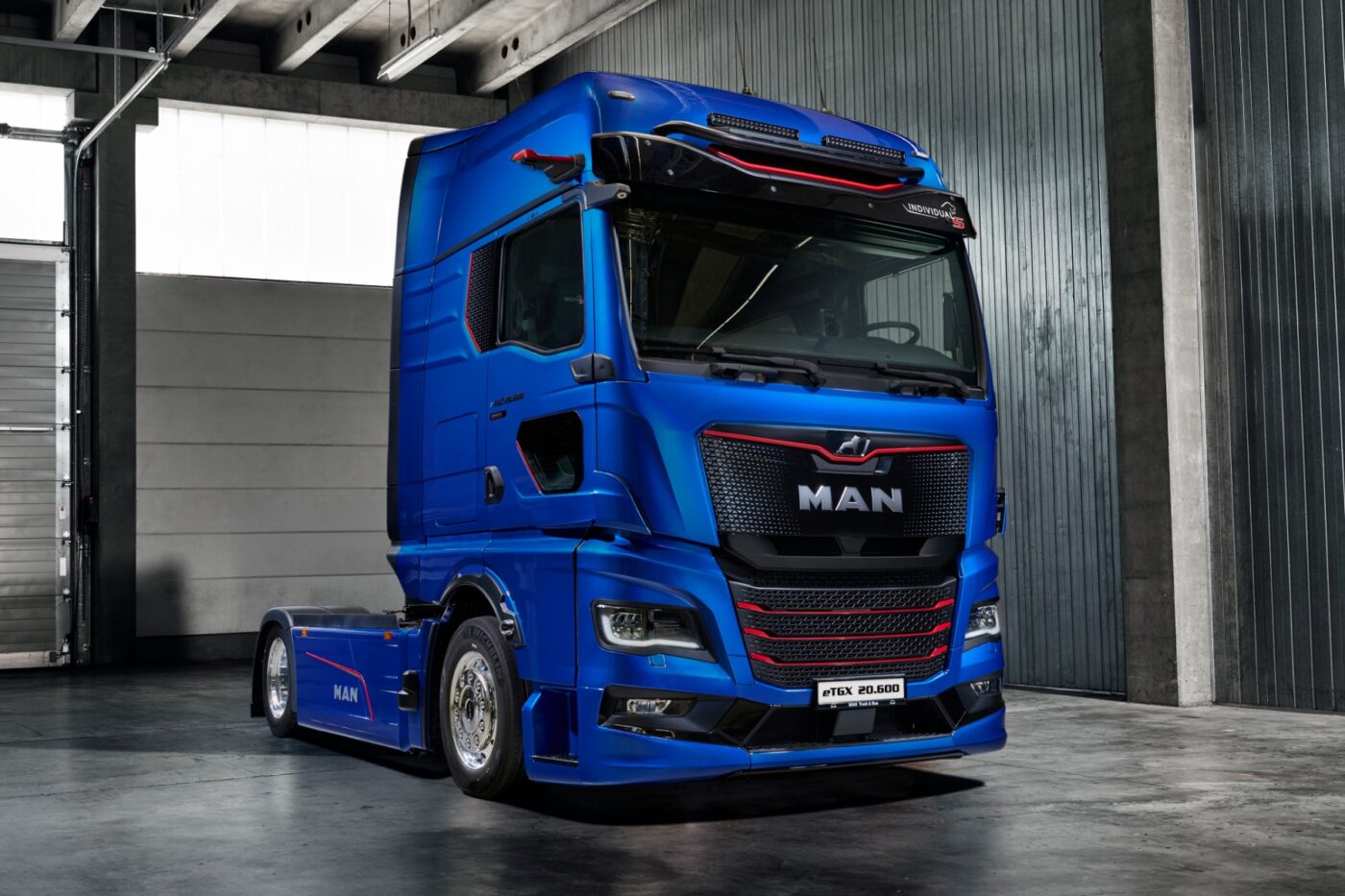
MAN has unveiled an updated version of its eTGX electric long-haul truck at IAA Transportation 2026 in Hanover, introducing a new battery generation, improved regenerative braking and aerodynamic changes that increase its claimed range to as much as 720 kilometres.
The Munich-based commercial vehicle manufacturer is presenting the revised eTGX less than two years after the first customer deliveries of the electric truck began at Porsche’s plant in Leipzig. The model is among 15 press releases MAN has issued for the September 15-20 transportation show.
New Battery Generation Raises Available Capacity
The updated MAN eTGX uses battery packs with 92 kWh of gross capacity and 88 kWh net, compared with 89 kWh gross and 80 kWh net for the previous generation. The NMC cell chemistry remains unchanged, while MAN continues to produce and assemble the batteries at its Nuremberg facility.
The higher-capacity packs also allow the eTGX tractor unit to accommodate a seventh battery pack. Previously, seven packs were available only on chassis configurations.
The seven-pack setup is available on a 6×2 tractor configuration, while the 4×2 version can carry up to six packs. MAN said the three-axle configuration is required for the highest battery configuration because of payload and axle-load considerations.
With seven packs, the MAN eTGX 6×2 has 644 kWh of gross battery capacity and 616 kWh net. MAN claims a maximum range of 720 kilometres, while more than 600 kilometres should be realistically achievable in typical long-haul operating conditions.
Range Gains Extend Across Configurations
The revised battery system also increases the range of the 4×2 tractor. Equipped with six battery packs, the configuration has 552 kWh gross and 528 kWh net capacity and can travel up to 660 kilometres, according to MAN.
The company expects well over 500 kilometres to be achievable under real-world conditions in typical long-haul operations.
MAN attributes the range improvement to more than battery capacity alone. Regenerative braking performance has been improved by up to 20%, while aerodynamic changes further reduce energy consumption.
The front of the truck has been extended by 120 millimetres. MAN said the additional length makes use of EU regulations allowing extra vehicle length for zero-emission vehicles and has been designed to improve aerodynamic efficiency and direct visibility.
“With the new MAN eTGX, we are taking the next major step on the path to decarbonising long-haul transport,” said Alexander Vlaskamp, Chairman of the Executive Board of MAN Truck & Bus in Germany.
“The combination of a new battery generation, even greater range, megawatt charging, and a vehicle design consistently focused on efficiency creates tangible economic added value for our customers in daily operations. At the same time, we are improving direct visibility and thus safety for all road users,” Vlaskamp said.
Megawatt Charging Available As Standard
MAN has also expanded the charging capabilities of the eTGX. Since July, the electric truck has been offered with a Megawatt Charging System connector as standard, enabling charging at up to 750 kW.
The truck can also charge at up to 375 kW using a conventional CCS connector.
The combination of higher battery capacity, increased recuperation and improved aerodynamics is intended to make the eTGX more suitable for long-distance operations while maintaining compatibility with high-power charging infrastructure.
Electric TGE Targets Specialised Applications
MAN is also using IAA Transportation to showcase two near-series electric versions of its TGE transporter developed with Swiss company Flux.
The TGE is currently offered with internal combustion powertrains and is closely related to the Volkswagen Crafter. The Flux-developed vehicles are aimed at applications where conventional electric vans have faced limitations, including emergency services, fire brigades and municipal operations.
The two vehicles displayed in Hanover have gross vehicle weights of 4.0 tonnes and 5.5 tonnes. The heavier version offers payload capacity of up to 2,500 kilograms, while towing capacity reaches up to 3,500 kilograms.
Both vehicles use a 119 kWh gross battery and have a claimed range of up to 480 kilometres. DC fast charging is supported at up to 140 kW, allowing the battery to charge from 10% to 80% in less than 30 minutes.
The vehicles were developed for specialised applications requiring features such as higher gross vehicle weight, all-wheel drive and electrically powered auxiliary equipment.
“The presentation at IAA Transportation demonstrates how we are advancing electrification even for particularly demanding transport and special applications,” said Daniel Holbein, Head of Business Unit Van at MAN in Germany.
“Our goal is to offer customers practical solutions with high operational capability. Together with our development partner Flux, we gain important insights from direct exchange with customers,” Holbein said.
Next-Generation eTGE Under Development
MAN is separately working with Volkswagen Commercial Vehicles on the next generation of the MAN eTGE, which was discontinued in 2024.
The company said its cooperation with Volkswagen Commercial Vehicles remains an important part of TGE product development across different powertrain types. A successor to the eTGE is expected to arrive alongside the next Volkswagen e-Crafter, with both models likely to launch no earlier than 2028.