




Indian automaker Mahindra is developing a new nationwide fast-charging network under the ‘Charge_IN’ brand as it seeks to support rising electric vehicle sales and expand adoption across long-distance travel routes. The company plans to install 250 fast chargers and provide access to more than 1,000 charging points across India by 2027, according to a company announcement.
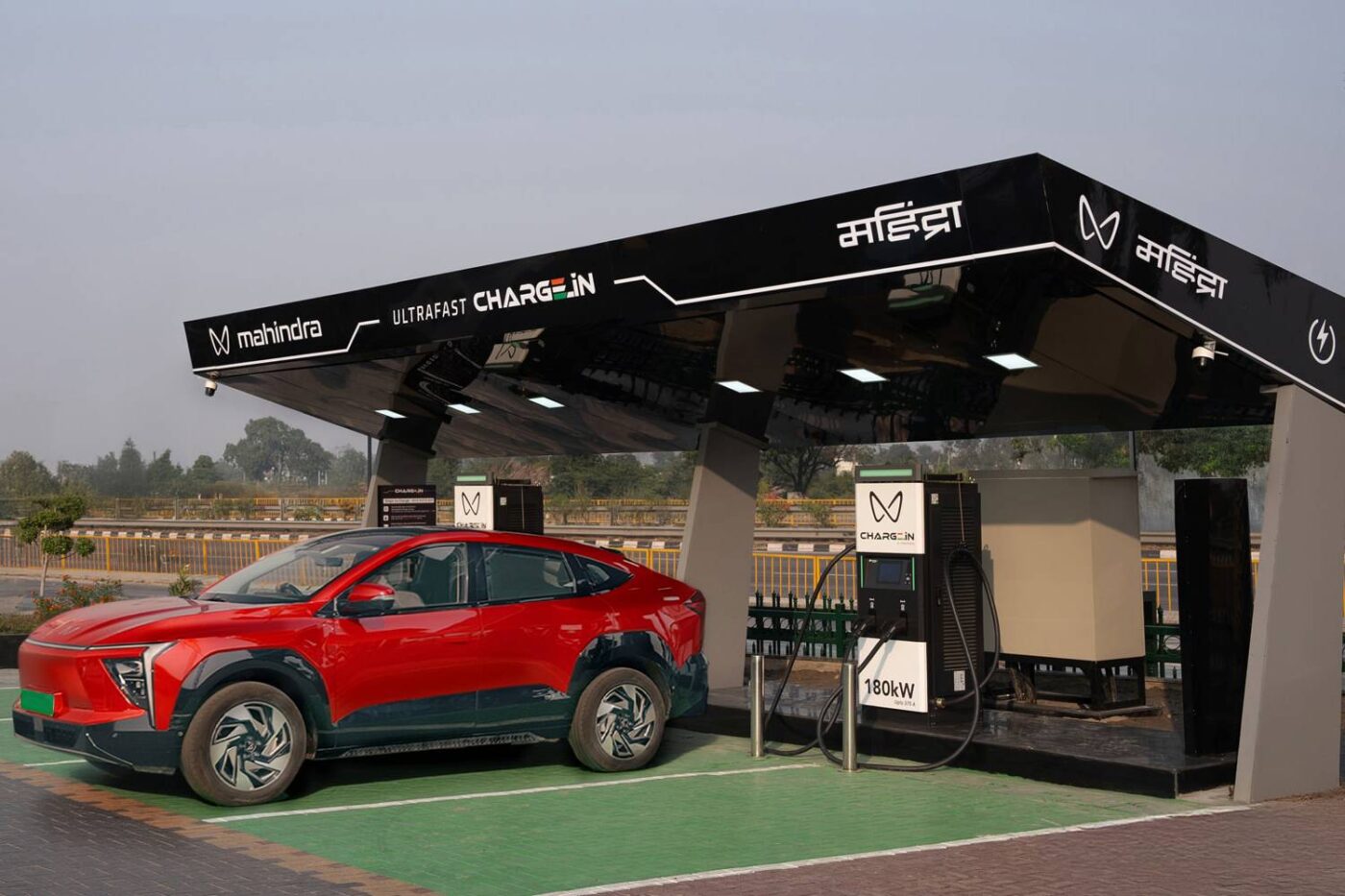
Mahindra said the Charge_IN stations will be deployed primarily along major highway corridors, located close to roadside amenities such as cafés and restaurants. Each site will be equipped exclusively with 180 kilowatt dual-gun DC fast chargers, designed to enable electric vehicles to recharge from 20% to 80% state of charge in about 20 minutes under optimal conditions. The network will operate as an open-access platform, allowing EVs from other manufacturers to use the chargers as well.
See also: Mahindra Reveals Limited Batman-Inspired BE 6 Electric SUV
“Our aim is to make long-distance travel with an electric vehicle effortless and reliable like conventional driving, thereby building customer confidence and accelerating India’s transition to electric mobility,” said Nalinikanth Gollagunta, chief executive of Mahindra & Mahindra’s Automotive Division and executive director of Mahindra Electric Automobile.
The company has already commissioned the first two Charge_IN locations: one in Hoskote, Karnataka, along the Bengaluru–Chennai highway (NH 75), and another in Murthal, Haryana, roughly 50 km north of New Delhi. Each site features two 180 kW dual-gun chargers, allowing up to four vehicles to charge simultaneously.
See also: Mahindra Racing Reveals Striking New Metallic Red and White Livery for 2025/26 Formula E Season
Mahindra currently sells three electric passenger vehicles in India — the XUV400, BE 6 and XEV 9e — with a fourth model, the XEV 9S, expected to join the portfolio. The newer BE 6 and XEV 9e models are built on a dedicated skateboard EV platform and are engineered to fully utilize high-power fast charging, unlike the XUV400, which is based on a modified internal combustion platform. Mahindra said the rapid expansion of charging infrastructure is intended to reinforce the practicality of its electric models relative to its conventional vehicle range.


