

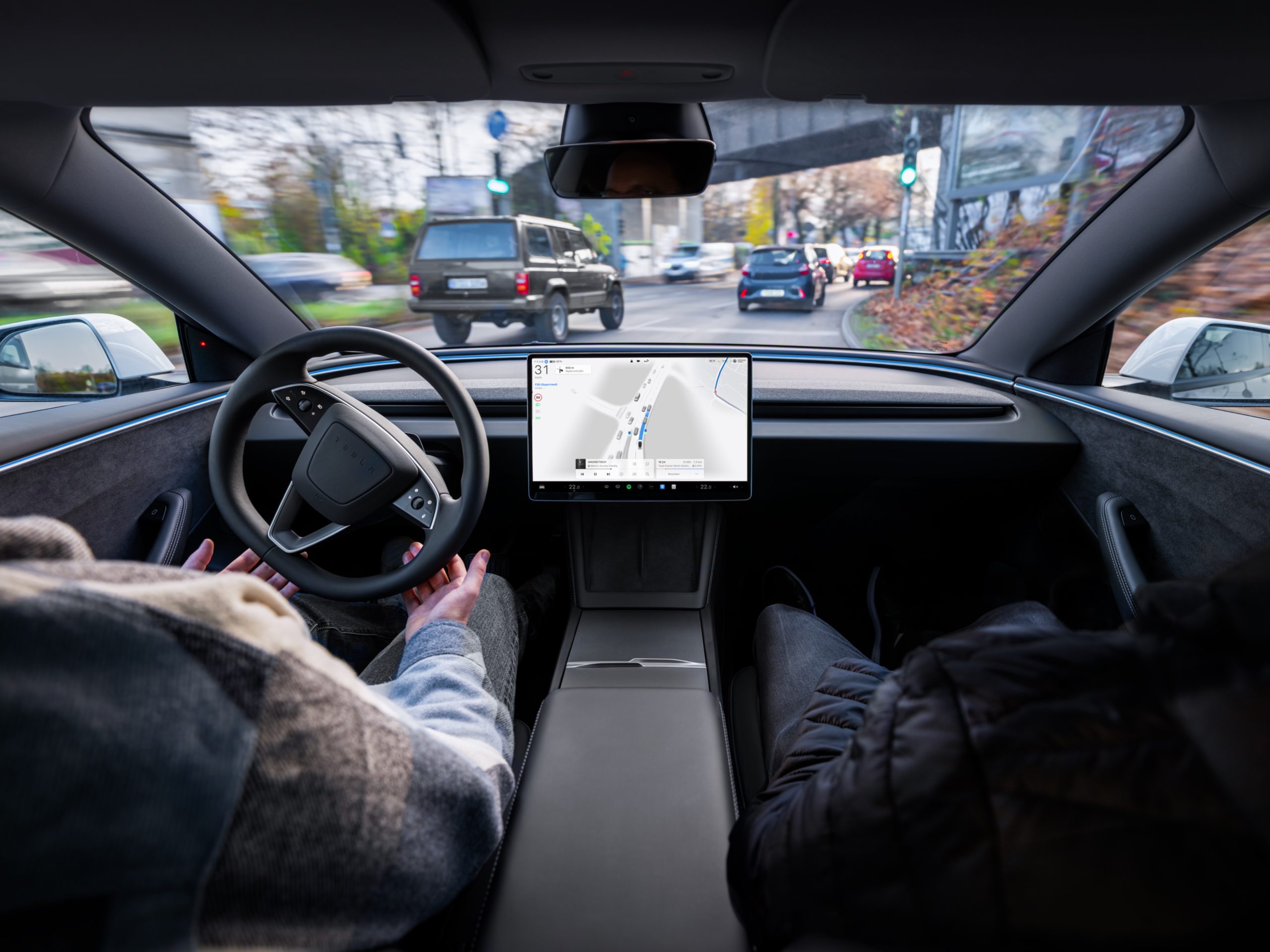
Li Auto has openly acknowledged Tesla’s leadership in autonomous driving technology, with a senior executive describing the US automaker as the industry’s strongest competitor and confirming that the company is using Tesla’s Full Self-Driving (FSD) system as a key benchmark for future development.
Speaking at a recent event, Li Auto’s head of autonomous driving research and development, Zhan, revealed that industry insiders returning from Silicon Valley had repeatedly shared the same assessment with both him and Li Auto Chief Executive Officer Li Xiang: Tesla remains ahead in intelligent driving technology.
Silicon Valley trip highlights technology gap
To validate those claims firsthand, Zhan traveled to Silicon Valley in May 2026 and spent two weeks extensively testing Tesla’s latest FSD V14.3 software, which was released in April.
According to Zhan, the experience reinforced Tesla’s technological strengths and highlighted the challenge facing Chinese automakers seeking to compete in advanced driver-assistance systems.
“Tesla’s technical depth is real, and the pressure to catch up becomes very tangible once you experience it firsthand.”
Zhan said confronting the gap is important because it forces companies to focus on the industry’s strongest competitor rather than becoming distracted by domestic competition alone.
“Feeling that pressure means you are looking the strongest rival on this planet in the eye, rather than comforting yourself through local competition,” he said.
Catching Tesla remains the first goal
Following his return from the United States, Li Auto reportedly organized an extensive review involving its core autonomous driving and algorithm teams.
Zhan emphasized that mastering and matching Tesla’s current technological capabilities remains the essential first step before any attempt to move beyond them.
“Fully understanding and catching up with Tesla’s capabilities is the prerequisite for eventually surpassing them,” he said.
The comments come as competition among China’s smart driving developers intensifies, with domestic automakers investing heavily in proprietary software, chips, sensors, and artificial intelligence technologies.
Tesla expands FSD presence in China
Tesla’s growing presence in China has further intensified the race.
In May, Tesla announced on social media platform X that its FSD Supervised system had become available in several international markets, including China.
The announcement marked the first formal confirmation from Tesla that its advanced driving software had entered the world’s largest automotive market, although the company has yet to disclose extensive details regarding rollout plans and functionality.
The move has prompted Chinese manufacturers to accelerate development of their own intelligent driving systems in an effort to narrow the technology gap.
Li Auto outlines autonomous driving roadmap
At the same event, Li Auto provided updates on its smart driving strategy for the remainder of 2026.
Zhan said the company’s in-house vision-language-action model, known as Mach VLA, will receive a major upgrade during the third quarter and be deployed across all vehicles equipped with AD Max hardware.
He added that by the fourth quarter, the company expects Mach VLA’s full-scenario driving capabilities to reach parity with Tesla’s FSD V14 system.
Li Auto’s flagship Li L9 Livis currently operates with the Mach VLA 2.1 platform.
The vehicle is powered by Li Auto’s proprietary Mach M100 autonomous driving chip, which delivers 1,280 TOPS of computing power per processor. In dual-chip configuration, total computing performance reaches 2,560 TOPS.
Chinese rivals also targeting Tesla
Li Auto is not alone in publicly comparing its autonomous driving technology to Tesla’s.
Xpeng Chairman and Chief Executive Officer He Xiaopeng has previously stated that the company’s vision-language-action driving system is expected to match the overall performance of Tesla’s FSD V14.2 in Silicon Valley by August 2026.
He has personally traveled to Silicon Valley on two occasions to evaluate Tesla’s technology and recently described the latest version of FSD as offering a reassuring experience approaching Level 4 autonomous driving capability.
Autonomous driving becomes key battleground
As China’s electric vehicle market becomes increasingly competitive, intelligent driving technology is emerging as one of the industry’s most important differentiators.
While price competition remains intense, automakers are also racing to improve software capabilities, autonomous driving performance, and AI-powered vehicle experiences.
Tesla’s continued influence in the sector suggests that despite the rapid progress made by Chinese EV manufacturers, the company remains the benchmark many rivals are striving to match.
Whether domestic players such as Li Auto and Xpeng can close the remaining gap over the next year may become one of the most closely watched developments in the global autonomous driving industry.
Source: CnEVPost