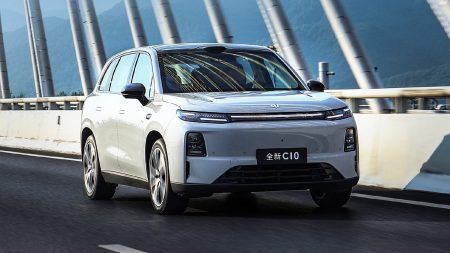




Li Auto has reached a significant milestone in the development of its in-house autonomous driving chip, the M100, moving closer to mass production as Chinese electric vehicle (EV) makers increasingly focus on proprietary technology, according to LatePost reports.
The M100 chip completed prototype production in the first quarter of 2025 and subsequently passed functional and performance testing within two weeks. The chip has already been installed in small batches on prototype vehicles for road testing.
The M100 is reported to provide computing power equivalent to two Nvidia Thor-U chips for tasks involving large language models and approximately three Thor-U chips for vision-based tasks such as image recognition using convolutional neural networks. Li Auto plans to begin mass production and vehicle integration of the chip next year, while continuing to rely on Nvidia and China’s Horizon Robotics for existing models.
Li Auto follows domestic peers Nio and Xpeng, which have already deployed their in-house chips. Nio’s Shenji NX9031 chip, launched in December 2023, is used in its ET9 sedan and selected models, while Xpeng’s Turing AI chip powers the G7 SUV and next-generation P7 sedan, with high-performance variants equipped with multiple chips delivering over 2,200 TOPS of computing power.
Li Auto has invested billions of dollars into the M100 project, covering hardware and software development, including neural processing units and system-on-chip technology. The company has focused on maximizing chip performance through integrated hardware-software strategies, with its CTO leading the R&D effort to optimize computing power and performance for autonomous driving applications.
The development of the M100 chip underscores the growing emphasis among Chinese EV manufacturers on controlling critical autonomous driving technologies amid intensifying industry competition and evolving market demands.