
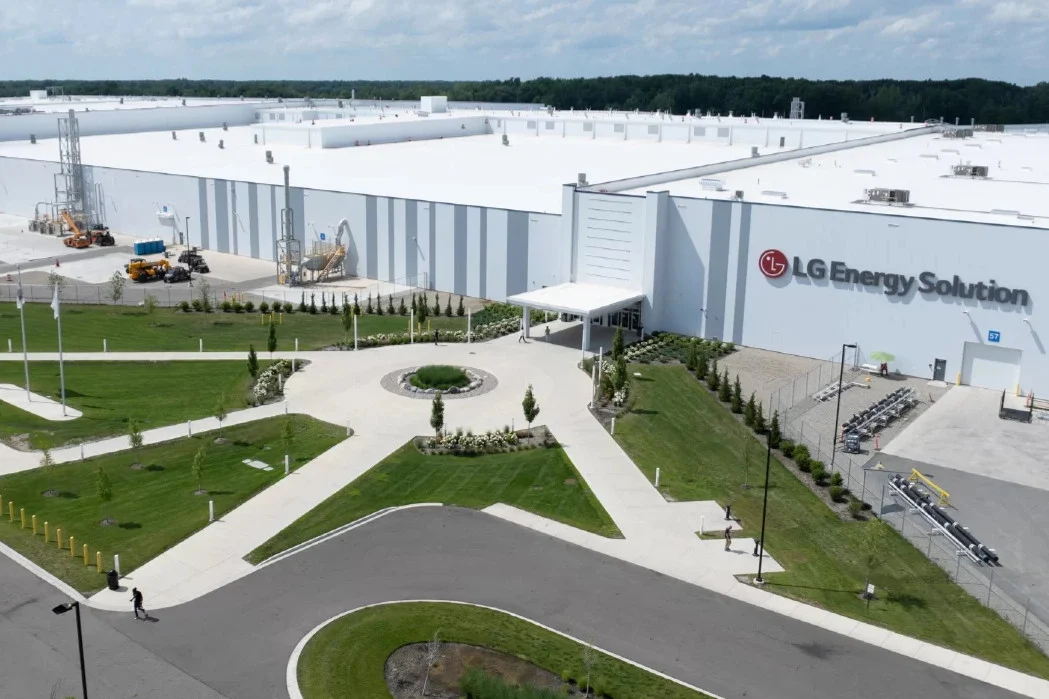
LG Energy Solution has started production at its battery plant in Lansing, Michigan, converting a facility originally planned as the third battery factory for the General Motors-LG Energy Solution joint venture into a multi-customer site serving electric vehicles and stationary energy storage.
The 91.5-hectare facility is expected to reach annual production capacity of more than 35 GWh at full capacity. LGES said it has invested more than $2 billion in the site since 2022. The plant currently employs around 900 people, with the workforce expected to increase to as many as 1,700.
LG Energy Solution Expands Nanjing Battery Output as Tesla Demand Grows
Lansing Facility Changes From GM Project to LGES Plant
The Lansing factory was initially intended to operate under Ultium Cells, the battery joint venture between General Motors and LGES. GM announced toward the end of 2024 that it would sell its stake in the nearly completed facility to LGES as it adjusted battery production capacity in response to EV market developments.
The decision did not affect the Ultium Cells facilities in Ohio and Tennessee. LGES completed the acquisition of the Lansing site in May 2025, when construction was already 98% complete, according to the company.
Since taking full ownership, LGES has reconfigured the facility to support customers beyond GM and to manufacture batteries for different applications.
LG Energy Solution, Honda Partner With Hanoi on Electric Motorcycle Battery Swapping Pilot
Toyota to Receive NMC Cells From Lansing
Toyota transferred an existing battery order with LGES to the Lansing plant in early 2025, providing the facility with an automotive customer following GM’s exit.
LGES plans to manufacture NMC cells containing nickel, manganese and cobalt for Toyota. One intended application is the all-electric Toyota Highlander for the 2027 model year.
The three-row electric SUV is planned for production at Toyota’s Georgetown, Kentucky, plant. Toyota has said its battery modules for the Highlander will be assembled at its battery facility in North Carolina, creating a supply chain that links LGES cell production in Michigan with module assembly and vehicle manufacturing at other U.S. facilities.
LG Energy Solution Secures Over 100 GWh Cylindrical Cell Orders, BMW Seen as Likely Customer
LFP Cells Support Stationary Energy Storage
LGES has already begun producing lithium iron phosphate, or LFP, cells at Lansing for stationary energy storage systems.
LG Energy Solution Vertech, the company’s U.S. subsidiary, will integrate the cells into complete energy storage systems for energy suppliers and commercial and industrial customers. Detroit-based DTE Energy is among the future customers identified for the systems.
The Lansing facility will therefore manufacture two different battery chemistries for separate applications. NMC cells will support automotive applications where energy density, weight and packaging are important, while LFP cells are intended for stationary storage applications where cost, lifespan and cycling capability are key considerations.
LG Energy Solution Launches Entry Into SDVerse Software Marketplace With Battery Solutions
Tesla to Source Lansing LFP Cells in 2027
Tesla is expected to begin sourcing LFP cells from Lansing in 2027 under a supply agreement announced by LGES in 2025.
The agreement covers prismatic LFP cells and is valued at approximately $4.3 billion. The U.S. government confirmed in March 2026 that Tesla was the customer associated with the contract.
The cells are expected to be used for stationary storage applications, including Tesla’s Megapack 3, which is planned for production in Houston, Texas.
The agreement expands the Lansing facility’s role beyond automotive batteries and gives LGES additional exposure to the stationary energy storage market.
LGES Expands North American Energy Storage Capacity
Lansing is part of LGES’s wider expansion of LFP battery manufacturing for energy storage in North America.
LG Energy Solution Said to Shift Tesla Cathode Supply From LG Chem to L&F
The company aims to establish more than 50 GWh of LFP production capacity for stationary storage by the end of 2026 across three company-owned facilities and two jointly operated sites in the region. LGES expects about 80% of its global ESS production capacity to be located in North America at that point.
The Lansing plant’s combination of Toyota’s future EV battery demand and existing and planned energy storage programs gives the facility a broader production base than originally envisioned under the Ultium Cells structure.