



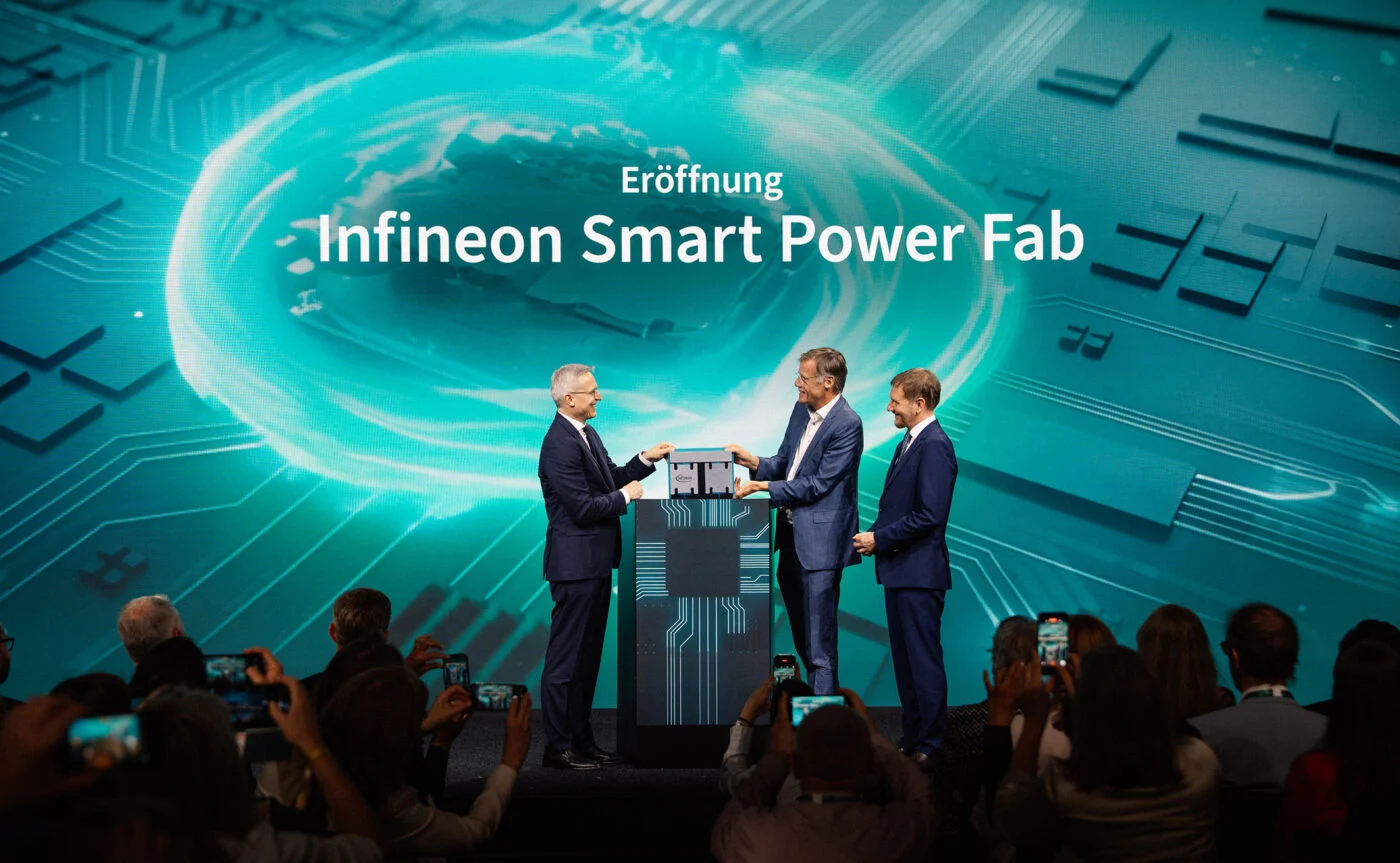
Infineon Technologies has officially opened its Smart Power Fab in Dresden, Germany, completing the company’s largest single investment to date with a project valued at €5 billion.
The advanced semiconductor facility will manufacture power semiconductors and analog/mixed-signal chips used in electric vehicles, renewable energy systems, industrial applications and artificial intelligence infrastructure.
Expanding Semiconductor Capacity
The Smart Power Fab began operations several months ahead of schedule and doubles Infineon’s production capacity for power semiconductors and analog/mixed-signal technologies at its Dresden campus.
The project has created approximately 1,000 new jobs and significantly expands the company’s manufacturing capabilities for next-generation semiconductor devices.
According to Infineon, the chips produced at the new facility will support applications including battery-electric vehicles, software-defined vehicles, charging infrastructure, wind and solar energy systems, and power supplies for AI data centers.
Chief Executive Officer Jochen Hanebeck said the expansion comes at a critical time for growing demand.
“We’re opening our new plant at just the right time. Our Smart Power Fab is creating urgently needed capacities for the key technologies of the future, for everything from energy supply for AI data centers to software-defined vehicles and renewable energies.”
Digital Manufacturing and Efficient Operations
Infineon designed and constructed the facility using digital engineering technologies, including digital twins that supported planning and development throughout the project.
Artificial intelligence is also being used to streamline equipment qualification and manufacturing process approvals.
The new fab operates as part of Infineon’s “One Virtual Fab” network with its semiconductor facility in Villach, Austria, enabling production sites to share manufacturing processes and accelerate product qualification.
The company said the integrated approach can reduce production ramp-up times by roughly 50% compared with previous manufacturing methods.
Supporting Sustainability
The Smart Power Fab has also been designed to improve resource efficiency.
Chip production operates without relying on natural gas, while approximately 90% of process water is recycled back into manufacturing operations.
In addition, up to 45% of the energy consumed during production is recovered and reused, helping lower the facility’s overall environmental footprint.
Strengthening Europe’s Chip Industry
The Dresden project forms part of the European Union’s broader effort to expand domestic semiconductor manufacturing under the European Chips Act.
Earlier this year, the European Commission approved up to €920 million in German state aid to support the facility’s development.
The factory incorporates a flexible 300-millimeter production line capable of manufacturing multiple semiconductor technologies on shared equipment with minimal reconfiguration.
Infineon expects the Smart Power Fab to strengthen Europe’s semiconductor supply chain while supporting growing demand for power electronics across the automotive, industrial, renewable energy and artificial intelligence sectors.