
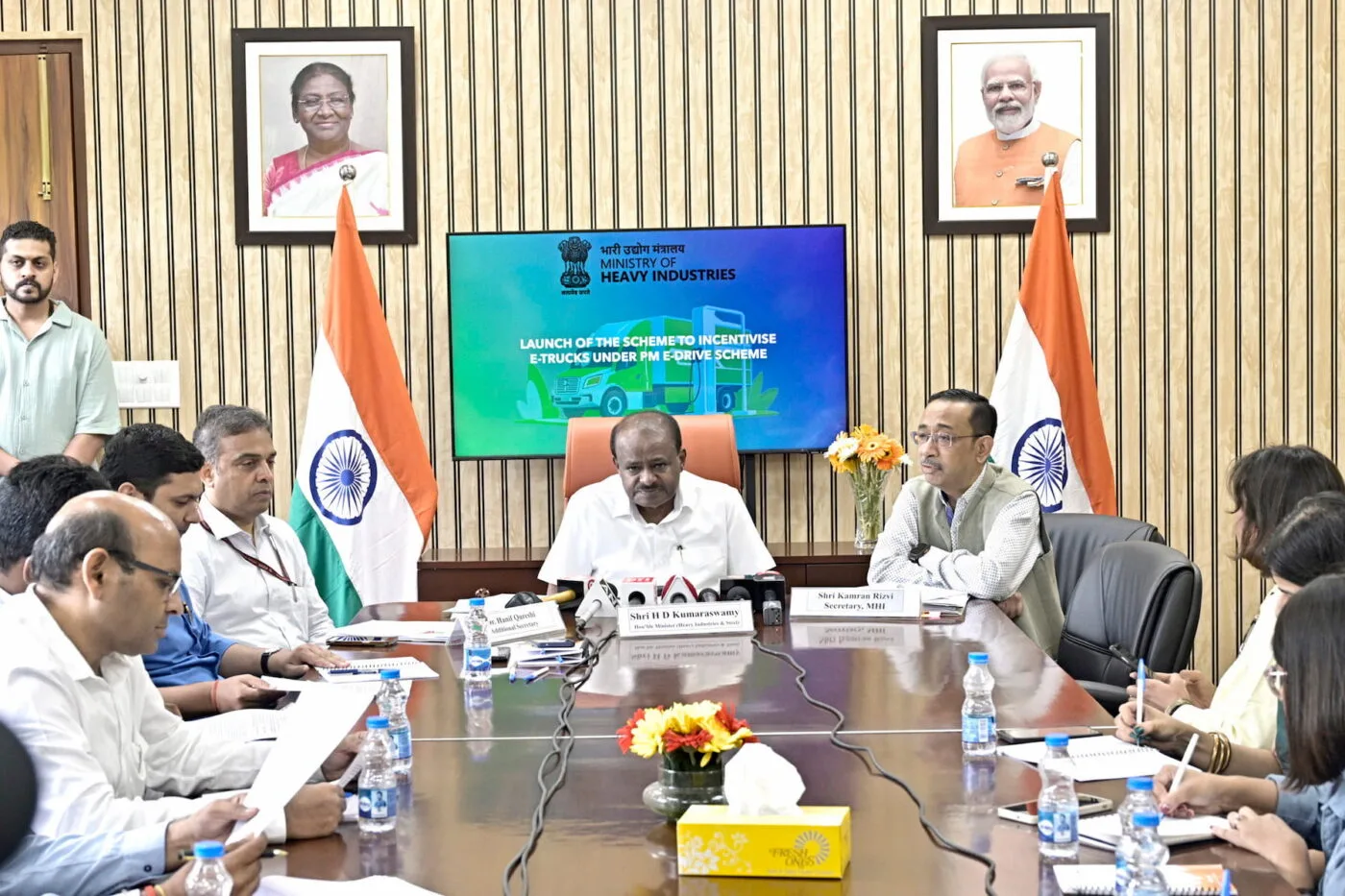
India’s Ministry of Heavy Industries (MHI) has earmarked ₹5 billion (approximately €50 million) to subsidise electric trucks under the recently launched PM E-Drive scheme, marking the country’s first direct incentive programme for the sector.
The allocation represents nearly five percent of the scheme’s total ₹109 billion (€1.1 billion) budget and is expected to support the deployment of 5,643 electric trucks during the 2025-26 fiscal year, including 1,100 units in Delhi, which faces persistent air quality challenges.
To qualify for the subsidy, electric trucks must have an ex-factory price of no more than ₹12.5 million. The incentive amount will be calculated based on gross vehicle weight, with the lowest value among three limits applied: ₹5,000 per kWh, 10% of the ex-factory price (excluding trailer costs), or a capped subsidy ranging from ₹270,000 to ₹960,000.
In line with the government’s ‘Make in India’ initiative, MHI has established localisation requirements for key components such as the high-voltage battery pack, vehicle control unit, traction motor, DC–DC converter, and CCS2 charging inlet. These rules will take effect on September 1, with stricter localisation standards, including mandatory domestic sourcing of the battery management system, set for March 2026.
The ministry has also issued minimum quality and performance standards for electric trucks, covering driving range, energy consumption, top speed, acceleration, and gradeability. Additionally, OEMs must provide warranties of five years or 500,000 km for the battery, and five years or 250,000 km for the motor and the truck itself.
Subsidies will be disbursed as an upfront discount at the time of purchase, with reimbursement to manufacturers processed through the PM E-Drive portal.
As part of the broader push toward electrification, the Steel Authority of India Limited (SAIL) has committed to procuring 150 electric trucks by 2027 and will ensure that electric vehicles make up at least 15% of the fleet it hires across its facilities.