

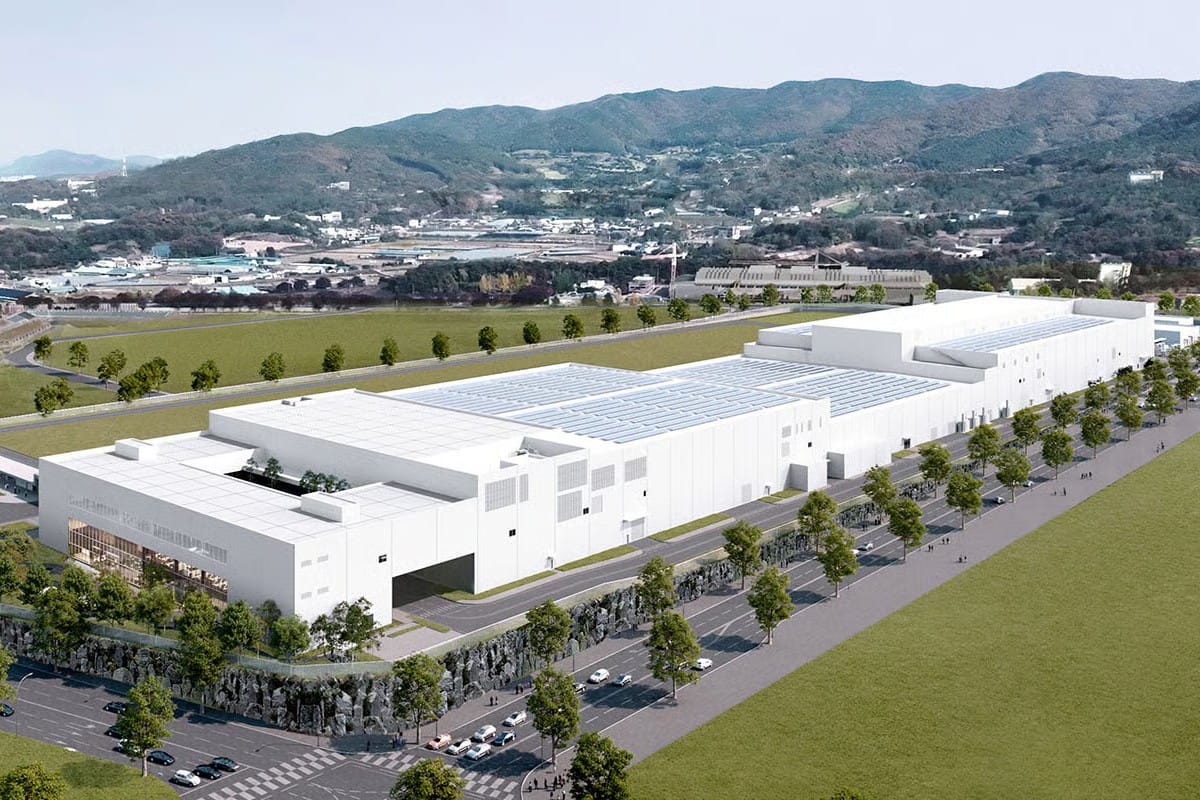
Hyundai Motor Group has marked the topping-out of its Future Mobility Battery Campus in Anseong, South Korea, a major step in building what it says will be its first comprehensive research and development hub dedicated to battery technology, with full completion targeted for the end of 2026.
The group broke ground on the campus in January 2025 and is investing about 1.2 trillion won ($about 700 million) in the project, according to company officials. The facility covers nearly 20 hectares and will have a total floor area of about 111,000 square metres. Hyundai said the site will be equipped with next-generation battery research infrastructure to support the development and validation of advanced battery technologies.
See also: Hyundai Motor Group and Michelin Sign New Deal to Develop Next-Gen EV Tires
Hyundai’s existing R&D centres in Namyang and Uiwang currently focus on battery materials, cell design and early-stage process technologies. Under the new structure, those functions will continue at the existing sites, while the Anseong campus will focus on continuous process validation under production-like conditions. Key functions will include the replication of real-world battery cell production processes, integrated testing for safety, quality and scalability, lifecycle testing from cell to vehicle integration, development of high-performance lithium-ion batteries for electric vehicles (EVs) and extended-range electric vehicles (EREVs), and the application of artificial intelligence and big data for battery optimisation.
The company said the campus is also intended to serve as a collaborative platform with battery manufacturers across the value chain, aimed at accelerating the development of new technologies and reducing risks associated with scaling production. “Through the Future Mobility Battery Campus, we aim to seamlessly connect the entire battery ecosystem to foster cross-industry collaboration and accelerate technological advancement,” said Heui Won Yang, President and Head of the Research and Development Division at Hyundai Motor Group. “We are committed to strengthening Hyundai Motor Group’s EV battery competitiveness and advancing global electrification through strategic collaborations.”
See also: Hyundai Targets 3-Minute Charging as Automaker Develops Faster 400 kW EV Systems
During the topping-out ceremony, Hyundai signed a letter of intent with Gyeonggi Province, Anseong City and the Gyeonggi Housing and Urban Development Corporation to support the creation of a regional battery industry cluster. However, the automaker has not confirmed whether battery cell production will take place at the site. The Korea Economic Daily previously reported, citing industry sources, that Hyundai has been considering in-house battery cell production from 2027, potentially starting with pilot lines with annual capacity of 1–2 GWh focused on nickel-cobalt-manganese (NCM) batteries. That information remains unconfirmed.
Separate media reports have also suggested Hyundai is nearing completion of a pilot solid-state battery line at its Uiwang research facility, though the company has not publicly verified those claims. For now, Hyundai has positioned the Anseong campus primarily as a research, validation and collaboration hub to underpin its long-term electrification strategy.