
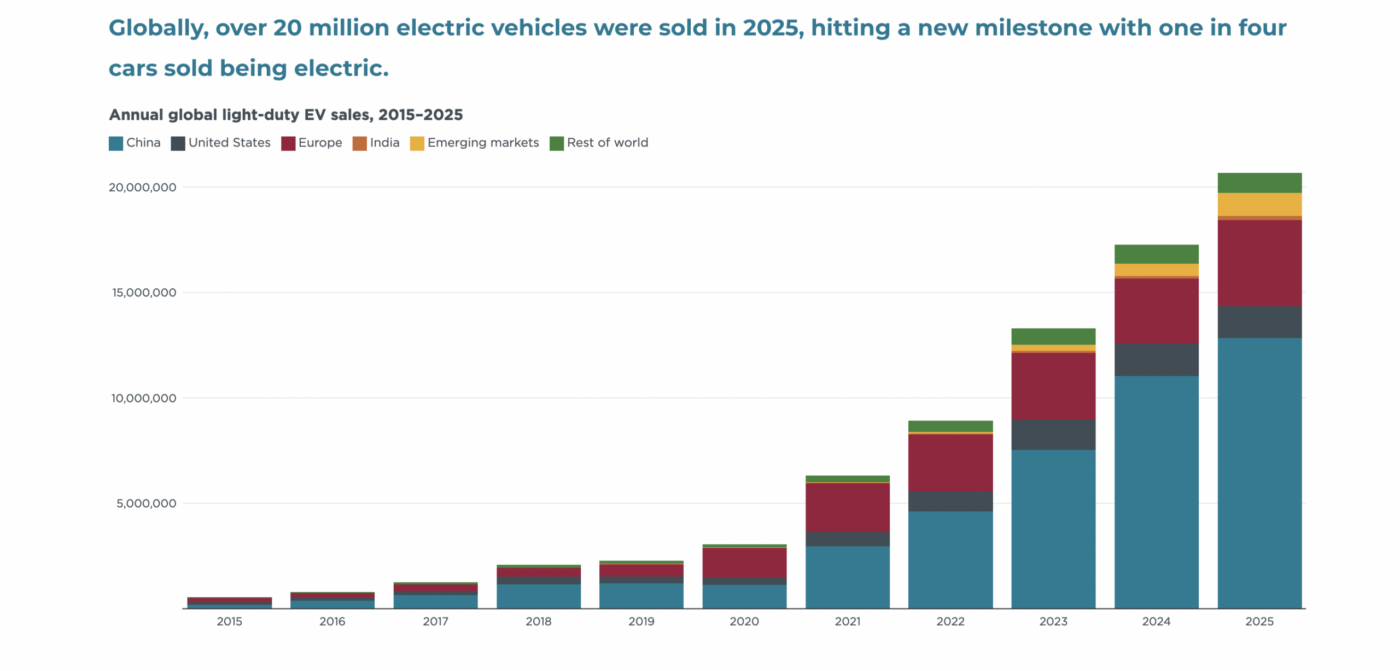
More than 20 million battery-electric and plug-in hybrid vehicles were sold globally in 2025, with emerging economies increasingly contributing to the expansion of the electric vehicle market, according to a report by the International Council on Clean Transportation.
The ICCT said roughly one in four new light-duty vehicles sold worldwide last year was either a battery-electric vehicle (BEV) or plug-in hybrid electric vehicle (PHEV).
China remained the world’s largest electric vehicle market, accounting for 62% of global light-duty EV sales and 71% of worldwide production, the report said.
“China remained the world’s leading EV market, representing 62% of all global light-duty electric sales and capturing 71% of global production,” the ICCT said in its Global Market Monitor for Light-duty Vehicles report.
The study covers passenger vehicles and light commercial vehicles including vans, pickups and transporters across major automotive markets and eleven emerging economies.
In Europe, electric vehicle sales reached around 4.1 million units in 2025, up 33% from the previous year, according to the report.
Battery-electric vehicles accounted for a significantly larger share of the European market than plug-in hybrids, representing 18% and 9% of total vehicle sales respectively.
In India, EV sales rose to around 202,000 units in 2025 from 125,000 a year earlier, with battery-electric models accounting for 99% of sales.
The ICCT said India’s EV market share reached 4.1%, supported by government incentives, tax reductions and expanding domestic manufacturing capacity.
Tata Motors led the Indian battery-electric vehicle market with sales of around 64,000 units.
“National and state policies supported growth in the electric LDV market in India in 2025, alongside the continued development of domestic EV manufacturing capacity,” the report said.
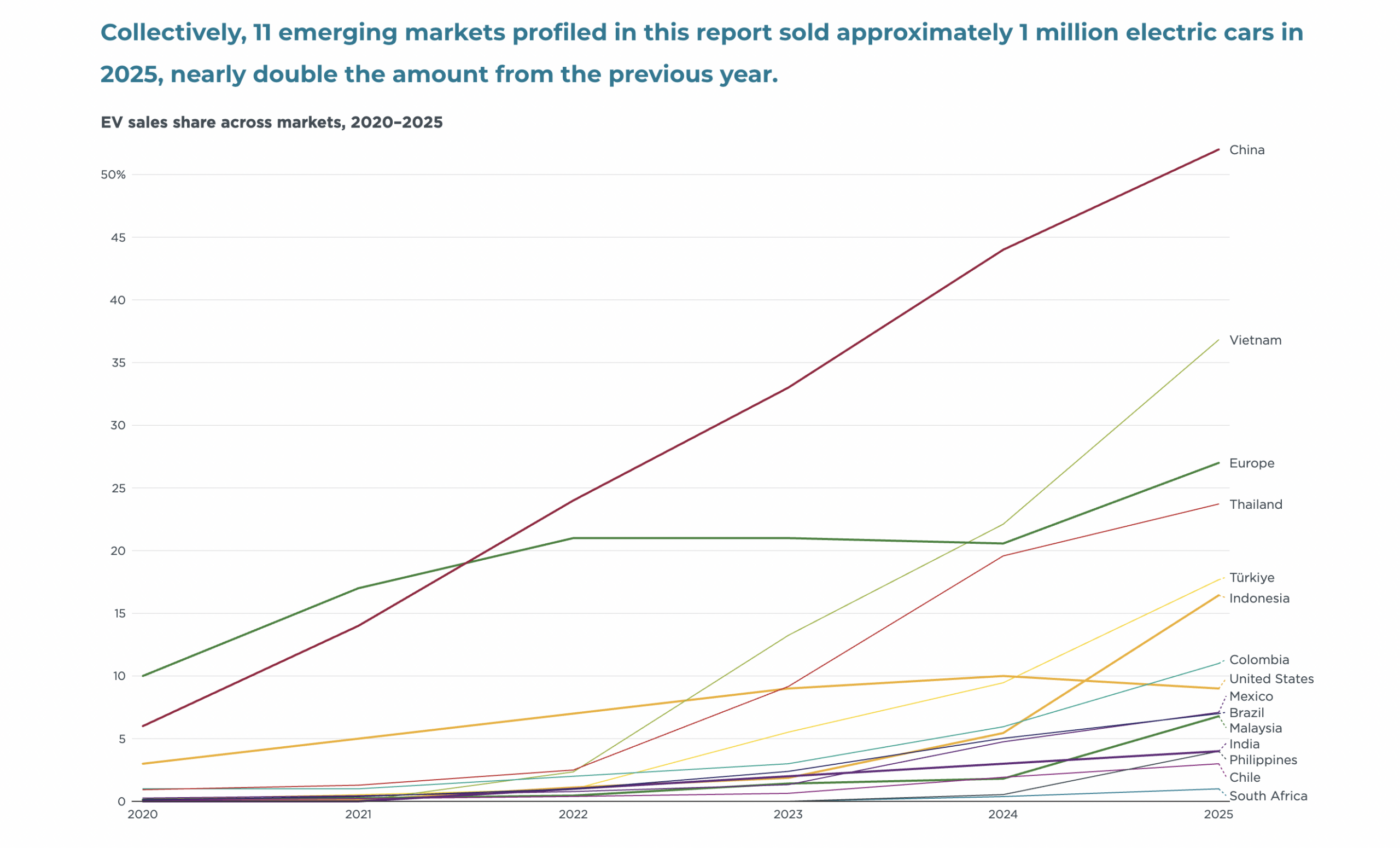
The United States was the only major market to record a decline in EV penetration, according to the study.
Plug-in vehicles represented around 9% of U.S. passenger car and light commercial vehicle sales in 2025, down from 10% in 2024.
The ICCT said the decline was partly linked to reduced investments by automakers and changing policy conditions.
“This was driven in part by automakers’ investment pullbacks and a shift away from EVs in response to the changing policy landscape,” the report said.
European manufacturers continued to hold strong positions in the U.S. EV market, led by Volvo Cars, BMW, Mercedes-Benz and Volkswagen.
The report also highlighted rapid growth across eleven emerging markets, which collectively recorded around one million BEV and PHEV sales in 2025, nearly double the previous year’s total.
Vietnam recorded the highest EV market share among those economies at 37%, followed by Thailand at 24%, Turkey at 18%, Indonesia at 16% and Colombia at 11%.
Battery-electric vehicles dominated sales in Vietnam, Indonesia and Malaysia, while plug-in hybrids gained greater importance in Latin America, South Africa and the Philippines.
Chinese automakers continued expanding their presence in emerging markets, particularly BYD, which maintained leading market shares in Brazil, Indonesia and Colombia.
The ICCT also pointed to domestic manufacturers including VinFast and Togg as contributors to EV growth in emerging markets.
“Rapid growth in these emerging markets is attributable to an increase in domestic manufacturing, growing access to affordable models, and consistent policy support,” the report concluded.