



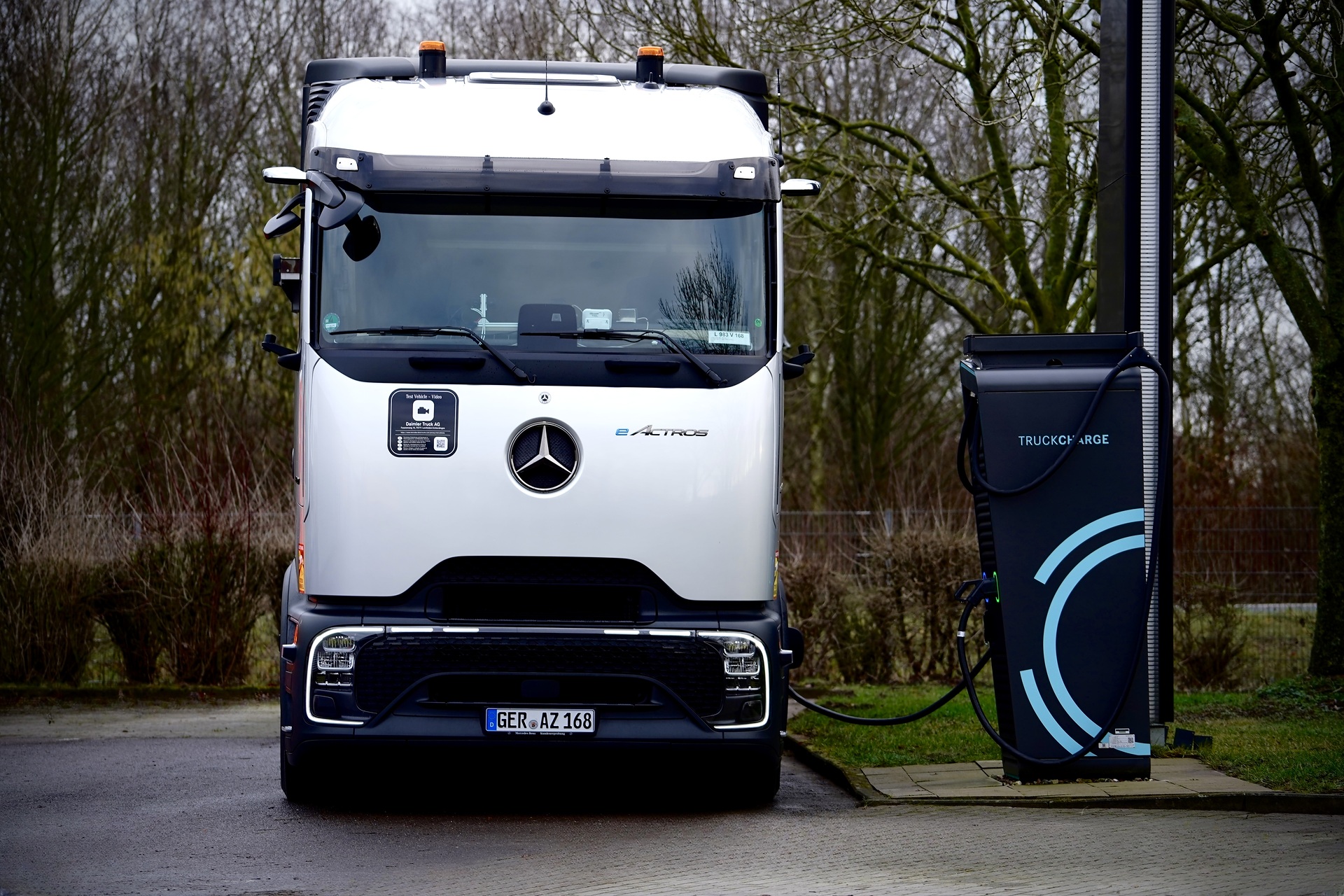
Germany’s Federal Ministry of Transport has launched a €1 billion funding program aimed at accelerating the expansion of charging infrastructure for battery-electric heavy-duty commercial vehicles across the country.
The initiative, which will run over four years, targets both companies installing charging systems at private depots and operators developing publicly accessible charging stations for electric trucks. The ministry has simultaneously opened three separate funding calls as part of the scheme.
See also: Germany Launches €220 Million Hydrogen Funding Call for Trucks and Refuelling Network
The program forms part of Germany’s Master Plan for Charging Infrastructure 2030, which seeks to significantly expand the availability of charging points suitable for heavy commercial vehicles in both public areas and logistics depots. Funding will cover not only charging infrastructure but also associated grid connections, battery storage systems, and charging load management technology.
The ministry said battery-electric trucks could “make the transport sector considerably more climate-friendly and resilient to fossil energy crises,” underlining the role of electrification in reducing emissions from freight transport.
See also: MAN Truck & Bus Commits One Billion Euros to Germany Under MAN2030+ Plan
In the first phase, the government will allocate €200 million through the three funding calls, representing one-fifth of the total planned budget. “Beyond 2026, we will launch further funding calls over the four-year term of the scheme, adapting them to market developments,” the ministry said. It added that the competitive selection process would prioritize projects requesting the lowest funding per kilowatt of installed charging capacity.
One funding call targets non-public charging infrastructure for small and medium-sized enterprises, supporting depot charging for company-owned vehicles or restricted fleets. Applications open on June 5, 2026, with approvals granted on a first-come, first-served basis. Eligible charging points must provide at least 50 kilowatts (kW) of capacity, with funding set at €500 per installed kilowatt.
See also: Germany Formalises Toll Exemption for Zero-Emission Trucks Until Mid-2031
A second call, open to all companies, also supports non-public depot charging infrastructure with the same minimum 50kW requirement and funding level. Applications for this category will be accepted between May 26 and July 7, 2026, with awards determined through a competitive selection process.
The third funding call focuses on publicly accessible charging infrastructure, including truck charging hubs, motorway rest areas, and public logistics sites. Projects under this category must provide at least 100kW per charging point and will also receive up to €500 per installed kilowatt. Applications will be accepted during the same May-to-July window.
The ministry said interested companies could attend a free online information event on May 19 organized by the National Centre for Charging Infrastructure in cooperation with Projektträger Jülich. Additional webinars covering the funding calls are planned for June 2 and 3.
See also: Germany Opens First Public Megawatt Charging Point for Electric Trucks
“Heavy road freight transport is indispensable for Germany as a business location—yet it faces the challenge of becoming climate-friendly,” said Patrick Schnieder, Germany’s transport minister. “With our billion-euro funding programme, we are now creating the conditions for a rapid expansion of charging infrastructure and making it easier for haulage and logistics companies to switch to battery-electric commercial vehicles,” he added.
The ministry said it is also continuing support for hydrogen-powered freight transport. A separate funding call launched earlier this year for hydrogen refueling stations and hydrogen trucks has had its application deadline extended to the end of June following strong interest nationwide.


