
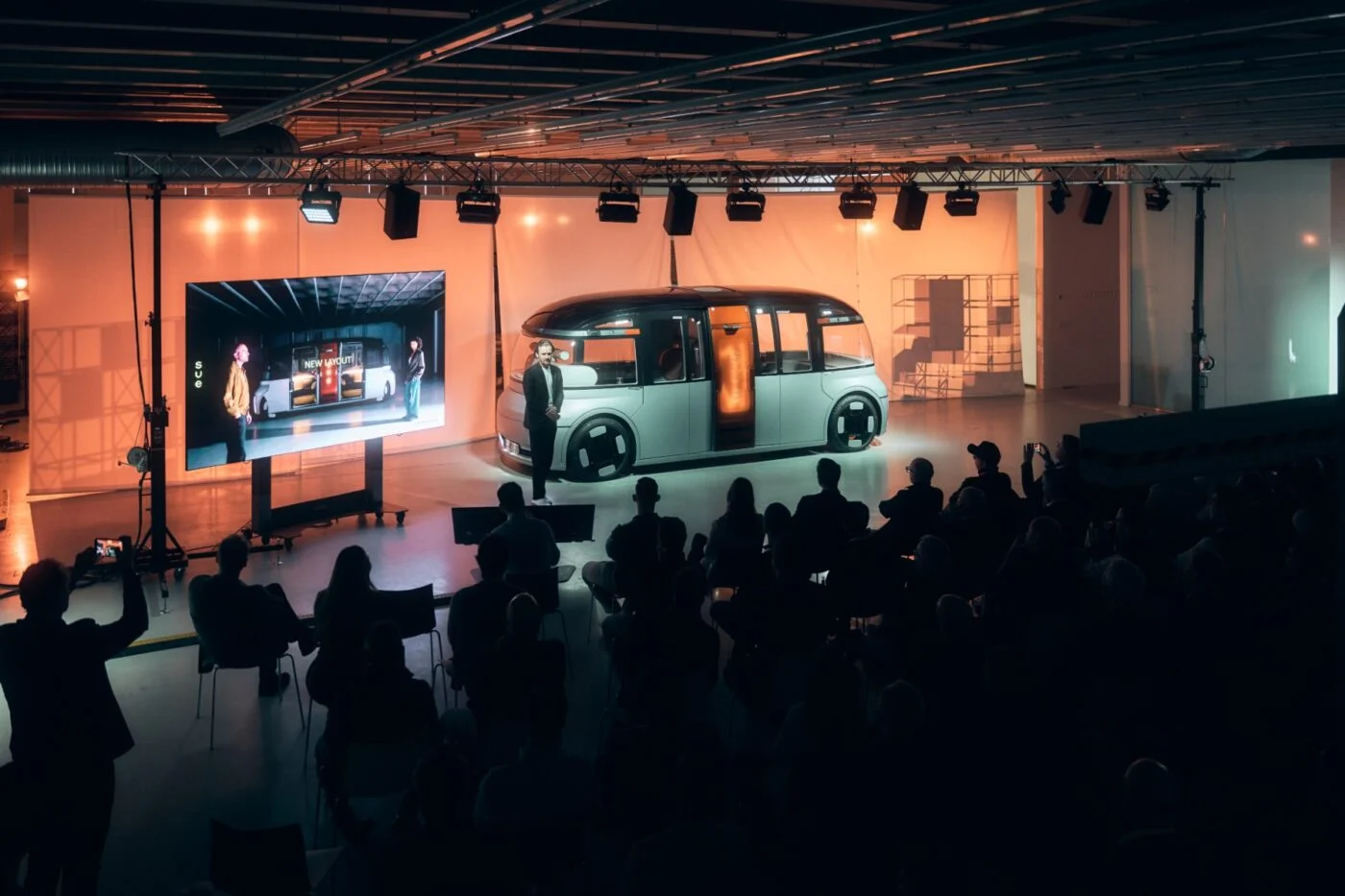
A German consortium led by Uedelhoven Studios (UE Studios) has unveiled an autonomous electric shuttle designed for public transport applications, marking a step toward deploying self-driving vehicles in everyday mobility services.
The vehicle, called SUE — short for “Self-Driving Urban E-Shuttle” — was developed with ten partners from industry, research institutions and the public sector. Built on a road-legal 48-volt skateboard platform, the shuttle is intended to operate in areas underserved by conventional transport. UE Studios said the prototype was “entirely developed in Germany” and represents a practical solution rather than a conceptual study.
Based in Gaimersheim, UE Studios acted as project initiator, lead developer and manufacturer, overseeing design and production. Partners in the project include DB Regio, ElringKlinger, TÜV Nord Mobilität, Fraunhofer EMFT, universities and municipal authorities. The initiative received funding from the German federal government as part of efforts to advance sustainable mobility technologies.
Technical details remain limited, though the developers confirmed a top speed of 50 km/h. Unlike most electric buses, the shuttle uses a low-voltage architecture rather than a high-voltage system. The modular skateboard chassis can accommodate different body configurations, potentially enabling additional vehicle variants in the future. Inside, the vehicle features large windows for improved visibility and materials described as sustainable.
“We developed and designed SUE from the ground up to give the mobility of tomorrow a face,” said Alexander Uedelhoven, Project Leader and Authorised Officer at UE Studios. “It is our contribution to autonomous and sustainable mobility, focusing consistently on the needs of users, municipalities, and operators. This makes SUE a benefit for citizens and communities—and thus for all of us.”
The shuttle has already received road approval along with an exemption for autonomous testing, allowing trials on public roads. One planned route will connect Neustadt an der Donau with the nearby spa town of Bad Gögging, where the vehicle will operate in real-world conditions.