
Researchers at Georgia Tech have discovered that fast charging zinc-ion batteries can make them stronger, challenging conventional assumptions about battery design and potentially paving the way for safer, more affordable alternatives to lithium-ion technology.
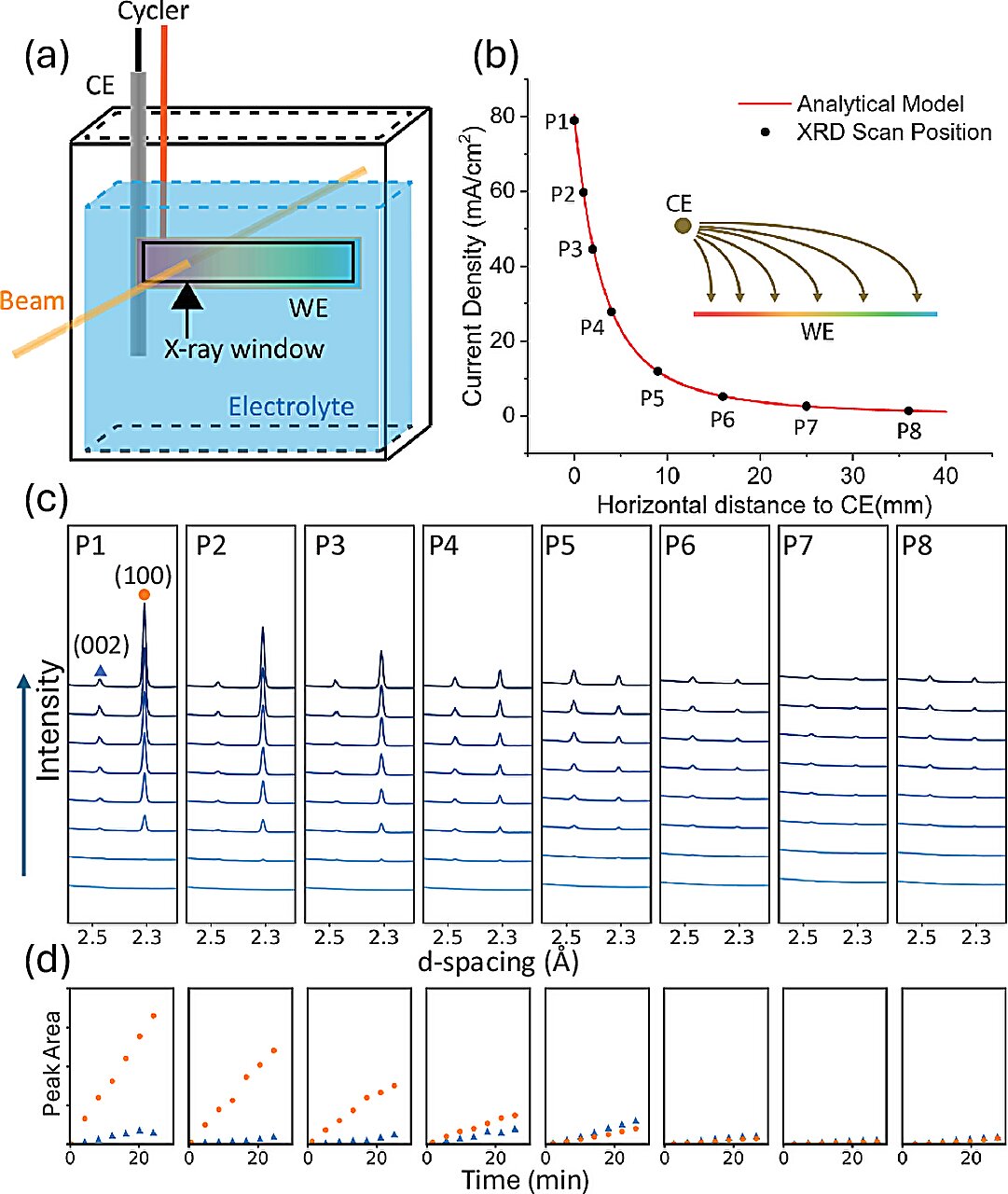
The study, led by Hailong Chen, an associate professor in the George W. Woodruff School of Mechanical Engineering, found that higher charging currents suppressed dendrite formation—spike-like deposits that can short-circuit batteries—allowing zinc to form smooth, compact layers instead. The research was published in Nature Communications.
“We found that using faster charging actually suppressed dendrite formation instead of accelerating it,” Chen said. “It’s a very different behavior than what we see in lithium-ion batteries.” He added, “It goes against the conventional thinking that fast charging shortens battery life. What we found expands people’s understanding of fast charging that could rewrite how we think about battery design and where they can be used.”
Zinc-ion batteries have advantages over lithium-ion, including abundant raw materials, lower cost, nonflammability, and easier recycling. Until now, dendrite growth during charging has limited their longevity and widespread adoption.
Chen’s team developed a novel testing system that allowed them to observe hundreds of samples under different charging conditions in real time, providing unprecedented insight into how zinc ions settle during fast charging. “We weren’t just seeing whether the battery worked or not; we were watching the structure of the material evolve as it charged,” Chen said.
While the breakthrough significantly improves the battery’s anode, challenges remain in optimizing the cathode. Chen and his team are experimenting with new materials and combinations to enhance overall performance.
“You can imagine these zinc-ion batteries being used to store solar energy in homes, or for grid stabilization,” Chen said. “Anywhere you need reliable, affordable backup power.” The team estimates that zinc-ion batteries could be ready for everyday use in about five years if research and development proceed as planned.
With increasing demand for clean energy, concerns over lithium supply chains, and safety issues related to flammable batteries, the discovery offers a potential alternative that could accelerate the adoption of renewable energy storage.
Resurce:
- Yifan Ma et al, Understanding rate-dependent textured growth in zinc electrodeposition via high-throughput in situ x-ray diffraction, Nature Communications (2025). DOI: 10.1038/s41467-025-61813-y