
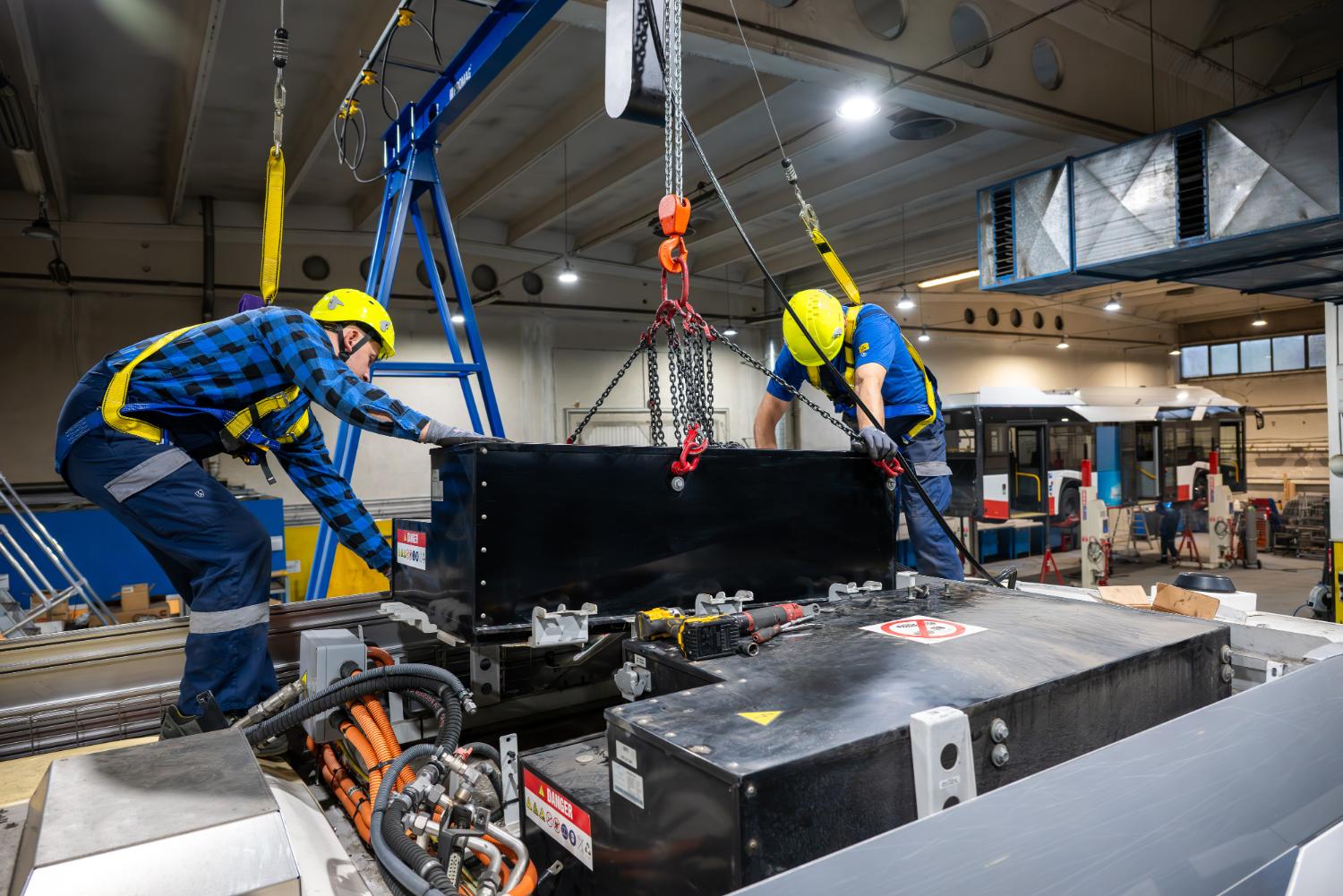
A new study by the Swiss Federal Laboratories for Materials Science and Technology (Empa) suggests that converting existing diesel buses into battery-electric vehicles could significantly accelerate the decarbonisation of Europe’s public transport sector.
The researchers estimate that large-scale e-retrofitting could bring forward the electrification of Europe’s bus fleet by approximately 15 years while reducing emissions, lowering costs and extending the useful life of existing vehicles.
Retrofitting could speed up fleet electrification
According to the study, Europe’s transition to zero-emission buses is constrained less by technology availability than by the long operating life of existing diesel vehicles, which typically remain in service for around 20 years.
Even if all newly registered buses from 2035 were battery-electric, the researchers estimate that Europe’s fleet would not reach 95% electrification until 2057.
Instead of replacing buses before the end of their service life, operators could retrofit them by replacing diesel engines, gearboxes, fuel tanks and exhaust systems with battery-electric drivetrains while retaining the vehicle body, chassis and interior.
Empa said this approach could substantially accelerate fleet electrification without requiring the premature retirement of otherwise serviceable vehicles.
Lower emissions and reduced resource use
The study’s life cycle assessment found that converting an existing diesel bus generates around half the greenhouse gas emissions associated with manufacturing a new battery-electric bus.
On average, each retrofit could avoid approximately 58 tonnes of carbon dioxide equivalent emissions while also reducing demand for raw materials, energy consumption, water use and particulate emissions.
If implemented across Europe’s bus fleet, the researchers estimate the approach could reduce cumulative carbon emissions by around 300 million tonnes by 2100, roughly equivalent to Spain’s annual greenhouse gas emissions.
Economic benefits for operators
The study also identified significant financial advantages.
Researchers estimate that retrofitting costs approximately half as much as purchasing a new battery-electric bus. Combined with lower operating and maintenance costs associated with electric drivetrains, transport operators could achieve long-term savings while accelerating fleet decarbonisation.
Depending on future deployment scenarios, total bus transport costs could decline by between 2.2% and 3.2% by 2100, with the savings potentially supporting further investment in public transport services.
The authors also suggest that e-retrofitting could support Europe’s growing electric mobility industry by easing pressure on manufacturers to rapidly increase production of new electric buses while creating opportunities for suppliers of retrofit kits, batteries, electric axles and powertrain components.
Challenges remain
Despite the promising findings, the researchers acknowledge that several barriers remain before large-scale deployment becomes practical.
The economic analysis is based on modelling and limited pilot projects, with actual retrofit costs expected to vary depending on vehicle type, battery configuration and operational requirements.
The study also highlights unresolved issues surrounding vehicle certification, warranties and technical standardisation.
Charging infrastructure represents another key challenge. Although existing depot charging systems and overhead line infrastructure could support some retrofit projects, operators would still need to invest in charging equipment, electricity grid connections and energy management systems.
Battery availability also remains a potential constraint, with the supply of battery cells expected to remain one of the industry’s primary bottlenecks.
The researchers conclude that e-retrofitting could become an important complement to the production of new battery-electric buses, provided governments introduce supportive funding programmes, streamlined approval processes and industrial-scale retrofit solutions.