
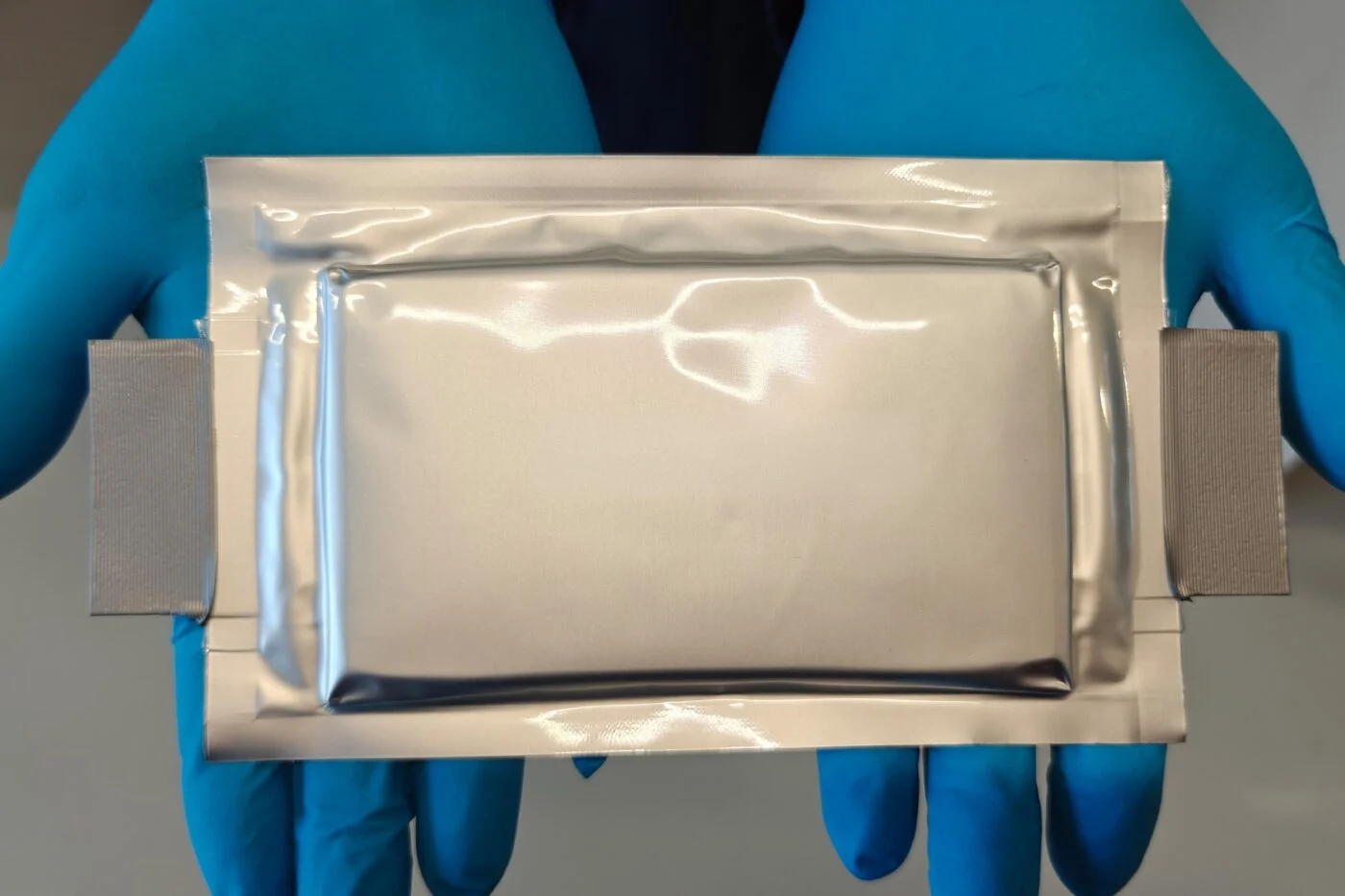
Researchers at Germany’s Fraunhofer Institute for Solar Energy Systems (ISE) have operated a 25-Ah pouch battery cell with a silicon-rich anode for more than 1,000 full cycles while retaining over 83% of its initial capacity. The cell was developed as part of the StrOboBatt project, marking progress towards longer-lasting, high-energy-density batteries for electric vehicles.
Reaching 1,000 cycles with at least 80% capacity retention is considered an important benchmark for commercial battery applications.
Silicon Anodes Offer Higher Energy Density
Silicon can store more lithium than graphite, potentially increasing battery energy density. However, silicon expands by up to 300% during charging and contracts during discharge, placing mechanical stress on electrodes and accelerating electrolyte degradation. Graphite typically expands by only around 10–12%.
To address this challenge, Fraunhofer ISE researchers used a silicon-carbon composite that accounted for 51% of the anode’s active material, paired with a nickel-rich cathode. The cell was manufactured on an industry-scale pilot production line.
Pressure and Charging Power Affect Battery Life
During testing, the researchers applied axial pressure of 1,000 kilopascals, equivalent to approximately 10 bar, during charging and discharging. This helped maintain electrode contact despite changes in material volume.
At a lower pressure of 300 kilopascals, or around 3 bar, usable capacity declined considerably faster. Tests also showed that high-power operation caused faster capacity loss than gentler cycling, highlighting the importance of charging conditions and mechanical design.
The findings suggest that battery-pack construction and battery management systems will be important in translating silicon-rich anode technology into practical EV applications.
Potential for Longer Electric Driving Range
The tested cell achieved a gravimetric energy density of 280 Wh/kg. Fraunhofer ISE estimates that industrially optimised production could reach approximately 330 Wh/kg.
At that level, a battery could store more energy without a corresponding increase in weight. The researchers’ estimates suggest a mid-sized electric vehicle could potentially accommodate close to 100 kWh of battery capacity instead of around 75 kWh at a similar battery weight, potentially increasing driving range from approximately 450 km to more than 600 km. These figures are projections rather than demonstrated vehicle performance.
The technology could also offer supply-chain benefits for Europe. Silicon can be sourced or synthetically produced regionally, potentially reducing reliance on imported graphite used in conventional anodes.
Although further development and industrial optimisation are needed, the results demonstrate how silicon-rich anodes could contribute to higher-energy batteries, provided their mechanical stresses and operating conditions are carefully managed.