

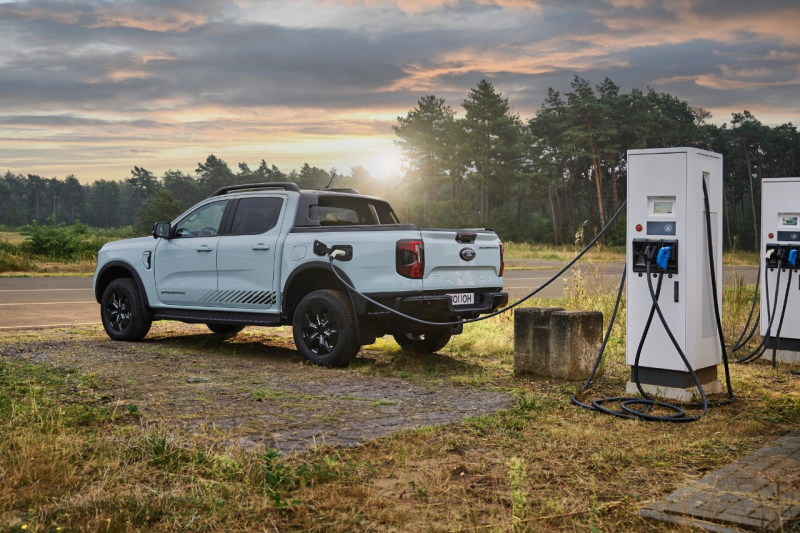
At the IAA Transportation event in September, Ford introduced the Ranger PHEV pickup specifically designed for the European market. This new model combines full Ranger capabilities—including towing, payload, and off-road performance—with the ability to drive in electric-only mode.
The Ranger PHEV boasts an impressive torque output of up to 690 N·m, making it the most powerful production Ranger to date, and offers an electric-only driving range exceeding 45 km (28 miles). Additionally, the Ranger PHEV introduces the Pro Power Onboard feature, allowing customers to power tools directly from the onboard battery, providing up to 6.9 kW of power without the need for a generator.
Ford Pro will launch the Ranger PHEV in several variants, including the Wildtrak and XLT series, along with a PHEV-exclusive Stormtrak launch edition. Production will take place in Silverton, South Africa, with initial customer deliveries slated for spring 2025. The new PHEV model will complement the existing diesel-powered Ranger lineup in Europe, catering to diverse customer needs and local emissions regulations.
The innovative PHEV powertrain combines a 2.3-liter Ford EcoBoost gasoline engine with a 10-speed automatic gearbox, a 75 kW electric motor, and an 11.8 kWh (usable) battery. This configuration results in 690 N·m of torque, surpassing the power output of the 3.0-liter V6 turbodiesel Ranger, with a total power of 279 PS.
Ford has integrated a new Modular Hybrid Transmission that positions the e-motor within the bellhousing to facilitate hybrid driving. The battery can be charged in less than four hours using a single-phase 16 amp charger, providing a targeted range of over 45 km in EV-only mode.
Drivers of the Ranger PHEV will retain the ability to carry a payload of up to one tonne and tow up to 3,500 kg while benefiting from the enhanced off-road capabilities provided by Ranger’s latest e-4WD system, dual-range transfer box, and rear differential lock. The traction battery is strategically located between specially engineered frame rails to optimize weight distribution.
The e-motor enables electric driving, allowing drivers to select between Auto EV, EV Now, EV Later, or EV Charge modes for managing battery usage. Customers will also experience advantages from the electric motor’s regenerative braking and additional torque during towing and off-road maneuvers, including rock crawling and steep inclines. Ford engineers have fine-tuned the suspension for enhanced comfort and performance on and off the road, considering the unique chassis and weight distribution of the Ranger PHEV.
In areas where available, Ford Pro Home Charging will enable owners to schedule charging during lower-cost overnight periods. Ford anticipates that the hybrid powertrain will yield better fuel savings compared to the Ranger’s higher-displacement V6 diesel engine option.
The Ranger PHEV’s Pro Power Onboard technology enhances utility, allowing users to simultaneously power high-draw tools and equipment at job sites or campsites without relying on a generator. Standard output for the system is 2.3 kW, with an optional upgrade to 6.9 kW available, featuring two 15 amp outlets in the load box, each capable of delivering 3.45 kW to meet the demands of heavier-duty equipment.