

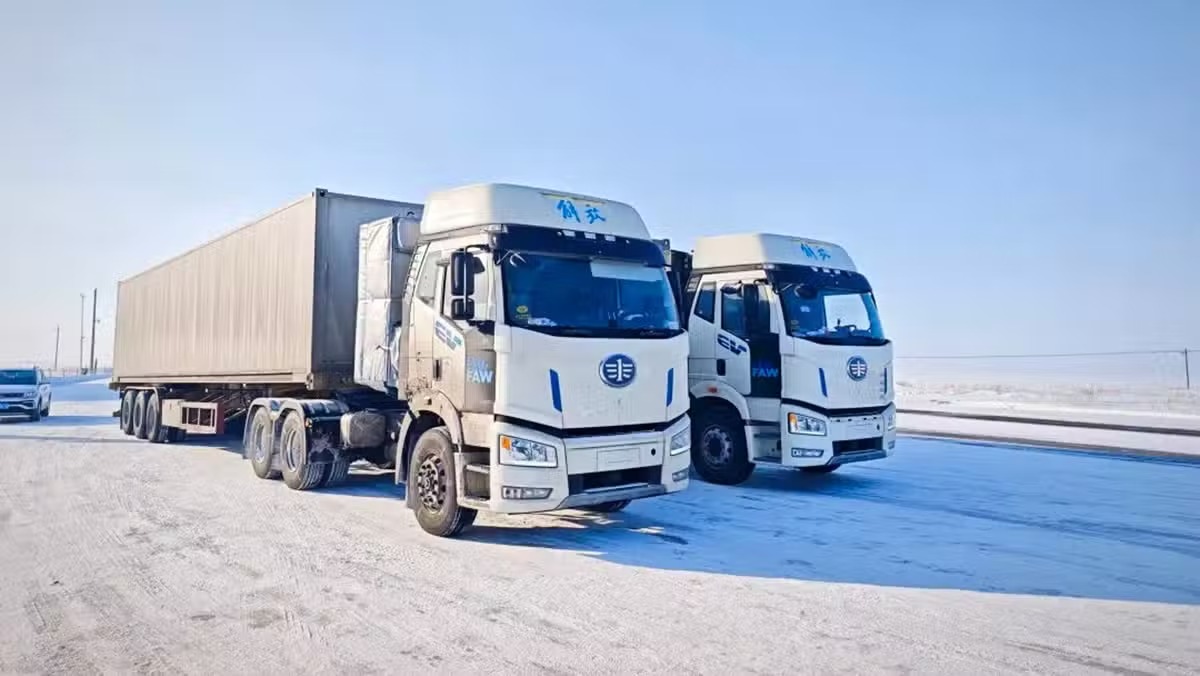
FAW Jiefang, the commercial vehicle subsidiary of China’s FAW Group, has completed full-condition testing of a heavy-duty electric truck powered by a sodium-ion battery, marking a significant step toward the commercialization of the technology in the heavy truck sector.
The testing program was conducted in partnership with Chinese sodium-ion battery manufacturer Hina Battery and focused on evaluating the performance, durability, and safety of sodium batteries under real-world operating conditions.
Seven-Month Testing Program Completed
The vehicle used in the trial was a Jiefang J6P battery-electric tractor equipped with a 339-kWh sodium-ion battery pack.
According to FAW Jiefang, the testing program lasted nearly seven months and covered more than 15,000 kilometres of road operation designed to replicate actual freight transportation scenarios.
The evaluation included bench testing, vehicle reliability assessments, power performance testing, and operation in extreme temperature environments.
The company said the results validated the truck’s adaptability across different operating conditions while confirming the safety and reliability of the sodium-ion battery system.
Strong Performance in Extreme Cold
One of the key advantages highlighted by FAW Jiefang was the battery’s performance in low-temperature environments.
The company said the battery retained more than 90% of its usable capacity at temperatures as low as -40 degrees Celsius, a level of performance that could make the technology particularly suitable for freight operations in northern China.
Cold-weather performance has been a persistent challenge for many battery-electric commercial vehicles, where low temperatures can significantly reduce available range and charging efficiency.
Fast Charging and Long Cycle Life
FAW Jiefang said the sodium-ion battery can be fully charged in approximately 20 to 25 minutes.
The company also reported a cycle life exceeding 8,000 charge-discharge cycles under fast-charging conditions.
According to the manufacturer, this exceeds conventional industry benchmarks and could support the high-utilization requirements common in commercial transport operations.
The truck maker added that sodium-ion battery chemistry offers strong thermal stability, an attribute that could be beneficial for heavy-duty vehicles operating under high loads and frequent charging cycles.
Growing Interest in Sodium-Ion Technology
The development comes as China’s battery industry increases investment in sodium-ion technology as a potential alternative to lithium-based batteries.
Supporters of sodium-ion batteries argue that the technology could help reduce reliance on lithium while offering advantages in cold-weather operation, safety, and potentially lower long-term costs.
Hina Battery General Manager Li Shujun has previously said sodium-ion battery costs could reach parity with lithium batteries by 2027 or 2028 as production scales increase.
He noted that declining sodium battery costs and rising lithium prices could narrow the cost gap between the two technologies.
Industry Investment Accelerates
Several major Chinese battery and automotive companies are expanding their sodium-ion battery programs.
CATL recently announced plans to invest 5 billion yuan ($735 million) in new sodium-ion battery production capacity in Fujian province, targeting annual output of 40 GWh.
The battery manufacturer also secured a 60 GWh sodium battery order for energy storage projects earlier this year.
Meanwhile, BYD has disclosed development of a sodium-ion battery capable of up to 10,000 charge cycles, while BAIC Group has unveiled sodium battery cells with energy density exceeding 170 Wh/kg.
Commercial Vehicle Sector Seen as Key Market
FAW Jiefang said it plans to continue investing in new-energy technologies and expand its portfolio of electrified heavy trucks.
The company believes sodium-ion batteries could play a role in supporting the logistics sector’s transition toward lower-carbon transportation, particularly in applications where durability, fast charging, and cold-weather performance are critical requirements.
As battery manufacturers seek alternatives to lithium-based technologies, heavy-duty commercial vehicles are emerging as one of the early markets where sodium-ion batteries could gain traction due to their operational characteristics and growing production scale.