



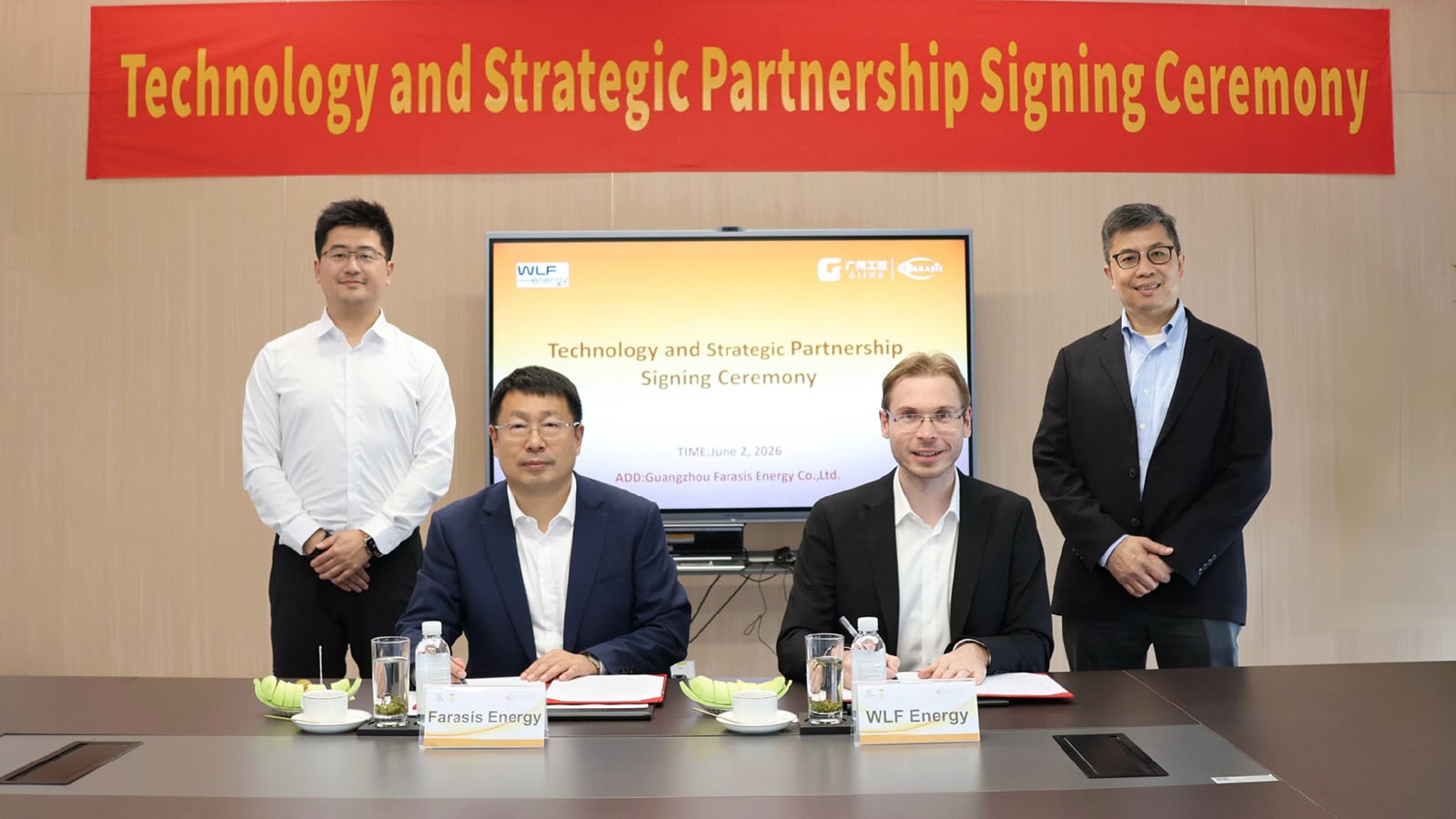
Chinese battery manufacturer Farasis Energy has signed a strategic cooperation agreement with German energy technology company WLF Energy, marking a new step in its efforts to expand internationally and strengthen its position in the rapidly growing energy storage sector.
The partnership will focus on the joint development of next-generation battery technologies and energy storage products targeting utility-scale, commercial and industrial, as well as distributed energy storage applications.
Joint development of advanced energy storage solutions
Under the agreement, Farasis Energy and WLF Energy will collaborate on a long-term technology and product roadmap designed to accelerate innovation in battery storage and energy management.
The cooperation will cover battery cells, battery systems, energy management software, and large-scale energy storage solutions.
Farasis President Dong Ligang and WLF Energy Founder and Chief Executive Officer Sebastian Wolf signed the agreement on behalf of their respective companies.
The partners said they aim to combine Farasis’ battery expertise with WLF Energy’s artificial intelligence-driven energy management platform to create more efficient and competitive energy storage solutions.
AI integration at the core of collaboration
A central element of the partnership is the integration of Farasis’ battery technologies with WLF Energy’s AI-powered energy management systems.
The companies believe this combination can improve battery performance, enhance safety, optimize operating costs, and extend system lifecycles.
By leveraging AI-based analytics and optimization tools, the partners intend to improve energy storage efficiency while reducing total ownership costs for customers.
The collaboration will also explore advanced battery management systems and intelligent optimization algorithms designed to support increasingly complex energy networks.
Focus on emerging energy applications
Beyond traditional energy storage projects, the companies plan to investigate a range of emerging energy applications.
These include virtual power plants, smart energy infrastructure, and technologies designed to enhance grid stability and flexibility.
As electricity systems increasingly incorporate renewable energy sources, energy storage is becoming a critical component for balancing supply and demand while maintaining grid reliability.
The companies believe their combined technologies can help address these challenges across multiple regions and market segments.
Long-term technology roadmap
Farasis and WLF Energy plan to establish a technology roadmap covering the next decade.
The roadmap will evaluate multiple battery chemistries, next-generation battery management technologies, and AI-driven operational strategies.
The long-term approach reflects growing industry demand for energy storage solutions capable of supporting increasingly decentralized and renewable-heavy power systems.
The companies said continuous innovation will be essential as energy storage deployments expand globally.
Global market expansion
The agreement also includes plans to jointly pursue opportunities in key international markets.
Target regions include Europe, Asia, North America, the Middle East, and Africa.
For Farasis, the partnership represents another step in its broader globalization strategy, which increasingly emphasizes international collaboration and localized market development.
The company sees the cooperation as an opportunity to combine technology exports with local expertise to accelerate overseas growth.
Strengthening international presence
Farasis is best known as a manufacturer of pouch-format lithium batteries and has built expertise in battery chemistry research, product development, and large-scale manufacturing.
WLF Energy focuses on integrated clean energy solutions that combine battery technology, artificial intelligence, energy management systems, and project development capabilities.
The partnership reflects a growing trend of collaboration between Chinese battery manufacturers and international energy technology companies seeking to capitalize on the expanding global energy storage market.
While Farasis remains a relatively small player in China’s highly competitive battery industry, the company continues to pursue opportunities beyond the automotive sector as demand for stationary energy storage accelerates worldwide.
According to data from the China Automotive Battery Innovation Alliance (CABIA), Farasis ranked tenth in China’s ternary lithium battery market in May. The company hopes that expanding its presence in energy storage and international markets will create new avenues for growth beyond its traditional battery business.