
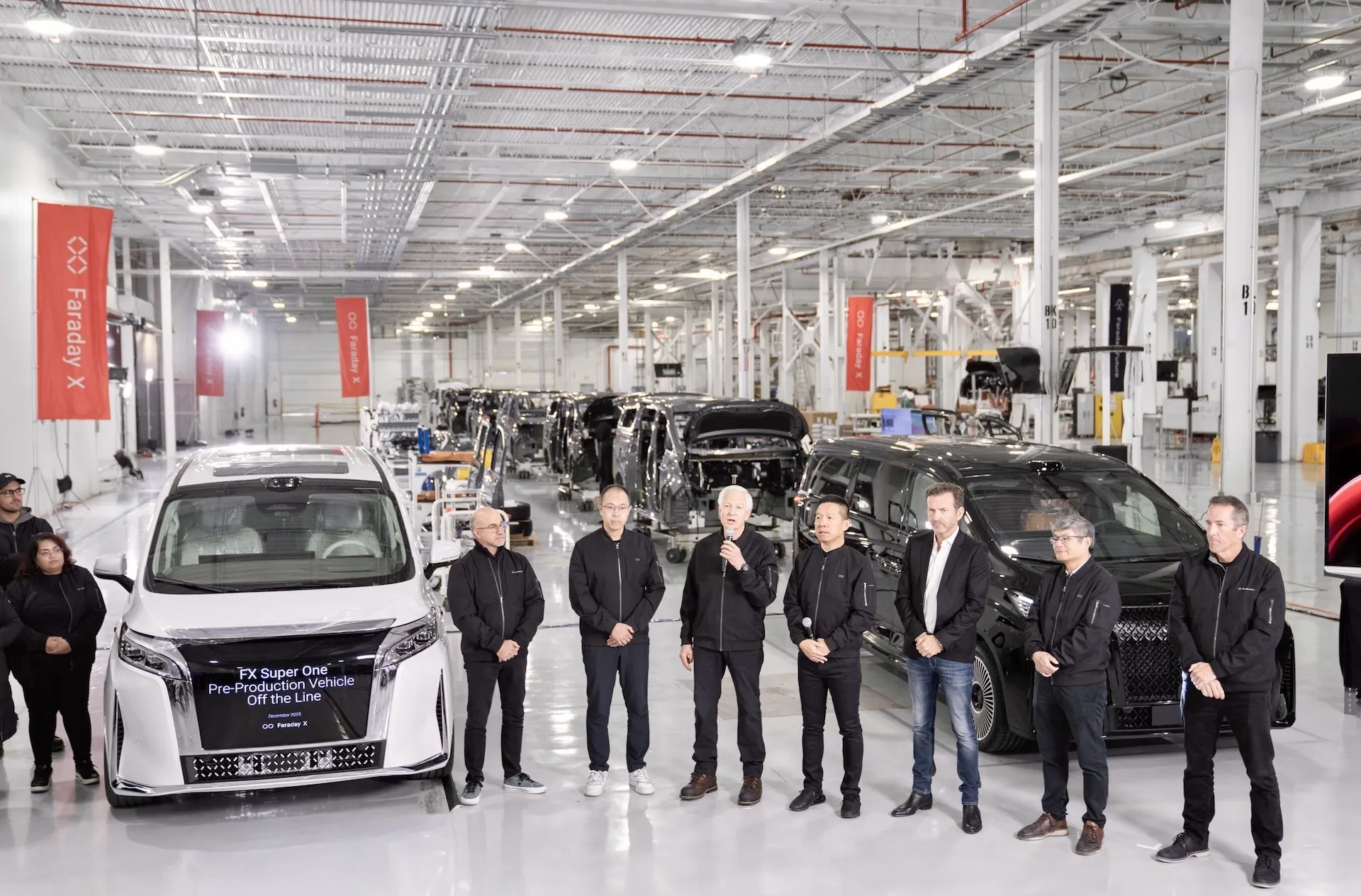
Faraday Future Intelligent Electric said it has completed the first pre-production build of its FX Super One multi-purpose vehicle at its Hanford, California facility, marking a key milestone in the company’s efforts to expand beyond its flagship FF 91 model.
The rollout marks the completion of Faraday Future’s initial “Global Automotive Industry Bridge Strategy” in the United States and signals the transition of its FX brand into the next development phase, which will focus on localized testing, homologation, and real-world validation ahead of mass production.
The company said the FX Super One will be positioned as a premium, mass-market MPV aimed at both business and family users. The model will be offered with all-wheel drive and multiple powertrain options, including a battery-electric version and a forthcoming AI hybrid extended-range system. It will be built on the company’s FF EAI 6×4 technology platform, which integrates AI-driven functions and advanced safety systems.
Faraday Future said the FX Super One will be produced at its FF AI-Factory California facility in Hanford, a 1.1 million-square-foot site that has received roughly $300 million in cumulative investment. The plant currently assembles the FF 91 2.0 and is being upgraded with flexible production lines to support the FX series. With additional investment and regulatory approvals, the facility could reach annual output of more than 30,000 FX vehicles.
As part of its global rollout, the company said one FX Super One unit will be delivered to Ras Al Khaimah’s Innovation City later this month, following earlier vehicle deliveries to the Middle East. Faraday Future plans to host a shareholder and product preview event during CES 2026 in Las Vegas, where it will also outline its broader product roadmap, including plans for the FX 4 model.
The FX Super One is designed as a core product in Faraday Future’s effort to bridge the gap between ultra-premium electric vehicles and more accessible mass-market offerings. The company said its strategy aims to leverage global supply chains while localizing manufacturing and quality control to support long-term scalability.