
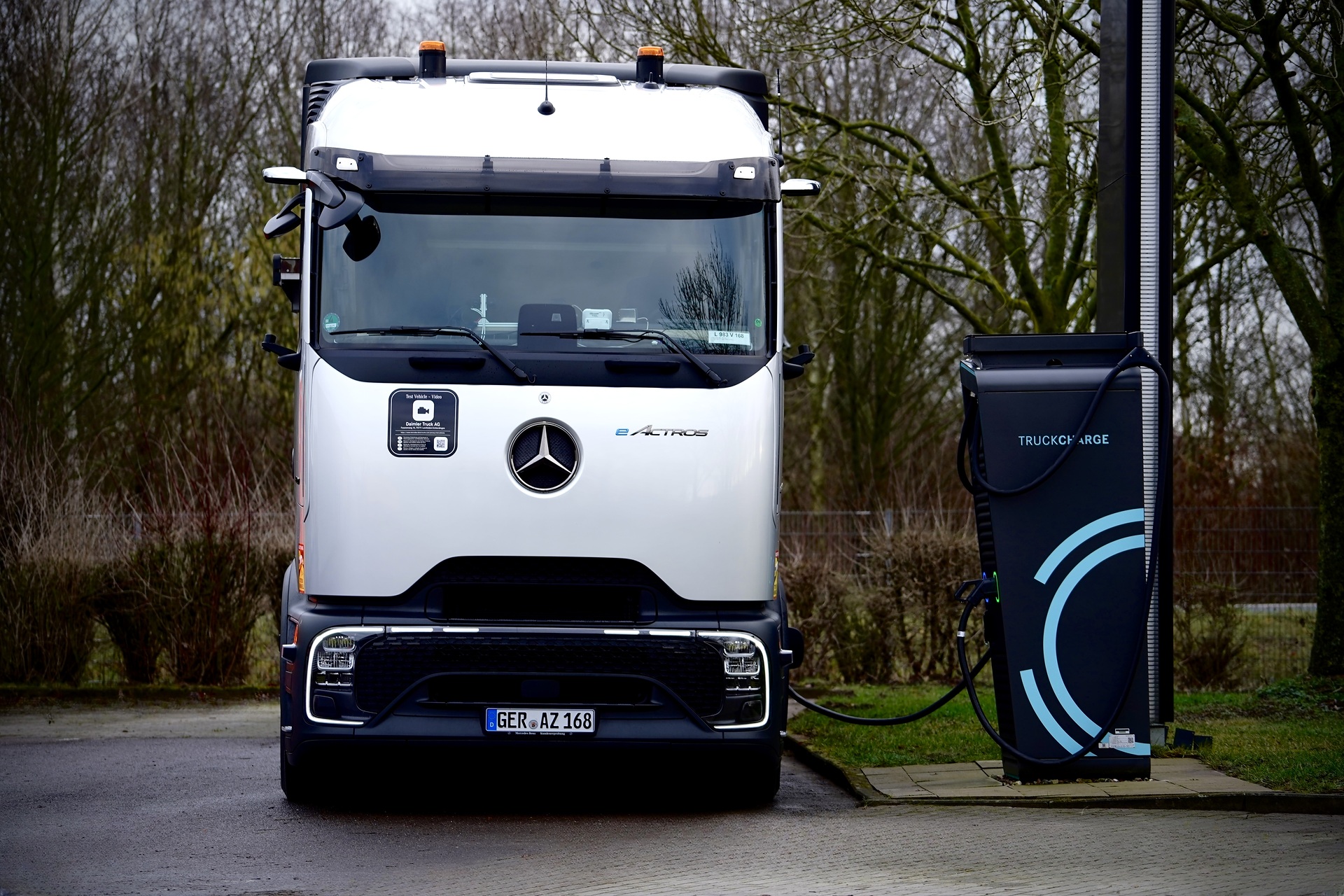
European transport and mobility groups have warned the European Commission against allowing a pause in EU funding for heavy-duty charging and hydrogen refuelling infrastructure, arguing that a gap in support in 2026–2027 could slow the adoption of zero-emission trucks despite recent investment momentum.
In a joint letter, the International Road Transport Union (IRU), the European Automobile Manufacturers’ Association (ACEA) and campaign group Transport & Environment (T&E) urged Commission President Ursula von der Leyen and Transport Commissioner Apostolos Tzitzikostas to ensure continuity of funding beyond the current framework.
The groups pointed to the expected exhaustion of the Alternative Fuels Infrastructure Facility (AFIF) as a key risk, warning that a break in EU-level support could undermine the rollout of electric and hydrogen-powered heavy-duty vehicles across the bloc.
“AFIF is proving to be an effective tool in meeting critical infrastructure needs along the TEN-T network, accelerating compliance with the Alternative Fuels Infrastructure Regulation and de-risking much-needed investments,” the letter said.
The organisations called on the Commission to extend AFIF funding into 2026 and 2027 and to assess whether the facility could be adapted to support depot charging, which is currently not eligible. They argued that depot charging is essential for the daily operation of electric trucks, alongside public charging points, grid connections and energy storage.
AFIF, launched under the EU’s Connecting Europe Facility transport programme, has supported around €3 billion of investment since its introduction, funding public charging infrastructure, depot charging, hydrogen refuelling stations and electrification projects in ports and airports.
Industry groups say the facility has been instrumental in expanding charging and refuelling networks along major freight corridors and logistics hubs, helping to create conditions for the market entry of zero-emission trucks. However, current discussions in Brussels suggest no dedicated successor instrument is planned before the next EU Multiannual Financial Framework begins in 2028, raising the prospect of a two-year funding gap.
The warning comes despite substantial recent allocations. In February 2025, the Commission selected 39 projects under a second AFIF call, awarding nearly €422 million in grants. These projects are expected to support the installation of about 2,500 charging points for light-duty vehicles and 2,400 charging points for heavy-duty vehicles along the TEN-T network.
One of the largest beneficiaries was truck charging operator Milence, which received €111 million for projects covering 64 truck charging parks across nine EU countries, including 256 megawatt charging system points and 236 CCS chargers. Additional funding in 2025 backed cross-border charging projects coordinated by E.ON Drive Infrastructure, as well as hydrogen refuelling stations and port and airport decarbonisation schemes.
For 2024–2025, AFIF had a total budget of €1 billion. The Commission confirmed in late 2025 that most of the remaining funds had been earmarked and that the facility, in its current form, would not extend beyond 2025.
IRU EU Director Raluca Marian said a pause in funding would send the wrong signal to the market just as deployment accelerates. “What signal would the EU send to the market if it pauses funding precisely when deployment is finally taking off?” she said, adding that operators with thin margins cannot commit to costlier zero-emission trucks without guaranteed access to charging.
From the manufacturing side, ACEA’s chief commercial vehicles officer Thomas Fabian said continuous support was needed to align infrastructure rollout with vehicle availability and investment cycles, warning that a funding gap could weaken Europe’s competitiveness.
T&E Fleets and Freight Director Stef Cornelis said AFIF-backed projects are already taking shape across Europe. “Now is not the time to pull the plug and stop the momentum,” he said.