
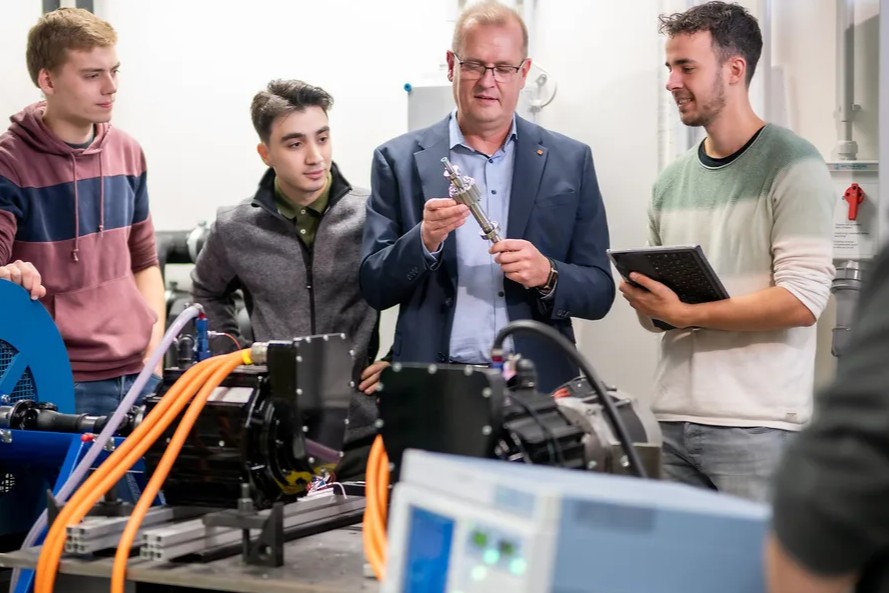
A European research consortium has launched a multi-year project to develop electric vehicle powertrains operating far above today’s 800-volt architectures, with the goal of dramatically improving charging performance and efficiency.
The initiative, called ODYSSEV (Optimised DYnamics of High-Voltage Powertrains: Developing Sustainable Systems for Electric Vehicles), brings together academic and industrial partners including Dortmund University of Applied Sciences, University of Bremen, and automotive supplier ZF Friedrichshafen. The 42-month programme is funded by the EU’s Horizon Europe framework through the 2ZERO Partnership and recently held its kickoff at the CIRCE Institute in Zaragoza, Spain.
Electric vehicles traditionally used 400-volt electrical systems, but higher-voltage architectures have gained traction in recent years. The Porsche Taycan, launched in 2019, was the first production EV to adopt an 800-volt system, enabling faster charging and improved performance. ODYSSEV seeks to determine the next technological step by focusing on systems exceeding 1,000 volts—levels not yet deployed by European automakers.
Project leader Markus Thoben said ultra-high voltages could deliver multiple advantages. “High-voltage technologies beyond 800 volts not only enable dramatically shorter charging times, but also lighter vehicles thanks to thinner cables and higher overall efficiency due to reduced energy losses,” he said.
However, operating above 1,000 volts introduces significant engineering challenges. Insulation requirements increase sharply, conventional silicon semiconductors approach their limits, and batteries must safely absorb very high power during fast charging without overheating or degrading.
The consortium includes 14 institutions from eight European countries, among them University College London, KTH Royal Institute of Technology, and Mitsubishi Electric Europe. The project aims to address the entire drivetrain ecosystem, from advanced semiconductor materials and power electronics to integration into onboard chargers and traction inverters.
Researchers will also develop a purpose-built electric motor and a reconfigurable battery pack tailored to the ultra-high-voltage architecture. Together, these components are intended to form a scalable and highly efficient propulsion system for future electric vehicles.
The effort comes as global competition intensifies. Chinese automaker BYD has already introduced vehicles with 1,000-volt platforms capable of megawatt-level charging, underscoring the urgency for European manufacturers to advance next-generation EV technologies.