
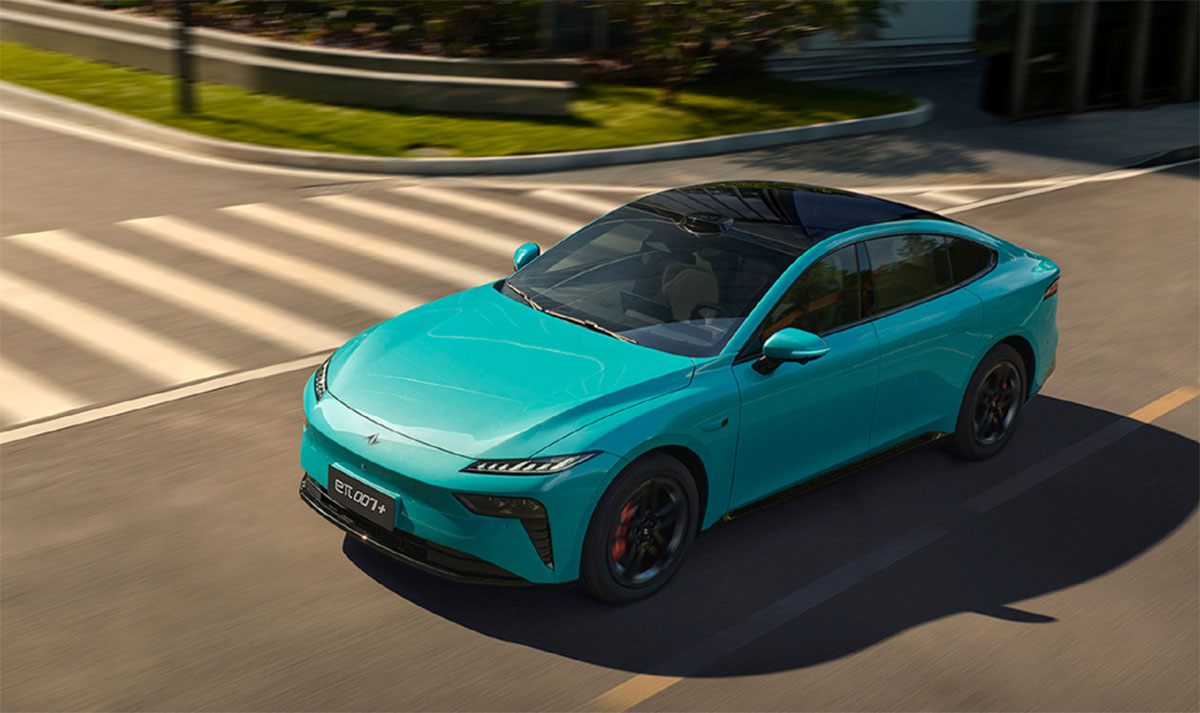
Chinese automaker Dongfeng has officially launched the eπ 007+, an upgraded version of its eπ 007 mid-to-large sedan. The new model is offered in three variants, with an official guide price ranging from 144,900 to 154,900 yuan ($20,300 to $21,700).
The eπ 007+ introduces several notable improvements over its predecessor, including standard LiDAR across all trims and the integration of the Qualcomm Snapdragon 8295P in-car chip. The exterior maintains the eπ 007’s design language, with two new color options—“Sky Grey” and “Harbour Blue”—alongside fluid side lines, flush door handles, and body-colored five-spoke wheels.
See also: Nissan and Dongfeng Launch China’s First Foreign-Backed Vehicle Import-Export Joint Venture
The LiDAR system is paired with a “little blue light” indicator to support assisted driving. The vehicle measures 4,880mm in length, 1,915mm in width, and 1,476mm in height, with a 2,915mm wheelbase.
Inside, the eπ 007+ continues the previous model’s interior styling, featuring a 15.6-inch 2.5K central control screen and a 10.25-inch instrument cluster. The eπOS 2.0 system, powered by the Snapdragon 8295P chip, supports card-based partitioning, split-screen interaction, and personalized wallpapers, and integrates AI language models such as Doubao and Deepseek.
See also: Dongfeng’s Voyah Brand Reaches 300,000 NEV Production Milestone with Titan SUV
Comfort enhancements include electric release door buttons on all four doors, a heated leather steering wheel, upgraded ultra-soft cabin fabrics, and an 8-point large-area massage system with increased intensity and coverage.
The eπ 007+ is available with both extended-range electric vehicle (EREV) and pure electric (EV) powertrains. The EREV combines a 1.5L engine producing 77 kW with a 160 kW electric motor and uses a lithium iron phosphate battery. The EV version is offered in single-motor rear-wheel-drive and dual-motor all-wheel-drive configurations, delivering 200 kW and 400 kW respectively, with the dual-motor variant capable of accelerating from 0-100 km/h in approximately three seconds.