




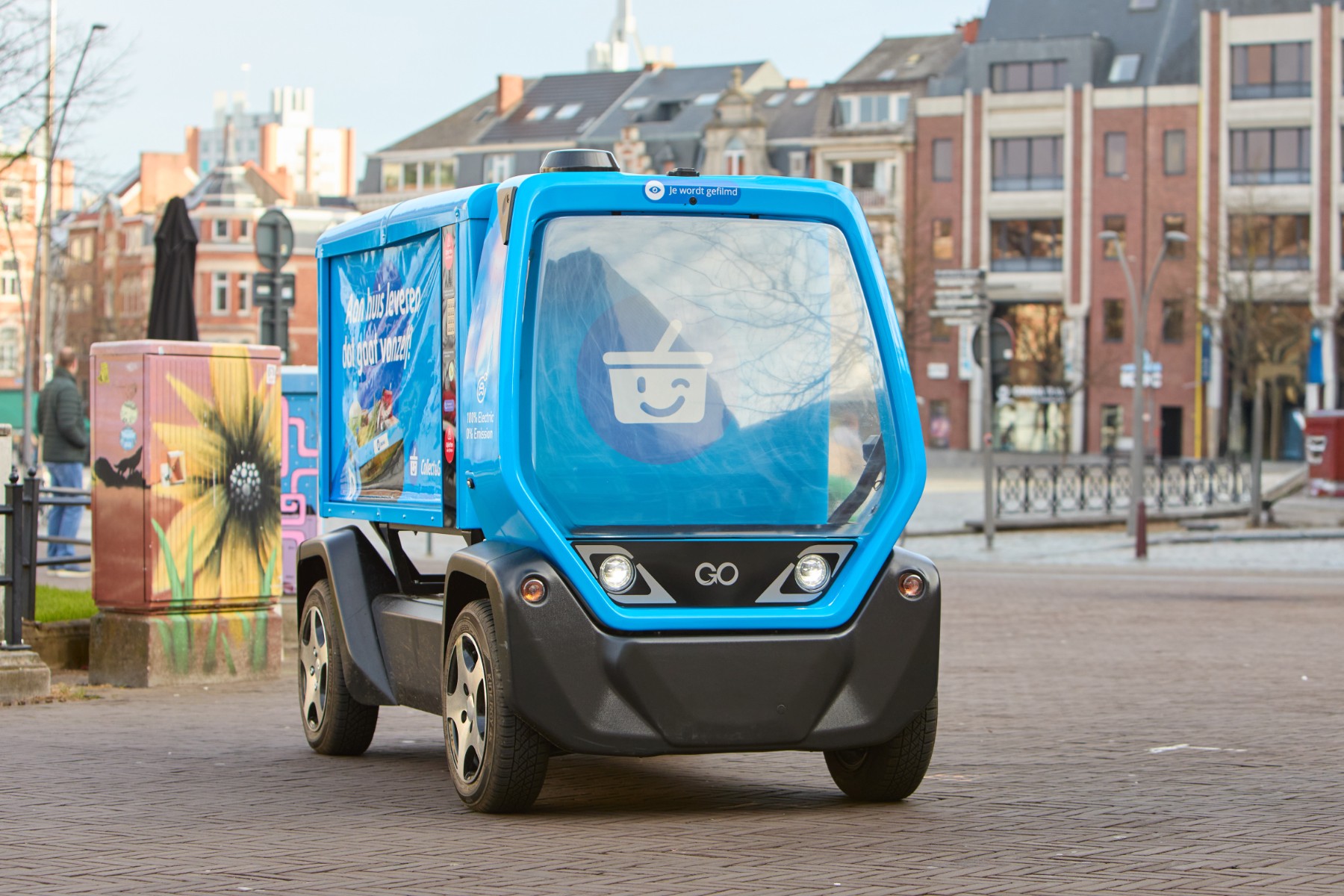
Collect&Go will begin testing driverless delivery vehicles in central Leuven from mid-May through August, as part of a pilot project aimed at improving last-mile logistics.
The initiative is being conducted in partnership with Telenet, which will provide mobile network connectivity linking the vehicles to a remote security control centre.
The pilot will use the Clevon 1, an autonomous delivery vehicle developed by Clevon and acquired in 2025 by indiGOtech. The compact electric vehicle, described by its developer as an “autonomous delivery robot,” operates without a steering wheel or pedals and is designed for urban environments, measuring 2.50 metres in length, 1.55 metres in height and 1.15 metres in width.
During the trial, the vehicle will deliver groceries directly to customers in Leuven’s city centre, carrying orders for up to two households per trip. Each delivery is secured with a unique access code provided to the customer. After completing its route, the vehicle returns to a pickup point in Kessel-Lo for reloading. Delivery fees will remain unchanged at €7, in line with standard services.
Tom De Prater said the pilot reflects the company’s focus on innovation in e-commerce logistics.
“Online grocery shopping is a key pillar for Colruyt Group, and our ambition is to remain best-in-class, as we have been for over 25 years,” said Tom De Prater, Director at Collect&Go. “In a rapidly evolving e-commerce landscape, we continuously look for ways to organise the last mile as efficiently and sustainably as possible. The cost of these final kilometres is high, and urban mobility presents challenges. Investing in innovation and creative solutions is crucial and is part of Colruyt Group’s DNA.”
Belgium’s Mobility Minister Jean-Luc Crucke said the project reflects broader efforts to support autonomous mobility.
“Autonomous mobility is no longer a distant vision of the future: it is a transformation that is happening right now, and one that we must guide responsibly,” said Jean-Luc Crucke. “My role as Minister is to create the conditions that allow this innovation to develop safely, while also steering it towards more sustainable and low-carbon mobility. That is exactly what we are working on today, both at Belgian level and together with our European partners, to ensure that this transition becomes a collective success.”
Vanessa Matz highlighted the role of connectivity in enabling such technologies, pointing to the country’s expanding 5G network.
“In recent years, our country has made significant progress in 5G coverage. Today, nearly 97% of Belgians can access this technology. However, 5G is about much more than fast internet or telephony; it enables new applications such as autonomous unmanned vehicles. To encourage this innovation, the federal government supports pilot projects like this, which can evolve into new use cases and opportunities,” she said.


